
China's Two-Front Push on Japan: History and Missiles
Beijing is pressing Tokyo on two fronts: a rhetorical campaign casting Japan's defence build-up as 'new militarism' and military signalling that put Okinawa's Kadena base in the PLA missile force's sights. Southeast Asia watches closely.
China's Two-Front Push on Japan: History and Missiles
Beijing is pressing Tokyo on two fronts at once — a rhetorical campaign that casts Japan's defence build-up as the return of "new militarism," and a military signalling campaign that this week put the US Air Force's Kadena base in Okinawa on display as a target of the People's Liberation Army's missile force. The twin moves, spread across state media and official commentary in the past 48 hours, underscore how the China-Japan rivalry has moved beyond disputed islands and historical memory into a struggle over international narrative and military credibility in the western Pacific.
Tags: China-Japan relations, new militarism, Kadena Air Base, PLA Rocket Force, Okinawa, Shinjiro Koizumi, ISEAS survey, non-nuclear principles, DF-17 hypersonic missile, Taiwan Strait, defence diplomacy, Southeast Asia, Pacific security, World War II history
Beijing's Rhetorical Offensive: The "New Militarism" Framing
China's most pointed line of attack is historical. In an analysis published by the South China Morning Post on August 7, Fudan University's Shen Yi, executive director of the Centre for National Security Studies, argued that Beijing faces "a profoundly distorted global narrative that has largely obscured the fascist atrocities committed by Japan against China and other nations during World War II that have never been fully reckoned with at the international level." He warned that "the gap in collective memory has provided fertile ground for Japan's new militarism to resurface."
Shen framed the campaign as more than a dispute over the past. "China is pointing out more than just the rise of new militarism in Japan; the core agenda-setting is about safeguarding the post-World War II international order," he said, invoking the legal framework of the 1943 Cairo Declaration and the 1945 Potsdam Proclamation, including the total elimination of Japanese militarism and the preservation of Japan's pacifist constitutional order. He also suggested Beijing expand historical research and global communications through films, literature and academic outreach, proposing that AI technologies be used to present historical facts visually to international audiences.
Tokyo's Counter-Push: "False Claims" and Transparent Defence Diplomacy
Japan has rejected the label outright. Speaking at the Shangri-La Dialogue in May, Japanese Defence Minister Shinjiro Koizumi dismissed China's accusations of new militarism as "nothing further from the truth," arguing that "it is only natural" for every country to update its defence capabilities to meet new challenges. Tokyo has cast itself as a defender of regional security and a peace-loving nation, warning that Beijing's expanding arsenal, "opaque" military build-ups and "challenges to the established rules" should worry the international community.
Some Japanese analysts worry the rebuttal itself is a trap. Masahiro Matsumura, a professor of international politics and national security at St Andrew's University in Osaka, wrote in The Japan Times in July that "getting dragged into an exhausting, asymmetrical debate over past grievances is a losing proposition." He argued Tokyo "must proactively engage and reassure its neighbours through transparent defence diplomacy, ensuring that Beijing cannot use the ghosts of the 20th century to drive a wedge between Japan, its Western allies and its vital East Asian neighbours."
The Military Dimension: Kadena in the PLA's Sights
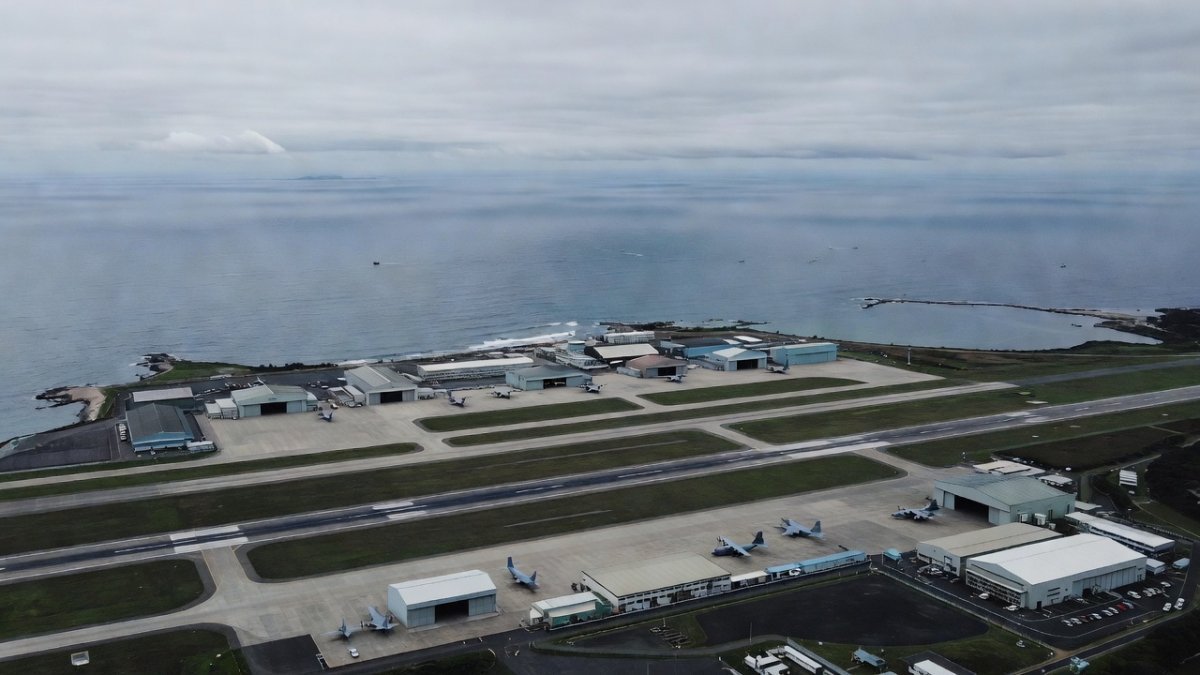
Alongside the rhetoric, China has shown its missile force preparing for a conflict in which Okinawa's bases are primary targets. An episode of the CCTV documentary Securing Victory, broadcast on August 3 as part of a series marking the PLA's 99th anniversary, showed a satellite image of an airfield surrounded by urban development that closely matched Kadena Air Base. In the footage, PLA Rocket Force officer Luo Tingrong stood before the image and told personnel: "Everything you practise today could be what happens tomorrow."
Kadena is the largest US airbase in East Asia, positioned in the heart of the "first island chain" and the closest major American base to potential flashpoints in the Taiwan Strait and the East China Sea. It sits about 600km from Taiwan and less than 800km from the mainland coast — well within the range of the DF-16 and DF-21 ballistic missiles and the latest DF-17 hypersonic missile, all designed to strike high-value fixed targets such as airbases. Tetsuo Kotani, a professor of global studies at Meikai University, said Kadena had been a known target of the Rocket Force for decades, and that "releasing it now, timed to the PLA's anniversary, is about projecting resolve to domestic and foreign audiences, not revealing a new capability."
What the Signal Means for the Taiwan Strait and Japan's Southwest Islands
Japanese analysts see the broadcast as a deliberate deterrent message. Hirohito Ogi, a researcher with the International House of Japan, said the satellite image was intended to "deter US military intervention in contingencies such as those across the Taiwan Strait." He added that it also implied Beijing was worried about the geostrategic utility of Japan's Southwest Islands — the Ryukyu and Nansei archipelago — in a possible Taiwan contingency, "reminding the Japanese of the necessity to strengthen their defence capabilities to prevent China's pre-emptive attacks against Japanese territories."
The timing carries added weight because the ongoing US-Iran war has exposed the vulnerability of American bases on foreign soil. US military facilities across the Middle East, including in Bahrain, Saudi Arabia, the UAE, Qatar, Kuwait and Jordan, have come under fire from Iranian ballistic missiles and suicide drones, causing infrastructure damage and the loss of high-value assets such as aircraft. A CCTV report last December also offered a glimpse of PLA planning, showing a wargaming exercise featuring simulated battles near Mexico and Cuba, the Sea of Okhotsk and Taiwan.
Southeast Asia in the Middle: Trust Data and the Limits of Neutrality
The narrative battle is being fought for an audience that is not fully convinced by either side. This year Japan retained its standing as Southeast Asia's most trusted major power, with 65.6 per cent of regional respondents expressing confidence in Tokyo in the ISEAS-Yusof Ishak Institute's annual survey. China's score of 39.8 per cent was much lower, though trust in Beijing across Asean surpassed distrust for the first time since the survey began in 2019.
Ge Hongliang, vice-dean of the Asean College at Guangxi Minzu University, said the region's public silence reflected "Asean centrality" and a commitment to avoiding sides in major-power disputes — a position rooted in the countries' complex World War II experiences. He recalled that Japan's "Fukuda Doctrine" of 1977, pledging that Japan would never become a military power and committing to "heart-to-heart" partnerships with Southeast Asia, had effectively rebuilt regional trust through decades of economic diplomacy. But he cautioned that neutrality was not indifference: "Southeast Asia's silence is not unconditional. If Japan's new militarism crosses a line that directly destabilises the regional balance or threatens Southeast Asian security interests, Asean's quiet neutrality will inevitably begin to fray."
The Nuclear Taboo Frays
The fraying may already have begun. In July, Defence Minister Koizumi called for breaking Japan's long-standing taboo on discussing nuclear weapons — remarks widely seen as laying the groundwork to dismantle the country's three non-nuclear principles, the commitment not to possess, produce or permit the introduction of nuclear weapons into Japanese territory. The Mainichi Shimbun, in an editorial published August 7, said Koizumi had argued Japan "must debate all policy measures without taboo and advance them." The move directly conflicts with Asean's long-standing push to strengthen the Southeast Asia nuclear weapon-free zone, a commitment signed in 1995 to keep the region free of nuclear weapons and other weapons of mass destruction.
What to Watch For
For Japan and the wider Asia-Pacific, the two-front dynamic is likely to intensify in the coming months. Beijing's historical narrative campaign will probably expand as it deploys new communications tools, while the PLA continues to signal its targeting priorities around Okinawa and the first island chain. Tokyo, for its part, is expected to press ahead with transparent defence diplomacy and deeper security coordination with Southeast Asian partners — even as it weighs the politically sensitive debate over its nuclear posture. The key variable is whether either side's rhetoric crosses the line that Ge Hongliang warned about: the moment Asean's quiet neutrality begins to fray, the region's careful balancing act between Beijing and Tokyo will no longer be sustainable. For now, both capitals are competing for the same audience — and the ghosts of the 20th century remain very much alive in the contest for the 21st.
By Kenji Tanaka, Staff Writer
This article was produced with AI-assisted research and editorial support. Reporting is based on sources cited in the article.
What's Your Reaction?
 Like
0
Like
0
 Dislike
0
Dislike
0
 Love
0
Love
0
 Funny
0
Funny
0
 Wow
0
Wow
0
 Sad
0
Sad
0
 Angry
0
Angry
0

Japan Correspondent at Global1.News. Tokyo-based voice covering Japanese politics, technology, economy, and culture. Tracks the intersection of tradition and innovation in one of the world's most dynamic societies.











Comments (0)