
Busan Tugboat Capsizing: Six Missing as Coast Guard Probes Towline Failure
The waters off Busan, South Korea's premier maritime gateway, have become the site of a grim and methodical recovery operation.
The waters off Busan, South Korea's premier maritime gateway, have become the site of a grim and methodical recovery operation. On Wednesday, September 2, 2026, the 286-ton tugboat TNS Catcher capsized and sank approximately nine kilometers southeast of Oryukdo Island, claiming the life of one crew member and leaving six others missing. As of Saturday, September 5, the search has entered its fifth day, with authorities confronting treacherous conditions and a complex underwater recovery that has yet to begin in earnest.
Busan Tugboat Disaster: Six Missing as Coast Guard Probes Towline Failure in Fatal Capsizing
Seoul, South Korea - September 5, 2026 - The sudden capsizing of a harbor tugboat during a routine assistance operation has cast a stark light on the perilous nature of maritime work in one of the world's busiest ports. The incident, which unfolded in a matter of seconds, has triggered a multi-agency rescue effort, a formal investigation by the Korea Coast Guard, and a national reckoning over the safety protocols governing the vessels that shepherd massive container ships into port.
The Sequence of a Catastrophe
The TNS Catcher, a Busan-registered vessel, departed from a government vessel pier at Busan Port at 10:15 a.m. on September 2. Its mission was specific and demanding: to assist in maneuvering a 66,332-ton, Liberia-flagged container ship that had been involved in an earlier accident. The tug was part of a three-vessel team tasked with positioning the large merchant vessel, with the TNS Catcher taking a position on the starboard side of the container ship's bow.
At approximately 1:29 p.m., the operation turned fatal. Closed-circuit television (CCTV) footage from the container ship, released by Yonhap news agency, captures the moment of crisis. The footage shows the TNS Catcher beginning a starboard turn before suddenly rolling violently to port and capsizing. The entire sequence, from the initiation of the turn to the vessel's disappearance beneath the surface, transpired in what appears to be less than a minute, leaving the eight crew members aboard with little time to react.
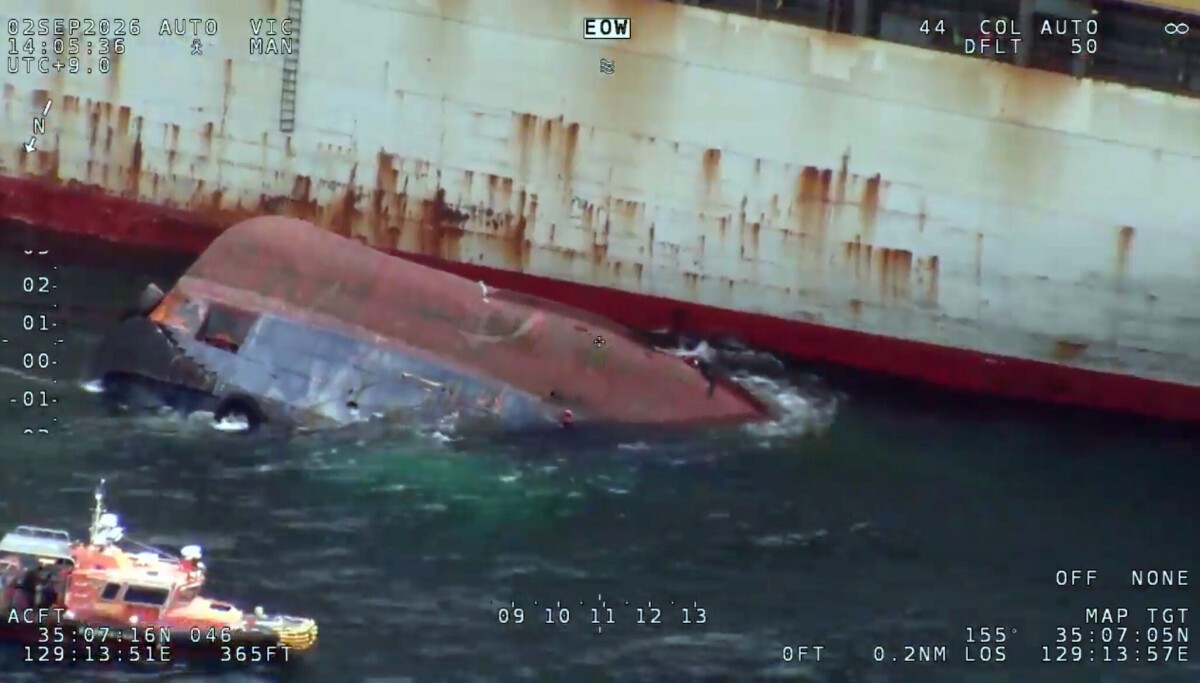
The Busan Coast Guard has been circumspect in its preliminary assessment, but the evidence points toward a mechanical or operational failure rather than a collision. Lee Kyeong-yeol, head of investigation at the Busan Coast Guard, stated at a briefing, "We presume that the vessel capsized due to the towline while making a starboard turn." This statement effectively rules out a collision between the tug and the container ship, focusing the investigation on the complex dynamics of towline tension and vessel stability during turning maneuvers.
Rescue Efforts and the Human Toll
The immediate aftermath of the capsizing saw a swift, if ultimately incomplete, rescue response. The nearby container ship, which had been the object of the towing operation, managed to rescue one crew member at approximately 1:49 p.m. The survivor, a 53-year-old Indonesian national, was reported to be in stable condition and not in life-threatening circumstances. This rescue, while successful, underscored the narrow window of opportunity in such incidents.
The search for the remaining seven crew members continued through the afternoon. A 57-year-old South Korean crew member was located by the Central Special Sea Rescue Team, a specialized unit of the Korea Coast Guard. The crew member was found unconscious inside the capsized tugboat and was immediately transported to a hospital. Despite the efforts of medical personnel, the individual was later pronounced dead. The remaining six crew members — five South Korean nationals and one Indonesian national — remain unaccounted for as of this writing.
The crew manifest reflects the international character of South Korea's maritime workforce. Of the eight individuals aboard, six were South Korean and two were Indonesian. This demographic is not unusual for the sector, where foreign seafarers, particularly from Southeast Asia, constitute a significant portion of the labor force on Korean-flag and coastal vessels. The Indonesian government has been notified, and authorities have arranged emergency interpretation services for the foreign nationals affected, a small but crucial measure in a crisis that transcends national borders.
Underwater Recovery and Environmental Challenges
The physical challenges of the recovery operation are formidable. The TNS Catcher sank completely at 3:27 p.m. on the day of the incident, coming to rest on the seabed in waters approximately 87 meters deep. That evening, the Korea Coast Guard located the wreck approximately 6.5 kilometers east of Songjeong Port, confirming its position at a depth of roughly 87 meters. This depth, while not extreme by deep-sea standards, presents significant difficulties for divers and remotely operated vehicles.
The Korea Coast Guard has marshaled substantial resources for the search and recovery effort. A total of 13 Coast Guard vessels have been deployed to the area, supported by the Republic of Korea Navy, which dispatched the ROKS Gwangyang, a dedicated salvage and rescue ship, along with aircraft. However, these efforts have been hampered by adverse weather conditions. Waves of 1 to 1.5 meters and northwesterly winds of 4 to 6 meters per second have created a challenging operating environment, particularly for the delicate work of underwater search and recovery.
As of Saturday, September 5, the search has entered its fifth day with no signs of the missing crew. Six Coast Guard vessels conducted an overnight search without success. Critically, underwater searches of the sunken vessel have not yet been carried out due to the persistent bad weather. This delay is a source of profound anxiety for the families of the missing, who await news with a mixture of hope and dread. The operation continues, with additional vessels being brought in to augment the search, but the window for finding survivors has effectively closed, shifting the mission from rescue to recovery.
National Response and Political Oversight
The disaster has prompted a high-level response from the South Korean government. President Lee Jae Myung has ordered authorities to "mobilize all available resources" for the rescue and recovery efforts, according to chief presidential spokesperson Kang Yu-jung. This directive underscores the national significance of the incident and the political imperative to respond decisively. Prime Minister Han Seong-sook has issued more specific instructions, ordering the Ministry of Oceans and Fisheries and the Korea Coast Guard to mobilize all available equipment and personnel, including underwater divers. The Prime Minister has also requested support from the Interior Ministry, the Defense Ministry, and Busan city authorities.
This coordinated response reflects the established protocols for maritime disasters in South Korea, a nation that has learned hard lessons from previous incidents. The sinking of the Sewol ferry in 2014, which claimed 304 lives, remains a traumatic national memory and has fundamentally reshaped the country's approach to maritime safety and emergency response. The current operation, with its emphasis on inter-agency coordination and resource mobilization, bears the imprint of those reforms, though questions will inevitably arise about whether prevention measures have kept pace with response capabilities.
In addition to the operational response, authorities have arranged psychological counseling for the families of the crew members. This recognition of the psychological toll of such incidents represents a more holistic approach to disaster management, one that acknowledges the long-term trauma experienced by those left behind. The provision of emergency interpretation services for foreign nationals affected is another indicator of the increasingly international dimension of South Korea's maritime sector and the need for culturally competent support services.
Investigative Framework and Maritime Safety Context
The investigation into the capsizing has begun in earnest. A 41-member investigation team has been formed, and officials from the shipping company have been questioned. The Korea Coast Guard, which has jurisdiction over the incident, will conduct a thorough inquiry into the circumstances surrounding the capsizing. The findings will likely be reviewed by the Korea Maritime Safety Tribunal, the quasi-judicial body responsible for investigating marine accidents and determining their causes.
The central question for investigators will be the role of the towline in the capsizing. Tugboat operations are inherently high-risk, requiring precise coordination between the tug's crew, the vessel being assisted, and the forces exerted by towlines under tension. A sudden shift in load, a failure of equipment, or an error in judgment can have catastrophic consequences. The CCTV footage, which captures the tug's sudden roll to port, will be a critical piece of evidence in determining the sequence of events.
The incident also raises broader questions about the safety of tugboat operations in Busan, one of the world's largest container transshipment ports. The port handles millions of containers annually, and the constant movement of large vessels in constrained waterways creates a high-risk environment for the tugs that guide them. The TNS Catcher was engaged in a particularly delicate operation, assisting a vessel that had already been involved in an accident. The added complexity of this task may have contributed to the conditions that led to the capsizing.
International Standards and the Future of Maritime Safety
The disaster also has an international dimension that extends beyond the nationalities of the crew. The container ship involved was Liberia-flagged, a common registry for vessels in international trade. The incident will be of interest to the International Maritime Organization (IMO), which sets global standards for maritime safety, and to the broader international community concerned with the welfare of seafarers. The Maritime Labour Convention, which establishes minimum standards for seafarers' working and living conditions, provides a framework for considering the rights and protections of the crew members involved.
The presence of Indonesian crew members on a Korean-flag tugboat highlights the increasingly transnational nature of the maritime workforce. Seafarers from Indonesia, the Philippines, and other developing nations crew a significant portion of the world's commercial fleet. Their welfare, safety, and legal protections are matters of international concern, and incidents such as this one underscore the need for robust enforcement of international standards across all flags and vessel types.
As the search for the six missing crew members continues, the focus will inevitably shift from rescue to investigation and, ultimately, to accountability. The families of the missing deserve a thorough and transparent inquiry into the causes of this tragedy. The broader maritime community, in South Korea and beyond, will be watching closely. The lessons learned from the TNS Catcher disaster must inform future safety protocols, not only in Busan but in ports around the world where similar operations are conducted daily. The sea, as always, demands respect, and the cost of complacency is measured in human lives.
By Prof. David Park, Staff Writer
This article was produced with AI-assisted research and editorial support. Reporting is based on sources cited in the article.
What's Your Reaction?
 Like
0
Like
0
 Dislike
0
Dislike
0
 Love
0
Love
0
 Funny
0
Funny
0
 Wow
0
Wow
0
 Sad
0
Sad
0
 Angry
0
Angry
0

East Asia/Technology Correspondent at Global1.News. Seoul-based voice covering Korean politics, technology, business, and culture. Analyzes how technology and geopolitics intersect across East Asia.













Comments (0)