
BRICS 2026: A Forum, Not a Front
India’s role as chair of the 2026 BRICS summit in New Delhi has sparked intense scrutiny, especially because the event featured high‑profile meetings between Chinese President Xi Jinping and Russian President Vladimir Putin.
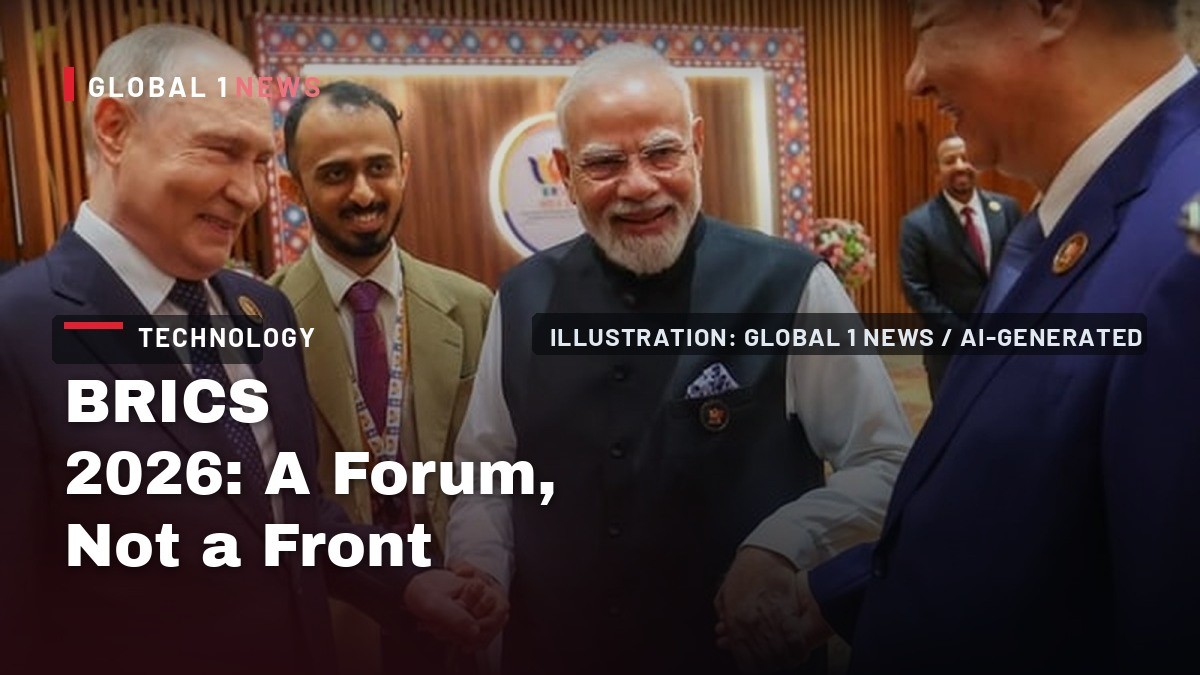
India’s role as chair of the 2026 BRICS summit in New Delhi has sparked intense scrutiny, especially because the event featured high‑profile meetings between Chinese President Xi Jinping and Russian President Vladimir Putin. While the photographs of the three leaders together have fed narratives of an emerging anti‑Western bloc, the substance of the summit’s declaration and the broader pattern of India’s diplomatic activity reveal a more nuanced strategy. As a journalist covering the intersection of technology, economics and geopolitics in the Asia‑Pacific, I examine how India is using BRICS as one forum among many to craft a multi‑aligned posture that preserves strategic space while still offering value to its Western partners.
India’s View of BRICS: A Forum, Not a Front
Indian officials have consistently framed BRICS as a “forum” rather than a “camp.” The 2026 New Delhi declaration underscores this positioning: it highlights common interests such as the “smooth flow of global trade, supply chains and energy,” while deliberately omitting references to contentious topics that divide members. The language of “recalling our respective national positions” signals that the host sought consensus on narrow issues and avoided language that would force the grouping into a political front.
In practice, this means India is using the summit to secure a seat at the table where the emerging multipolar order is being negotiated, without allowing the BRICS platform to dictate its broader strategic choices. The emphasis on consensus‑building, rather than on a unified stance against the West, aligns with India’s stated policy of “multi‑alignment,” a term that captures its effort to engage with multiple power centers while preserving autonomy.
The Global Context Shaping India’s Multi‑Alignment
The summit took place against a backdrop of three simultaneous great‑power contests: Europe’s security environment, the Middle East’s energy volatility, and East Asia’s technology rivalry. The war in Ukraine entered its fifth year, the Strait of Hormuz remained closed to normal traffic for more than six months, and Brent crude hovered above $100 after peaking at $126 in March. At the same time, China and the United States are intensifying competition over energy, semiconductors, computing power and critical minerals—resources that underpin artificial intelligence and the next industrial era.
These overlapping crises have forced supply chains to be rerouted, export controls to be weaponized, and payment systems to fragment. Defense budgets are expanding worldwide. For a nation of 1.4 billion people, India cannot afford to align exclusively with any single bloc. Instead, it must navigate a “three‑theater world” by hedging against risks in each region, a strategy evident in its recent diplomatic and economic moves.
Recent Diplomatic Wins Illustrate Multi‑Alignment
In the months surrounding the BRICS summit, India secured a series of high‑profile agreements that illustrate its hedging approach. It concluded a free‑trade agreement with the European Union and signed a security and defence partnership with the EU in the same week, signalling deepening ties with Europe. Shortly thereafter, India hosted the AI Impact Summit, underscoring its ambition to be a hub for emerging technologies.
Simultaneously, New Delhi struck a tariff truce with the United States under President Donald Trump, while maintaining a broader strategic relationship with Washington. India’s navy escorted tankers through the Strait of Hormuz, demonstrating a willingness to protect commercial shipping in a contested waterway without directly confronting Iran or the United States. Additional agreements—including a trade deal with the United Kingdom, a Comprehensive Economic Partnership with Oman, and a landmark free‑trade pact with New Zealand—further diversify India’s economic partnerships.
The BRICS Declaration: What Is Said and What Is Omitted
The official New Delhi declaration is notable for both its inclusions and its silences. It references “maximum restraint” in the “continued escalation of tensions in Middle East/West Asia,” but it does not name the Strait of Hormuz, Iran, the United States, Ukraine, or the U.S. dollar. The omission of a direct reference to the ongoing conflict in Ukraine and the absence of any discussion on a BRICS currency suggest that members could not reach agreement on these sensitive topics.
Instead, the document focuses on generic goals such as the “smooth flow of global trade, supply chains and energy.” By avoiding contentious language, the host allowed members with divergent interests—such as Iran and Russia on one side, and Saudi Arabia and the UAE on the other—to sign off on a consensus text. This diplomatic balancing act reflects India’s role as a mediator rather than a champion of any particular agenda within the grouping.
China‑India Relations: Competition Managed, Not Resolved
Xi Jinping’s presence in New Delhi marked his first visit to India in seven years, following the 2020 border clashes in the Galwan Valley. The legacy of that conflict still shapes bilateral ties: roughly 50,000 troops remain stationed on either side of the Line of Actual Control, and China’s strategic support for Pakistan during last year’s India‑Pakistan conflict reinforced New Delhi’s perception of Beijing as a security rival.
Despite these frictions, India has engaged China at high levels, most recently at the Shanghai Cooperation Organization summit in Tianjin and now at the BRICS summit. Prime Minister Narendra Modi’s remarks to Xi—that the relationship “should not be seen through a third‑country lens”—can be read as an attempt to decouple the bilateral rivalry from broader geopolitical narratives. This approach acknowledges competition as a permanent feature while seeking mechanisms to manage it, a stance consistent with India’s multi‑aligned doctrine.
Implications for Western Partners and Europe
India’s diplomatic choreography during the BRICS summit offers a clear signal to its Western allies: participation in the grouping does not equate to a shift away from existing partnerships. The simultaneous conclusion of a free‑trade agreement with the European Union and a security partnership indicates that Europe can continue to engage with India on both economic and strategic fronts.
Moreover, India’s careful handling of the BRICS declaration—eschewing overt criticism of the United States or explicit support for Iran—helps preserve a neutral posture that reassures Western partners. By keeping the summit’s language deliberately vague on contentious issues, New Delhi avoids forcing its Western allies into a binary choice, thereby maintaining the strategic space needed for future cooperation on technology, trade and security.
Strategic Outlook: The Future of India’s Multi‑Alignment
Looking ahead, India’s experience at the 2026 BRICS summit suggests that its multi‑aligned strategy will continue to revolve around selective engagement. The country is likely to keep using international forums—whether BRICS, the G20, or regional groupings—to extract incremental benefits while steering clear of commitments that could constrain its autonomy.
In the technology arena, India’s hosting of the AI Impact Summit signals an ambition to become a hub for emerging digital industries, a goal that aligns with its broader economic diversification plan. At the same time, its defence and security partnerships with the United States, Europe and regional allies provide a counterbalance to China’s growing influence in the Indo‑Pacific.
Ultimately, the 2026 BRICS summit underscores a central tenet of India’s foreign policy: the pursuit of “strategic space” through a calibrated, multi‑aligned approach. By positioning BRICS as a forum for limited consensus rather than a platform for ideological confrontation, India preserves its freedom to navigate an increasingly complex global order while offering tangible value to both its Eastern and Western partners.
This article was produced with AI-assisted research and editorial support. Reporting is based on the source material cited below. Sources: The Diplomat; thediplomat.com; Global1.News (17 September 2026).
By Kenji Tanaka, Staff Writer
What's Your Reaction?
 Like
0
Like
0
 Dislike
0
Dislike
0
 Love
0
Love
0
 Funny
0
Funny
0
 Wow
0
Wow
0
 Sad
0
Sad
0
 Angry
0
Angry
0

Japan Correspondent at Global1.News. Tokyo-based voice covering Japanese politics, technology, economy, and culture. Tracks the intersection of tradition and innovation in one of the world's most dynamic societies.










Comments (0)