
AOC 2028: Is She Ready to Run for President?
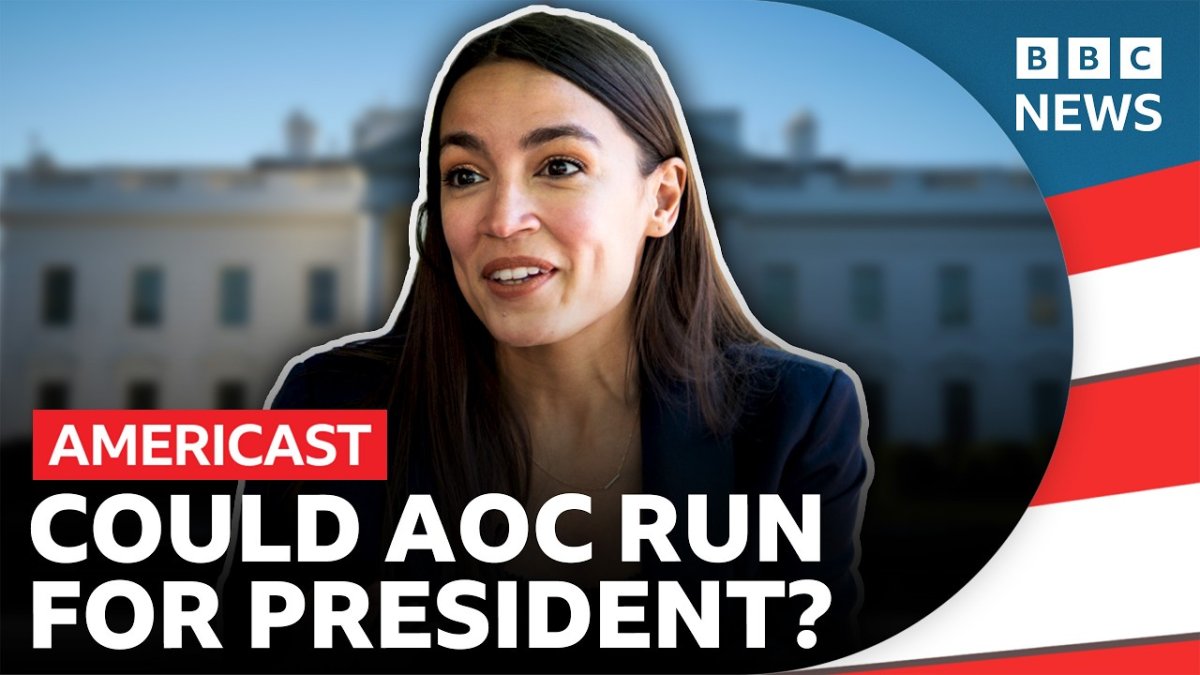
In a recent BBC News Americast report, hosts Justin Webb, Sarah Smith, and Anthony Zurcher posed a question that has quietly animated Democratic politics for months: Is Alexandria Ocasio-Cortez ready to run for president? The episode, aired this week, examined whether the 36-year-old congresswoman from New York is laying the groundwork for a 2028 White House bid, and more pointedly, whether a party still scarred by its 2024 defeat would ever pick her.
In a recent BBC News Americast report, hosts Justin Webb, Sarah Smith, and Anthony Zurcher posed a question that has quietly animated Democratic politics for months: Is Alexandria Ocasio-Cortez ready to run for president? The episode, aired this week, examined whether the 36-year-old congresswoman from New York is laying the groundwork for a 2028 White House bid, and more pointedly, whether a party still scarred by its 2024 defeat would ever pick her. The discussion came at a moment of extraordinary flux for the Democratic Party, with its left flank surging in primary contests even as centrists warn of electoral peril. The answer to the Americast question, it turns out, is not a simple yes or no — it is a story about ambition, rebranding, and a party wrestling with its own identity.
AOC 2028: Is She Ready to Run for President?
Washington, D.C. – 15 August 2026 — Alexandria Ocasio-Cortez spent this week doing something she has rarely done in her seven years in Congress: she left the door open. In a Sunday interview on ABC's "This Week" with Jonathan Karl, the congresswoman from New York's 14th district declined to rule out a 2028 presidential run, declined to rule out a Senate primary challenge to Chuck Schumer, and offered a carefully calibrated message of humility and focus. Days earlier, she had revealed on Instagram that she was freezing her eggs, calling the disclosure a potential "political risk." And in the same interview, she distanced herself from the rhetoric that defined her 2020-era political rise, saying "Woke 1 was crazy" — a phrase she attributed to New York City Councilman Chi Ossé. The convergence of these moments, analysts suggest, signals a politician consciously reshaping her public image for a national audience.
A Door Left Open
The most consequential development came on Sunday, when Ocasio-Cortez told Jonathan Karl that she has not "ruled out" running for president in 2028. "I haven't ruled out the possibility, and I'm very humbled [by] the tremendous amount of support out there," she said. The statement, while hardly a formal announcement, marked a significant shift from her previous posture of categorical disinterest. When pressed on a potential Senate run against Chuck Schumer — who is up for re-election in 2028 — she was equally noncommittal: "I think that anything is possible at this juncture."
Yet she was careful to frame her immediate priorities in institutional terms. "I think that we have a responsibility to remain focused on the midterms and not on our individual aspirations," she said. That discipline, according to BBC Americast's Anthony Zurcher, is characteristic of a politician who understands that premature presidential positioning can alienate the very voters she needs. Ocasio-Cortez has spent the past year campaigning aggressively across the country alongside Senator Bernie Sanders of Vermont, appearing at rallies in key states and building a national network of progressive activists. She has emerged as a polling favorite in several early primary states, and her role as a power broker on the left has grown substantially since her decisive fourth-term re-election in November 2024.
Why the Party Is Watching
The Democratic Party's internal dynamics have shifted dramatically in recent months, and Ocasio-Cortez sits at the center of that shift. The Democratic Socialists of America, the organization that helped launch her political career, has seen a string of primary successes in the 2026 midterm cycle. The most striking came in Michigan, where Abdul El-Sayed, a progressive physician and former Detroit health director, won the Democratic gubernatorial primary in a left-wing upset that sent shock waves through the party establishment. El-Sayed's victory was widely interpreted as evidence that progressive candidates can win in competitive states, not just in safely Democratic urban districts.
But the left also suffered a setback this week in Wisconsin, where DSA-backed candidate Francesca Hong lost to centrist David Crowley in the race for state governor. The Wisconsin result, according to BBC North America Editor Sarah Smith, offers a more complicated picture: it suggests that while the progressive wing can mobilize its base, it has not yet demonstrated a consistent ability to win in the states that will decide the 2028 general election. The contrast between Michigan and Wisconsin, analysts say, underscores the party's unresolved tension between its activist left and its institutional center — a tension that any 2028 nominee will have to navigate.
The Egg Freezing Disclosure and the 'Woke 1.0' Rebrand
Ocasio-Cortez's decision to publicly disclose that she has begun freezing her eggs was, by her own admission, a calculated risk. In an Instagram post published this week, she described the process as deeply personal but acknowledged that sharing it carried political consequences. The disclosure, she said, was a potential "political risk" — a recognition that her personal life, like her policy positions, would be scrutinized on a national stage. The reaction was largely sympathetic, with many commentators noting that the announcement humanized a politician often portrayed as a purely ideological figure.
More striking, perhaps, was her attempt to distance herself from the rhetoric of her own political youth. On "This Week," Ocasio-Cortez said "Woke 1 was crazy," attributing the phrase to Chi Ossé, a New York City Councilman. The remark was widely read as an effort to signal that she has evolved beyond the maximalist progressive language of 2019 and 2020, when she was a central figure in the party's leftward lurch. CNN and the Boston Globe have both reported in recent days that Democratic strategists are actively seeking ways to help candidates explain away far-left statements made during that period, and Ocasio-Cortez's comments appear to align with that broader effort. Whether voters will accept the rebrand, however, remains an open question.
The Polling Picture
The data on a potential Ocasio-Cortez candidacy is, at this stage, genuinely mixed. A University of New Hampshire poll found her leading the field in the Granite State, ahead of former Transportation Secretary Pete Buttigieg and Senator Mark Kelly of Arizona. An AtlasIntel poll showed her topping a 2028 Democratic primary survey at 26 percent, ahead of Buttigieg, California Governor Gavin Newsom, and former Vice President Kamala Harris. Recent Polymarket odds put Ocasio-Cortez at 20 percent, followed by Newsom at 16 percent, Senator Jon Ossoff at 15 percent, and Harris at 7 percent.
Yet other polling averages have shown Harris maintaining a lead in some national surveys, and the primary electorate is notoriously difficult to predict this far out. What is clear is that Ocasio-Cortez's coalition — young voters, progressives, and a significant share of Latino voters — overlaps only partially with the broader Democratic primary electorate. Her strength in New Hampshire, a state with a heavily white, college-educated Democratic base, is notable, but it does not necessarily translate to success in more diverse states like South Carolina or Nevada. The polling picture, analysts suggest, is less a prediction than a reflection of the fluidity of the moment.
What a Candidacy Would Mean for the Democrats
If Ocasio-Cortez were to enter the 2028 race, she would fundamentally reshape the Democratic primary. Her candidacy would force every other contender to define themselves in relation to her — either as a more moderate alternative or as a fellow traveler of the left. The party's structural questions would come into sharp focus: Can a self-described democratic socialist win a general election in the United States? Would her past statements on defunding the police, on foreign policy, and on the nature of American capitalism become liabilities in a national campaign? And could she serve as a unifying figure, or would her presence deepen the party's internal divisions?
The Senate dynamic adds another layer of complexity. A primary challenge to Chuck Schumer, the Senate Minority Leader, would be an extraordinary act of political audacity. Schumer has been a fixture of New York politics for decades, and a challenge from the left would pit the party's institutional power against its activist energy. Ocasio-Cortez's refusal to rule out such a run suggests she is keeping all options open, but it also raises questions about her relationship with the party leadership she would need to win the presidency. On the international stage, a left-wing Democratic nominee would likely reshape debates over trade, military alliances, and foreign policy — positions that would be scrutinized by allies and adversaries alike.

Analysis — The Road to 2028
The road to 2028 runs through the 2026 midterms, and Ocasio-Cortez has been explicit about her focus on that immediate goal. Her campaigning with Bernie Sanders, her appearances in key states, and her careful positioning on the national stage all suggest a politician building a foundation for a possible run — but they do not, in themselves, constitute a decision. The midterms will provide crucial data: if progressive candidates like Abdul El-Sayed win in November, the case for a left-wing presidential nominee strengthens; if centrists like David Crowley prevail, the party may look elsewhere.
What to watch in the coming months is not whether Ocasio-Cortez makes a formal announcement — that is unlikely before 2027 — but how she navigates the tension between her activist base and the party's institutional center. Her "Woke 1.0" rebrand, her personal disclosures, and her refusal to rule anything out all point to a politician who understands that the 2028 primary will be won not by the loudest voice, but by the most strategic one. Whether she is ready to run for president is, in some sense, the wrong question. The more pressing question is whether the Democratic Party is ready for her — and whether she can convince it that she is the future, not a relic of its recent past.
By Irina Volkov, Staff Writer
This article was produced with AI-assisted research and editorial support. Reporting is based on sources cited in the article.
What's Your Reaction?
 Like
0
Like
0
 Dislike
0
Dislike
0
 Love
0
Love
0
 Funny
0
Funny
0
 Wow
0
Wow
0
 Sad
0
Sad
0
 Angry
0
Angry
0

Russia/Eastern Europe Correspondent at Global1.News. Covering Russian politics, energy, security, and the shifting dynamics of the post-Soviet space. Provides clear-eyed analysis on one of the world's most opaque regions.















Comments (0)