
Amazonas Fire Hotspots Surge 407% as Drought Grips the Rainforest
The Brazilian state of Amazonas is burning at a pace that should alarm the entire country. Satellite monitoring data from INPE, Brazil's national space research institute, shows fire hotspots in the state have surged 407% in August 2026, reaching the worst level of the year. The
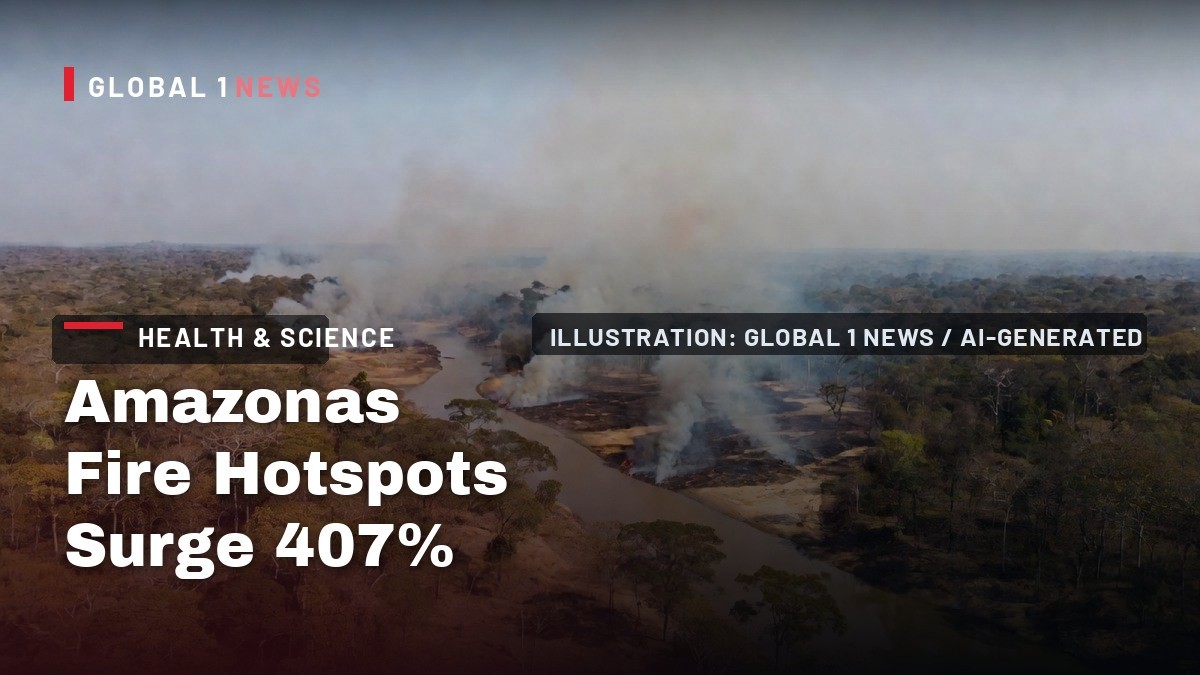
The Brazilian state of Amazonas is burning at a pace that should alarm the entire country. Satellite monitoring data from INPE, Brazil's national space research institute, shows fire hotspots in the state have surged 407% in August 2026, reaching the worst level of the year. The numbers are stark: 1,445 hotspots recorded so far this month, compared to just 285 in the first days of August. The fires are concentrated in the south of the state, where the dry season has tightened its grip and communities are bracing for what could be a catastrophic few months.
Amazonas Fire Hotspots Surge 407% as Drought Grips the Rainforest
Manaus, Brazil — The smoke is already visible on the horizon in parts of southern Amazonas, and the data confirms what residents are seeing. According to monitoring reports published by A Critica and ac24horas, citing INPE's fire detection system, the state has recorded 1,445 hotspots in August 2026 alone. That represents a 407% increase compared to the 285 hotspots registered in the first days of the month. The surge marks the worst fire activity of the year in Amazonas, and it comes as no surprise to researchers who have been tracking the region's deepening drought.
Southern Municipalities Bear the Brunt of the Crisis
The geographic concentration of the fires is striking. The municipality of Apuí leads the state with 532 hotspots, followed by Novo Aripuanã with 214. Together, these two municipalities account for 746 hotspots — more than half of all fire records in Amazonas this month. Apuí, a municipality known for its agricultural expansion and land conflicts, has historically been a flashpoint for fire use during the dry season. Novo Aripuanã, its neighbor to the north, is facing similar pressures as ranchers and farmers clear land under increasingly dry conditions.
Other municipalities with significant fire activity include Maués, Manicoré, Lábrea, Humaitá, Manacapuru, Autazes, Careiro and Canutama. Most of the most affected cities are in the southern part of the state, an area historically vulnerable to fire. This is not a random distribution — it reflects a pattern of land use, deforestation pressure, and climate conditions that have converged in recent weeks. The southern arc of Amazonas has long been a frontier for cattle ranching and soy production, and the fires are a direct consequence of that expansion.
Dry Season and El Niño Create a Perfect Storm
The surge in fires coincides with the advance of the dry season in Amazonas, characterized by reduced rainfall and higher temperatures. The drought scenario intensifies conditions for the rapid spread of flames in vegetation areas and increases risks of worsening air quality for the population. In Manaus, the state capital, residents have already reported hazy skies on several days this month, though the worst air quality is expected in the southern municipalities closest to the fire fronts.
The broader context is worrying. The dry period in Brazil usually lasts from August to October, and this year it is being amplified by a strengthening El Niño. Forecasters are warning of a very strong event during the Northern Hemisphere fall and winter of 2026-27, with effects intensified by climate change. Earlier in August 2026, Brazilian authorities relaxed an environmental rule for the Belo Monte hydropower plant on the Xingu River in the northeastern Amazon in anticipation of another potentially severe El Niño-fueled dry season. Amazon river levels have been falling faster than expected across the region, a sign that the drought is already taking hold.
River Levels Drop and Hydropower Faces Strain
The falling river levels are not just an environmental concern — they are an economic and energy security issue. The Belo Monte plant, one of the largest hydroelectric facilities in Brazil, has already seen its operating conditions adjusted as authorities prepare for reduced water flow. The relaxation of environmental rules at Belo Monte is a clear signal that the government is prioritizing energy generation over ecological preservation in the face of an anticipated severe dry season. This decision has drawn criticism from environmental groups, who argue that it sets a dangerous precedent for other dams in the Amazon.
For communities along the Amazon and its tributaries, the dropping water levels mean more than just energy concerns. River transport, the lifeblood of the region, is becoming more difficult. Small communities that depend on boats for food, medicine, and fuel are facing longer travel times and higher costs. Fishermen are finding their catches reduced as fish populations concentrate in shrinking waterways. And as the rivers recede, the exposed banks become dry fuel for the fires that are already spreading across the region.
Air Quality Risks and Public Health Concerns
The health implications of the fire surge are severe. Smoke from the burning vegetation contains particulate matter that can cause respiratory problems, especially in children, the elderly, and those with pre-existing conditions. In the southern municipalities, where the fires are most intense, health clinics are reporting an increase in patients with breathing difficulties, according to local media reports. The state health secretariat has not yet issued a formal alert, but public health experts are urging residents to limit outdoor activities and use masks when smoke is heavy.
The air quality issue is not confined to the immediate fire zones. Prevailing winds can carry smoke hundreds of kilometers, affecting urban centers like Manaus and even crossing into neighboring states. In recent years, smoke from Amazonas fires has reached as far as São Paulo and other southern Brazilian cities, creating hazy skies and triggering air quality alerts. This year, with the fires concentrated so heavily in the south of Amazonas, the risk of widespread smoke dispersion is high.
Historical Vulnerability and the Need for Action
The southern arc of Amazonas has been a persistent problem for environmental authorities. The region's history of land grabbing, illegal logging, and slash-and-burn agriculture has made it a perennial hotspot during the dry season. Despite increased enforcement efforts in recent years, the sheer scale of the territory makes monitoring and control difficult. The 407% surge in hotspots this month suggests that enforcement efforts are not keeping pace with the fires.
Local environmental agencies are mobilizing firefighting teams, but their resources are stretched thin. The state government has requested federal assistance, and the Brazilian Air Force has been deployed to support firefighting operations in the most affected areas, according to reports. However, the fires are spreading faster than crews can contain them, and the forecast for the coming weeks offers little relief. The dry season typically peaks in September, meaning the worst may still be ahead.
What This Means for Brazil and the World
The fires in Amazonas are not just a local tragedy — they are a global concern. The Amazon rainforest plays a critical role in regulating the Earth's climate, absorbing carbon dioxide and producing oxygen. When the forest burns, it releases massive amounts of carbon into the atmosphere, accelerating climate change. The 2026 fire season, if it continues at this pace, could rival the devastating fires of 2019 and 2020, which drew international condemnation and pressure on the Brazilian government to act.
For Brazilians, the fires are a reminder of the fragility of the country's environmental protections. The relaxation of rules at Belo Monte, the surge in fire hotspots, and the intensifying El Niño all point to a challenging period ahead. The government has announced plans to increase funding for fire prevention and control, but critics argue that more needs to be done to address the root causes of deforestation and land conflict. As the dry season continues, the people of Amazonas are left to hope that the rains come early — and that the fires do not consume their homes, their health, and their future.
This article was produced with AI-assisted research and editorial support. Sources: A Critica, ac24horas, INPE fire monitoring data.
By Elena Vasquez, Staff Writer
What's Your Reaction?
 Like
0
Like
0
 Dislike
0
Dislike
0
 Love
0
Love
0
 Funny
0
Funny
0
 Wow
0
Wow
0
 Sad
0
Sad
0
 Angry
0
Angry
0

Latin America Correspondent at Global1.News. Based in Mexico City, covering politics, economics, energy, and culture across the region. Brings an on-the-ground perspective to stories spanning from the Rio Grande to Patagonia.















Comments (0)