
Bolivia's Wildlife Rescuers Battle Climate Fires and Trafficking
The smoke hangs low over the Beni savanna, and the animals come first—singed, starving, or orphaned. In August 2023, Al Jazeera English’s Manuel Rapalo traveled to Santa Cruz, Bolivia, to document a grim reality: conservationists are being forced to rescue an increasing number of animals from the Amazon Rainforest as climate-driven fires and droughts compound the relentless pressure of illegal wildlife trade.
The smoke hangs low over the Beni savanna, and the animals come first—singed, starving, or orphaned. In August 2023, Al Jazeera English’s Manuel Rapalo traveled to Santa Cruz, Bolivia, to document a grim reality: conservationists are being forced to rescue an increasing number of animals from the Amazon Rainforest as climate-driven fires and droughts compound the relentless pressure of illegal wildlife trade. This is not a distant ecological footnote; it is a continental emergency unfolding in the heart of South America, where Bolivia’s ecosystems—home to nearly half of the continent’s bird species—are becoming both a graveyard and a triage unit. The story from Santa Cruz is a warning to every nation that shares the Amazon basin.
Bolivia's Wildlife Rescuers Battle Climate and Trafficking
Santa Cruz, Bolivia — August 2023 — Wildlife conservationists in Bolivia are being forced to rescue an increasing number of animals from the Amazon Rainforest as climate-driven fires and droughts compound the pressure of illegal wildlife trafficking.

The Rescue Frontline in Santa Cruz
In the sprawling eastern lowlands of Santa Cruz, the rescue work never stops. Manuel Rapalo’s report for Al Jazeera English captured conservationists moving through a landscape scarred by fire, pulling vulnerable animals from the path of destruction. The sheer scale of the 2023 wildfire season—officially estimated at up to 3.4 million hectares burned across La Paz, Beni, Santa Cruz, and Cochabamba—has turned these rescuers into first responders for a biodiversity crisis that shows no signs of abating. NASA’s SERVIR system registered 7,761 active fires on October 22, 2023, with nearly half—3,148—burning in the savanna and grassland of the Beni Savanna alone. President Luis Arce’s call for international aid from South America was not political theater; it was a desperate plea from a nation watching its natural heritage turn to ash.
The rescue frontline is not a sterile clinic. It is a makeshift operation where volunteers and biologists triage animals suffering from smoke inhalation, burns, and dehydration. In San Buenaventura, northwest of Santa Cruz, farmer Rilvert Salinas Pariamo described how rising temperatures have upended his life, affecting “our crops, animals and forests.” The community of Bella Altura has seen locals leaving water and fruit for coatis—small, ring-tailed mammals that are increasingly venturing into human settlements as their habitats vanish. Park Ranger Radamir Sevillanos of Madidi National Park, one of the most biodiverse protected areas on Earth, has been searching for hurt or trapped animals even as firefighters battle blazes in nearby sugar fields. This is the new normal: a permanent state of emergency where every rescued animal is a small victory against an overwhelming tide.
Climate's New Casualties
Climate change is no longer a future threat in Bolivia; it is a present-day killer. The 2023 fires were not random acts of nature—they were fueled by a punishing drought that turned forests and grasslands into tinderboxes. The Beni Savanna, a seasonally flooded plain that supports an astonishing array of wildlife, burned with an intensity that scientists had not anticipated. For species like the yellow-spotted river turtle (Podocnemis expansa’s smaller cousin, the Podocnemis unifilis), which is already listed as vulnerable by the IUCN, the loss of nesting sites along riverbanks is catastrophic. When fires sweep through these areas, they destroy not just adult animals but entire generations of eggs and hatchlings.
The human cost is equally severe. Rilvert Salinas Pariamo’s testimony from San Buenaventura underscores how climate change erodes the foundation of rural livelihoods. Crops fail, forests die, and animals flee—or perish. The coatis that locals now feed are a symbol of this disruption; they are survivors of a landscape that can no longer sustain them. Park Ranger Radamir Sevillanos’s work in Madidi National Park is a race against time, as he searches for animals that have been trapped by fire lines or weakened by dehydration. The fires in the sugar fields near Bella Altura are a stark reminder that agricultural expansion, often illegal, is colliding with climate change to create a perfect storm. Bolivia’s biodiversity—nearly half of South America’s bird species, approximately 350 mammal species, and around 260 reptile species, according to a joint investigation by InSight Crime and the Igarapé Institute—is being winnowed down by a crisis that knows no borders.
The Trafficking Pipeline
While fires scorch the land, a quieter but equally deadly threat moves through Bolivia’s shadows: the illegal wildlife trade. The numbers are staggering. A 2021 CITES report found that Bolivia loses approximately 61 jaguars to poaching each year—the highest rate in any Latin American country. Between 2014 and 2021, authorities seized more than 760 jaguar teeth, most destined for China. The scale of this pipeline is laid bare by the data: 337 fangs were seized between 2014 and 2016 across 16 ECOBOL postal shipments to China, and in 2015, a Chinese businessman was arrested at Beijing airport with 109 fangs in his possession. The economics are brutal—a single jaguar fang can fetch up to $2,500 in China, and a complete set of fangs, claws, and genitals can yield a profit of up to $20,000.
The trafficking pipeline is not just a jaguar problem. Birds, turtles, and even beetles are funneled out of Bolivia through a network that spans borders. Parrots, parakeets, and cockatoos are captured young from their nests, with species like the yellow-headed Amazon parrot and the saffron finch—known locally as botones de oro—particularly prized. In one seizure at Peru’s Cabanillas de Puno customs, authorities found approximately 500 saffron finches crammed into boxes on a bus. Migrants from western Bolivia transport between 100 and 500 parrots and parakeets at a time, smuggling them to Brazil, Ecuador, Chile, and Peru. The trade is so entrenched that local radio stations in Beni—in San Borja, Rurrenabaque, and Riberalta—have broadcast ads for jaguar fangs, preferably “long and clean,” as documented in 2017. This is not a black market; it is a gray economy that operates with impunity.
Bolivia's Biodiversity Under Siege
Bolivia’s position at the heart of South America makes it a crossroads for both biodiversity and criminal enterprise. The country’s borders with Brazil, Peru, Argentina, Chile, and Paraguay create a porous network that traffickers exploit with ease. Eduardo Franco Berton, an environmental journalist based in Santa Cruz, put it bluntly: “The fact that our country is in the heart of South America has made it much easier for traffickers to extract and bring animals and their parts to the border.” The result is a biodiversity crisis that touches every corner of the nation. The arrau, or giant Amazon turtle (Podocnemis expansa), and the yellow-spotted river turtle are consumed for their eggs in Beni, Cochabamba, La Paz, Pando, and Santa Cruz. While the Tsimané Indigenous community is allowed cultural collection, commercial poaching has devastated populations. In mid-2017, raids seized approximately 50,000 turtle eggs over a four-week period, many destined for Brazil.
The siege extends to the smallest creatures. Hercules rhinoceros beetles (Dynastes hercules and Dynastes satanas) are collected at night in the North Yungas region, where hunters earn $10 to $20 per beetle. In Japan, a single specimen can sell for up to $500. Bolivia’s Environmental Ministry classifies the satanas beetle as endangered, and it is listed under CITES Appendix II, yet the collection continues. The jaguar, meanwhile, is a keystone species under direct assault. A 2021 CITES study of 1,100 rural residents in northwestern Bolivia found that 17% had been approached about killing a jaguar. In March 2022, a raid on a chicken restaurant in Santa Cruz seized 16 jaguar claws. A market vendor in Trinidad offered a fang for just $100. The demand is driven by WeChat orders and transit routes through Brazil, Vietnam, and Hong Kong, where jaguar parts are used as substitutes for tiger parts in traditional medicine. With an estimated 2,000 to 3,000 jaguars left in Bolivia, the species—listed under CITES Appendix I and classified as near vulnerable by the IUCN—is on the edge.
The Sanctuaries That Never Close
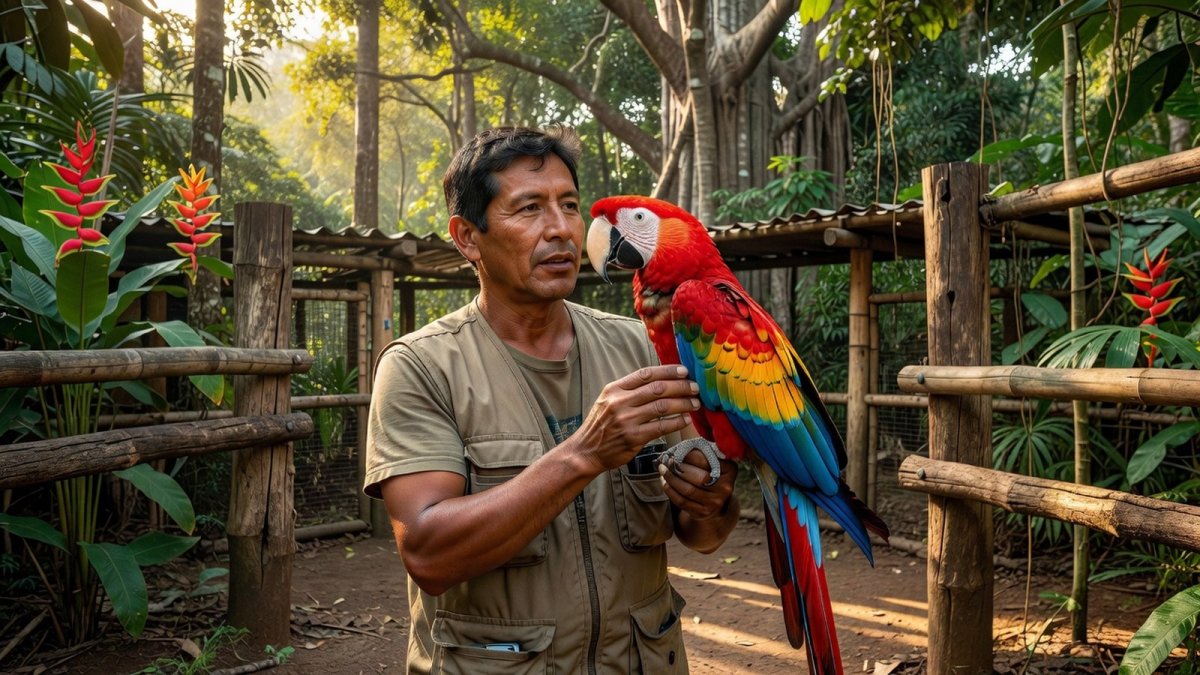
Amid the devastation, sanctuaries have become the last line of defense. Inti Wara Yassi, an NGO founded in Bolivia, operates three sanctuaries spanning a combined 1,000 hectares of Amazon rainforest: Parque Machía in Samaipata, Parque Ambue Ari, and a base at Villa Tunari in the Cochabamba department, situated along the riverside. These are volunteer-run operations that intercept animals from the illegal wildlife trade, providing refuge for pumas, jaguars, spectacled bears (Tremarctos ornatus) rescued from circuses, capuchins (Sapajus cay), squirrel monkeys (Saimiri boliviensis), margays, mealy amazons, tortoises, and armadillos taken from the bushmeat trade. Biologist Ingrid Bustos Hernández, who works with the organization, captures the challenge in a single observation: “People will say, oh I saved this monkey from the market.. So there’s still a real lack of knowledge, which is one of our biggest challenges here.”
The sanctuaries never close, and the influx of animals is growing. Ana Encina, director of communications at Inti Wara Yassi, notes that confiscations are increasing because authorities are finally acting more—a double-edged sword that saves animals but strains resources. Senda Verde, another sanctuary founded in 2003 in Bolivia’s Yungas region by Vicky Ossio and Marcelo Levy, has spent more than two decades rescuing wild animals from trafficking, abuse, and habitat destruction. These sanctuaries are not just shelters; they are permanent refuges for animals that can never be released into the wild. The spectacled bears, trained by circuses, and the monkeys, habituated to humans, are beyond rehabilitation. For every animal that finds safety, countless others die in transit or in the fires. The sanctuaries are a testament to human compassion, but they are also a stark admission of failure—a holding pattern for species that should be thriving in the wild.
Enforcement's Broken Backbone
Bolivia’s enforcement apparatus is woefully under-equipped to tackle the scale of the crisis. The POFOMA (Policía Forestal y de Protección al Medio Ambiente, or Forestry and Environmental Protection Police) operates out of a bare-bones office in an old house in downtown La Paz, where the courtyard doubles as an animal rescue center. Records are kept on paper, and physical files pile up in a system that is decades behind the traffickers it is meant to stop. POFOMA’s presence in Beni is limited, its officers are scant, and vehicles are in short supply. The Wildlife Conservation Society (WCS) has stepped in to provide fuel for joint operations, but this is a band-aid on a broken system. Mariana Da Silva, head of research on international wildlife trafficking at WCS, highlights a fundamental flaw: “Drug trafficking is considered a serious crime, while wildlife trafficking is seen as a minor crime.”
The legal framework compounds the problem. In 2020, a restructuring of Bolivia’s Prosecutor’s Office relegated wildlife crime under the department investigating drug trafficking and money laundering, effectively making it a lower priority. This bureaucratic demotion has real-world consequences. A 2019 IUCN report found that wildlife poaching and trafficking are widespread and pose a serious threat to biodiversity, yet Bolivia’s response remains fragmented. The situation is so dire that a prison in Trinidad has been paying inmates to craft fashion items from the skins of jaguars, snakes, caimans, and peccaries, as documented by World Animal Protection. Roberto Vieto of World Animal Protection notes that “Bolivia is classed as a transit country, acting as both a major source and bridge for the illegal wildlife trade between Brazil and Peru.” The WCS has helped create a digital database of eight years of seizures, revealing that more than 50% of jaguar seizures since 2010 are connected to China. But data alone cannot stop a trade that thrives on corruption and impunity.
The Bottom Line — A Regional Rescue Mission
The bottom line is that Bolivia cannot solve this crisis alone. The illegal wildlife trade is a transnational enterprise, and climate change is a global phenomenon. A 2020 Earth League International report identified 25 people in Bolivia and 50 persons of interest outside the country, operating within three “fully functioning” criminal networks. A 2020 study in Conservation Biology found that high corruption, Chinese investment, and low income combine to produce 10 to 50 times more jaguar seizures. This is not a law enforcement problem; it is a governance problem. Emi Kondo, documentary director of Jaguar Spirit: An Awakening Journey, reminds us that jaguars “used to be revered as gods” and that local traditional medicine made with wild animals is still sold to cure diseases. The cultural context matters, but so does the urgency of the moment.
As the COP16 UN Biodiversity Conference convenes in Cali, Colombia, in October 2024, ending illegal wildlife trade is a key element of the global agenda. But for Bolivia, the agenda is more immediate. The fires of 2023, the traffickers who move jaguar fangs through WeChat, and the volunteers at Inti Wara Yassi and Senda Verde are all part of the same story. The rescue mission is not just about saving individual animals; it is about preserving the ecological integrity of the Amazon for future generations. Bolivia’s biodiversity—nearly half of South America’s bird species, 350 mammal species, 260 reptile species—is a continental treasure that cannot be allowed to slip away. The international community must treat wildlife trafficking with the same seriousness as drug trafficking, and climate aid must reach the frontline communities like San Buenaventura and Bella Altura. The animals are waiting, and the clock is ticking.
By Elena Vasquez, Staff Writer
This article was produced with AI-assisted research and editorial support. Reporting is based on sources cited in the article.
What's Your Reaction?
 Like
0
Like
0
 Dislike
0
Dislike
0
 Love
0
Love
0
 Funny
0
Funny
0
 Wow
0
Wow
0
 Sad
0
Sad
0
 Angry
0
Angry
0

Latin America Correspondent at Global1.News. Based in Mexico City, covering politics, economics, energy, and culture across the region. Brings an on-the-ground perspective to stories spanning from the Rio Grande to Patagonia.















Comments (0)