
Amazon Just Permitted a Power Plant Bigger Than Any Coal Plant in America — for AI
Amazon confirmed it acquired the GW Ranch site in Pecos County, Texas, where a 35-turbine gas plant permitted to emit 33 million tons of carbon dioxide a year will power its first off-grid AI data center campus. It would become the largest single source of pollution in America.
Amazon Just Permitted a Power Plant Bigger Than Any Coal Plant in America — for AI
Let me tell you something that's been sitting heavy with me since the Cleanview scoop crossed my desk this week. Amazon — the company that co-founded the Climate Pledge, the company whose logo sits on every box in your driveway — has put its name on a natural gas power plant in West Texas permitted to dump 33 million tons of carbon dioxide into the atmosphere every year. That is more planet-warming gas than any single power plant in the United States is allowed to emit. More than the biggest coal plant in the country. And it exists for one reason only: to run AI.
I've been running hosting infrastructure for over a decade, and I've watched the AI buildout consume chips, water, land, and patience. But this one hit different. Amazon didn't just buy power from a dirty plant. Amazon bought the plant. It bought the dirt under it. It bought the permits. And it's building the data center to go with it — 8,000 acres in West Texas on a private grid that doesn't even have to ask anyone's permission to switch on. Let me walk you through what actually happened, because the details matter more than the headlines.
The Deal — 8,000 Acres, 35 Turbines, and a Grid That Never Gets Involved
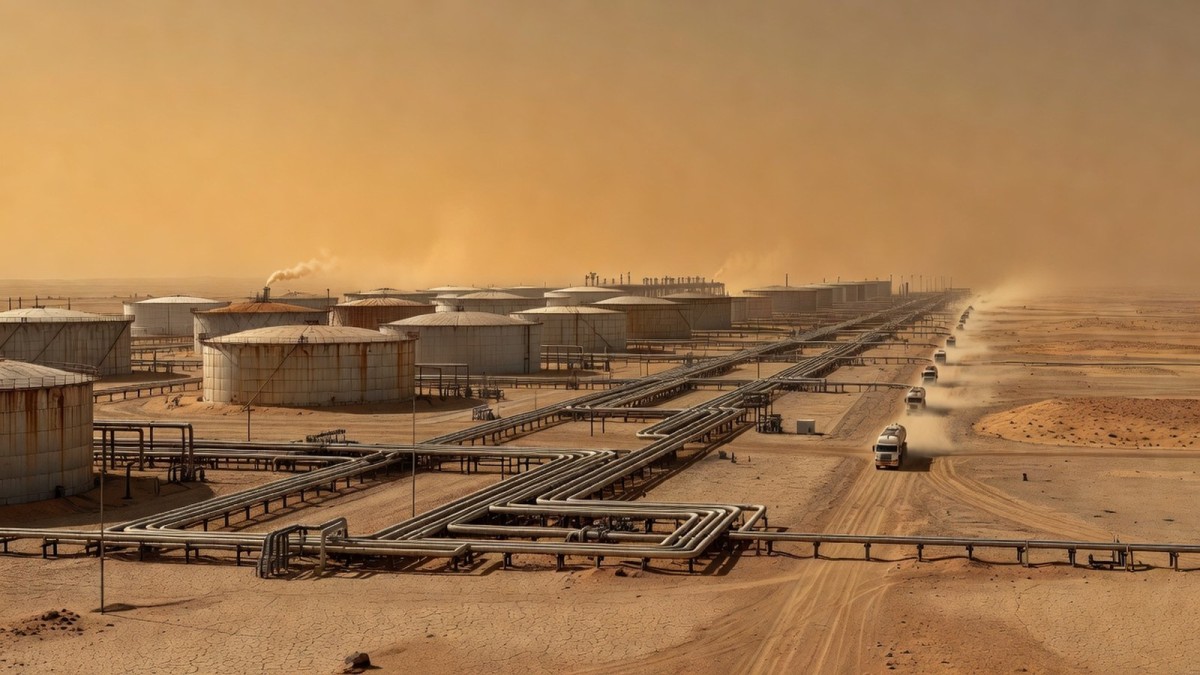
Here's the shape of it. Amazon confirmed to Cleanview that it acquired the GW Ranch site in Pecos County, a remote stretch of West Texas sitting right on top of the state's major natural gas producing regions. The original developer, Pacifico Energy, spent years permitting the project — a gas plant with 35 simple-cycle turbines, up to 7.65 gigawatts of nameplate capacity, and a nominal delivered output around 5 gigawatts, according to the Texas Commission on Environmental Quality's technical summary. Amazon won't say what it paid. It never does.
The telling part is the paperwork. Amazon filed three construction permits with the state for three data center buildings, construction beginning immediately, and satellite imagery shows land clearing already underway since July. This is not a PowerPoint project. Amazon is breaking ground on its first major off-grid data center — a fundamental break from its own history. Before this year, it powered every data center it operated from the grid. Every single one.
And the plant is designed to run behind the meter, entirely disconnected from the Texas grid, at least initially. No ERCOT interconnection queue. No transmission line wait. No auction capacity. Just 35 turbines burning gas on private land, feeding power directly into Amazon's own buildings, with a stated plan to connect to the grid "as interconnection timelines allow" — which, if you've seen the queues lately, means probably never.
The Permit That Broke the Scale — 33 Million Tons and No One in the Room
Now let's talk about the number. The air permit GW Ranch received from the state of Texas in January allows the plant to emit up to 33 million tons of carbon dioxide per year. To put that in perspective: the most polluting power plant in the United States today is the James H. Miller Jr. Power Plant, a coal plant in Quinton, Alabama, that emits about 16 million tons a year. GW Ranch's permit is more than double that. If this plant runs anywhere near its permit, it becomes the single largest source of climate pollution in the country — not in Texas, in the whole United States.
Fair caveat before the outrage: plants rarely emit the maximum their permits allow. Permits are ceilings, not operating plans. But the ceiling itself is the story — a blank check written in air. And gas plants don't just emit CO2; they release smog-forming pollutants that contribute to heart disease, asthma, and the kind of public health burden small towns in West Texas are not equipped to absorb.
This is the part that gets me as a founder. Amazon's official line — repeated in statements and in the company's own blog post on August 10 — is that it "believes in paying the full costs of powering our operations." Paying the full costs. The full costs of a 33-million-ton permit are not in the price of a megawatt-hour. They're borne by the air everyone in Pecos County breathes, by a climate system already straining, and by every other company on the planet that now has to explain why they're not the biggest polluter in America.
Reading One — The Grid Forced Their Hand
Now, before I get called a hypocrite, let me give you the other reading, because it's real. Amazon did not wake up one morning and decide to become a power company out of greed. The grid forced their hand. On July 30, Andy Jassy told investors that AWS grew at its fastest rate in 18 quarters on AI demand, and that the company has more demand for compute than it can supply — a mismatch he expects to persist well into next year. When you need gigawatts and the interconnection queue is years long, you have exactly two choices: wait, or build your own.
Amazon is not alone. Cleanview counts nearly 60 behind-the-meter gas power projects announced since the start of 2025, totaling about 90 gigawatts of capacity. Microsoft is building a Chevron-powered 2-gigawatt campus near Pecos, about 30 miles west of GW Ranch. Amazon is reportedly in talks on a 4.5-gigawatt gas plant in Homer City, Pennsylvania. The Trump administration has been cheerleading the whole thing — "energy dominance" — with an executive order last year designed to fast-track data center construction.
Michael Thomas, the Cleanview founder who broke this story, put it plainly: "We're going to see an explosion of off-grid gas projects." He's right. When the largest company in the history of the internet decides the only way to get power is to build a power plant the size of a small city's entire generating fleet, that's not a one-off. That's the market telling you the grid is broken.
Reading Two — The Net-Zero Contradiction Nobody Wants to Name
Here's the reading that keeps me up at night, though. Amazon co-founded the Climate Pledge. It promised net-zero carbon emissions by 2040. Its emissions have gone up each of the past several years, and the company has acknowledged that rising emissions from AI data centers could get in the way of its own climate goals. Then it goes and permits the biggest single-source CO2 allowance in American history. The contradiction isn't subtle.
The company's own spokeswoman, Margaret Callahan, gave the game away in a single sentence: "The world looks different now than when we co-founded the climate pledge." Translation: the pledge was written for a world without AI. Now that the AI buildout needs power, the pledge bends. She insisted "our commitment hasn't changed" — but commitments don't need defending when they're being kept.
I'll give Amazon credit where it's due: the company says GW Ranch will use non-potable brackish groundwater, custom cooling that minimizes water use, and it's exploring on-site solar and battery storage — Pacifico Energy has said it plans up to 750 megawatts of solar and 1.8 gigawatts of batteries. That's real. It's also roughly 10 percent of the gas capacity. A solar array on the corner of a coal plant doesn't make it a solar farm.
The Secondary Bottleneck — Emissions Liability Is Becoming a Business Risk
Here's where I want to talk about the thing nobody in the data center industry is pricing yet: emissions liability. For years, carbon accounting was a compliance exercise — a slide in the annual sustainability report. This project changes that math. A 33-million-ton permit is not a slide. It's a target. It's a legal liability, an organizing tool for every environmental group and community that feels steamrolled, and a stranded asset the moment carbon gets priced seriously.
Kathryn Guerra, a campaign director at Public Citizen, told reporters the plant "is going to absolutely have a huge impact on the environment, and on public health." That's the opening line of the next decade of litigation. Communities are already moving: residents in Pecos County have been upset since the ranch was green-lit in January, and there have been protests in nearby Andrews County over another Amazon investment. When the air permit becomes the battleground, the permitting process becomes the bottleneck. And unlike an interconnection queue, a community fight doesn't have a predictable timeline.
Think about what that means structurally. The giants are escaping the grid bottleneck by building their own power — only to walk straight into a new bottleneck: the emissions and community-consent gauntlet. The power plant that saves you from the queue can become the anchor dragging you through a decade of lawsuits. For a business built on certainty, that's a strange trade.
What This Means for Independent Hosting Providers
So what do you do with this if you're running an independent hosting business — the kind that doesn't have $100 billion in cash flow to build its own gas plant? Let me give you four things, and they're not the obvious ones.
First, carbon is becoming a priced input — get ahead of it. The moment the largest cloud provider in the world is also the largest single-source polluter permit holder in America, your customers' procurement teams are going to start asking about power mix. Not because they're activists — because nobody wants to be the customer of the company with the 33-million-ton permit. Know your energy source, be able to document it, and price it honestly. That's a selling point, not a tax.
Second, don't envy the giants' escape hatch. Off-grid gas looks like genius when the queue is five years long. It looks different when the permit is in the newspaper and the lawsuits start. The real lesson: the binding constraint isn't power, it's permission. The giants are trading one permission bottleneck for another, more expensive one.
Third, watch the air-permit battleground. The next fights in the AI buildout aren't going to be in ERCOT hearings. They're going to be at TCEQ, at the EPA, in county courthouses, and in town halls. Every permit Amazon-type project pulls is going to mobilize the opposition for the next one. That's your window. Grid-tied, transparent, community-communicating independents look very attractive when the alternative is a 35-turbine plant next door.
Fourth, power certainty is the product. Amazon just spent billions to guarantee its own supply. That tells you everything about how scarce firm power is. Lock your own power contracts now, understand what your uptime really depends on, and be honest with customers about where your electricity comes from. Certainty is the one thing the giants are paying a fortune to manufacture — and the one thing a well-run independent can still deliver at a human scale.
The Bottom Line
Amazon's GW Ranch project is the most honest statement the AI industry has made yet. Strip away the press releases about solar arrays and brackish water and "paying the full costs," and what's left is simple: the buildout will burn whatever it has to, wherever it has to, to get power. A permit for 33 million tons of CO2 is not an accident. It's a decision. It's the industry telling us — in the most expensive way possible — that the grid can't deliver, the promises can't hold, and the bill is going somewhere.
As an independent operator, that's not a reason to panic. It's a reason to position. The giants just spent billions to prove that power certainty is the most valuable thing in infrastructure right now. They also just handed the opposition the biggest single target in American energy history. Watch what happens when those two forces meet. And while you watch — lock your power, know your mix, and keep your name off the permit.
-- Allan Ali, Founder
This article was produced with AI-assisted research and editorial support. Sources: Cleanview Newsletter (Aug 7, 2026), The New York Times (Aug 8, 2026, via dnyuz), Amazon (aboutamazon.com, Aug 10, 2026), TechCrunch/Chron, Futurism, WFAA, CBS 8 San Diego, NewsWest 9.
What's Your Reaction?
 Like
0
Like
0
 Dislike
0
Dislike
0
 Love
0
Love
0
 Funny
0
Funny
0
 Wow
0
Wow
0
 Sad
0
Sad
0
 Angry
0
Angry
0

Publisher of Global1.News. Automation architect, systems builder, and the guy making sure the truth gets published.












Comments (0)