
Alliance Under Pressure: Ahn-Hegseth Talks and Korea's Strategic Crossroads
Ahn Gyu-back and Pete Hegseth met at the Pentagon on May 11, 2026, to align the U.S.-ROK alliance on OPCON transfer, nuclear-powered submarines, and Hormuz security after the HMM Namu attack. Months on, the central questions remain unresolved.
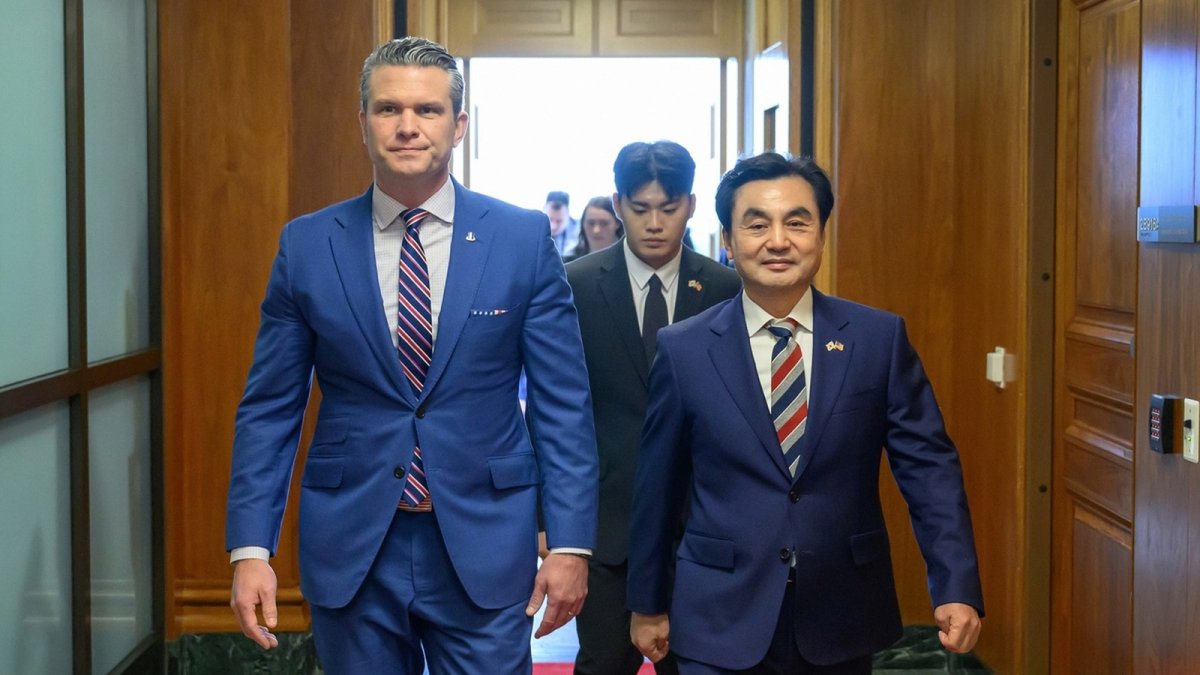
The May 11, 2026, meeting between South Korean Defense Minister Ahn Gyu-back and U.S. Secretary of Defense Pete Hegseth at the Pentagon marked the resumption of high-level military dialogue between the allies after a six-month hiatus. Occurring against the backdrop of a volatile Middle East and a delicate transition of wartime command authority, the talks served as a critical barometer for the future trajectory of the U.S.-ROK alliance. While the official readout was characteristically brief, the meeting’s agenda—spanning OPCON transfer, nuclear-powered submarine cooperation, and the immediate crisis in the Strait of Hormuz—revealed a complex matrix of shared interests and subtle divergences.
Alliance Under Pressure: The Ahn-Hegseth Pentagon Talks and the Shifting Geopolitics of the Korean Peninsula
Seoul, South Korea – August 16, 2026 — Three months after Defense Minister Ahn Gyu-back and Secretary Pete Hegseth met face-to-face for the first time, the issues they discussed in Arlington remain the central, unresolved threads in the fabric of the South Korea-U.S. alliance. The meeting, the first defense ministerial since the 57th Security Consultative Meeting (SCM) in Seoul on November 4, 2025, was intended to recalibrate a partnership navigating new strategic realities. As of mid-August 2026, the outcomes of that May dialogue continue to shape policy debates in Seoul and Washington, particularly regarding the timeline for wartime operational control (OPCON) transfer and Seoul's growing role in Middle East maritime security.

The OPCON Timeline Debate: 2028 vs. 2029
The most consequential strategic issue on the table in May was the future of wartime operational control. The joint Pentagon readout confirmed discussions on "wartime operational control transition and alliance modernization," but the specifics revealed a nuanced gap in expectations. Seoul has reportedly been targeting a transfer within President Lee Jae Myung's term, which concludes in 2030, with 2028 as a stated goal. In contrast, U.S. Forces Korea commander Gen. Xavier Brunson has indicated to Congress that the allies aim to meet the necessary conditions no later than the first quarter of 2029. This discrepancy, while seemingly small, is significant in the context of alliance politics.
The three-phase framework for transition—requiring South Korean capabilities to lead combined forces, robust strike and air defense systems, and a conducive regional security environment—remains the official benchmark. At the November 2025 SCM, both ministers agreed to develop a road map to expedite these conditions and to seek certification of Full Operational Capability (FOC) for the Future-Combined Forces Command Headquarters in 2026. The May meeting was meant to inject momentum into this process, yet the differing public timelines suggest that while the destination is agreed upon, the pace of travel is still under negotiation. The communique's language of a "systematic, stable, and proactive" transition underscores the sensitivity of moving too quickly in a volatile region.
Nuclear-Powered Submarines: A Slow Boil
Minister Ahn arrived in Washington with a clear, albeit cautious, agenda regarding Seoul's ambition to acquire nuclear-powered submarines. Despite the green light given by President Donald Trump during his October 2025 summit with President Lee, tangible progress has been slow. Ahn’s pre-departure comments—that he did not rule out an inaugural meeting on the subject before the end of the first half of 2026—signaled Seoul's intent to formalize the discussion. However, the lack of a public announcement following the May 11 talks suggests that the technical and legal hurdles remain formidable.
The crux of the matter lies in fuel-related support from Washington. Ahn stated that cooperation should move forward if the U.S. provides such support, a critical condition given that enriched uranium for naval reactors falls under strict nuclear non-proliferation agreements. While the South Korean Defense Ministry projects a potential domestic launch in the mid-to-late 2030s, this timeline is contingent on resolving these supply-chain and diplomatic issues. Crucially, Ahn reiterated that Seoul remains a signatory to the Non-Proliferation Treaty (NPT) and has no intention of developing nuclear weapons, a clarification aimed at assuaging both regional neighbors and domestic critics who see the submarine program as a stepping stone to a nuclear arsenal.
The Hormuz Dimension: The HMM Namu Aftermath
The May 4 attack on the Korean-operated cargo vessel HMM Namu in the Strait of Hormuz injected a sense of urgency into the Pentagon talks. The vessel, flagged in Panama, was struck twice on the first day of "Project Freedom," the U.S. Navy's initiative to guide commercial vessels past Iranian threats. Seoul’s announcement on May 10 that the explosion and fire were caused by a strike from two unidentified flying objects placed the incident squarely in the context of escalating U.S.-Iranian tensions, which had already seen the Trump administration authorize "Operation Epic Fury."
For South Korea, the attack was a stark reminder of its vulnerability to global supply chain disruptions. The presidential office "strongly" condemned the attack, and the defense ministry’s deputy spokesman, Lee Kyung-ho, confirmed that maritime security in the Strait of Hormuz was a topic of discussion at the May 11 meeting. The incident has forced Seoul to reconsider its role in Middle East tensions, with a review underway regarding participation in the U.S.-proposed "Maritime Freedom Construct" (MFC) coalition. This is a delicate balancing act for a nation that relies heavily on Middle Eastern energy imports but is wary of being drawn into a broader conflict. The decision on MFC participation, which remains pending as of August, will be a litmus test for Seoul's commitment to the U.S.-led security order.
Burden-Sharing and Alliance Modernization
Secretary Hegseth’s public statements during the visit were unequivocal in their emphasis on burden-sharing. His assertion that "real burden-sharing is the foundation of a resilient alliance" and that the U.S. expects partners to "stand shoulder to shoulder" during conflict reflects the Trump administration's core policy. The Pentagon has identified expanding burden-sharing as one of the four pillars of the 2026 National Defense Strategy, a position that places significant pressure on Seoul to increase its financial and material contributions to the alliance.
Minister Ahn’s response was crafted to demonstrate good faith. By emphasizing Seoul's efforts to realize a "Korea-led defense of the Korean Peninsula" through increased defense spending and by praising Hegseth's "peace through strength" doctrine, Ahn sought to frame South Korea's growing military budget not as a concession to U.S. pressure, but as a natural evolution of its own strategic autonomy. The reaffirmation of the Korea-U.S. Integrated Defense Dialogue (KIDD) as a key platform, with a round held on May 13-14, indicates that the institutional machinery for this modernization is in place. However, the underlying tension remains: Washington views burden-sharing as a prerequisite for its continued commitment, while Seoul views its increased spending as a means to gain more operational control and strategic independence.
Expert Perspectives: Divergence or Alignment?
Analysts in Seoul and Washington have interpreted the May 11 meeting with a mix of optimism and caution. The fact that the meeting occurred at all, after a six-month gap, is seen as a positive sign of institutional continuity. However, the subtle divergence on the OPCON timeline—2028 versus 2029—is viewed by some experts as a potential point of friction. One school of thought suggests that the U.S. is deliberately slowing the process to ensure that the transfer does not appear rushed or politically motivated, while another posits that Seoul’s aggressive timeline is a domestic political imperative for the Lee administration.
Regarding the submarine program, experts note that the lack of a public breakthrough in May is not necessarily a failure. The quiet diplomacy required for such a sensitive transfer of technology often proceeds away from the public eye. The real test will be whether Washington can provide the necessary fuel-related support without violating NPT norms, a challenge that has stymied similar proposals in the past. The Hormuz situation, meanwhile, has created a new imperative for cooperation, with some analysts suggesting that a South Korean commitment to the MFC could serve as a bargaining chip in other alliance negotiations.
What Comes Next: A Pivotal Autumn
As of mid-August 2026, the strategic landscape that framed the May 11 meeting has not fundamentally changed, but the pressure has intensified. The Hormuz crisis continues to simmer, keeping the question of Seoul's MFC participation at the forefront of policy discussions. The OPCON transition, while progressing through the KIDD framework, still lacks a definitive, publicly agreed-upon date. And the nuclear-powered submarine program remains in a state of diplomatic limbo, awaiting a concrete signal from Washington.
The coming months will be pivotal. The 58th SCM, expected later this year, will be the next major milestone to assess whether the promises made in May have translated into tangible policy outcomes. For the alliance, the challenge is to manage these divergent timelines and interests without fracturing the core deterrence posture on the Korean Peninsula. The May meeting established a baseline of communication, but the true test of the alliance’s resilience will be its ability to navigate the complex, interlocking crises of OPCON, proliferation, and Middle East security in the months ahead.
This article was produced with AI-assisted research and editorial support. Sources: KOREA NOW (Yonhap News Agency), Yonhap, Stars and Stripes, The Korea Times, Seoul Economic Daily, Asia News Network.
By Prof. David Park, Staff Writer
What's Your Reaction?
 Like
0
Like
0
 Dislike
0
Dislike
0
 Love
0
Love
0
 Funny
0
Funny
0
 Wow
0
Wow
0
 Sad
0
Sad
0
 Angry
0
Angry
0

East Asia/Technology Correspondent at Global1.News. Seoul-based voice covering Korean politics, technology, business, and culture. Analyzes how technology and geopolitics intersect across East Asia.












Comments (0)