
AI's Hidden Water Bill: Chile's Wetland Fight Echoes Across Latin America
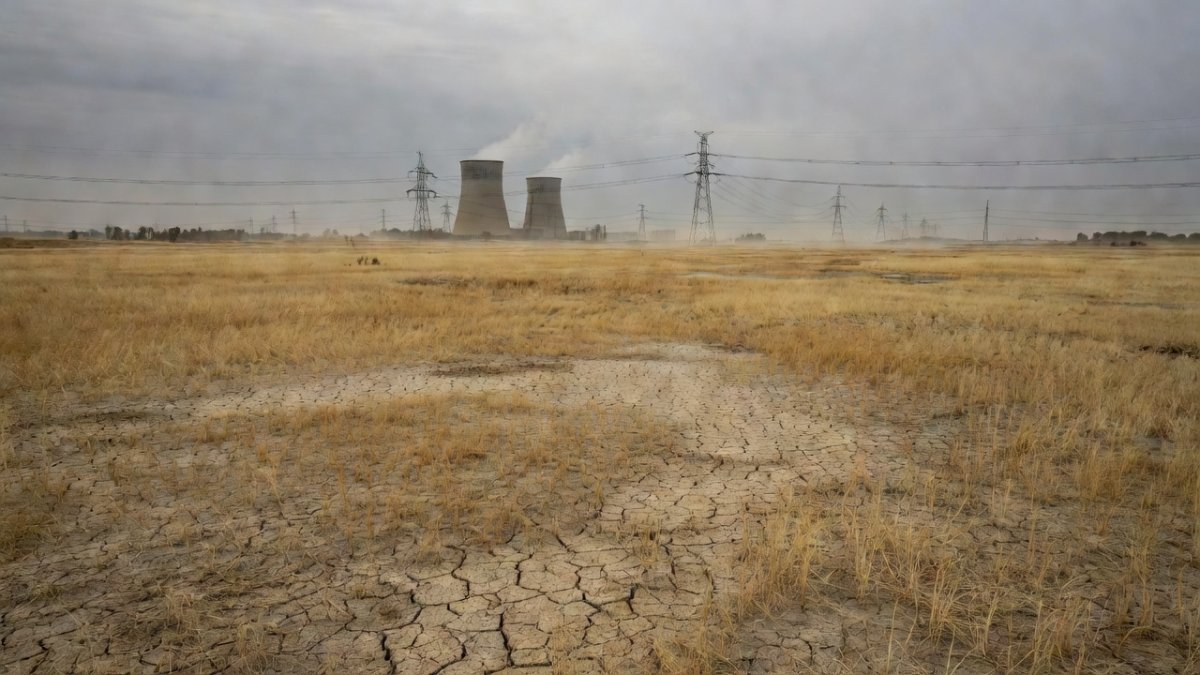
The Quilicura wetland was once a mirror of the sky, a vast expanse of reeds and shallow water on the northern edge of Santiago that held the memory of rain for months after the clouds had gone. Today, it is a cracked, dusty basin where the only reflection is the glare of the sun off the corrugated roofs of the data centres that surround it.
The Quilicura wetland was once a mirror of the sky, a vast expanse of reeds and shallow water on the northern edge of Santiago that held the memory of rain for months after the clouds had gone. Today, it is a cracked, dusty basin where the only reflection is the glare of the sun off the corrugated roofs of the data centres that surround it. As Latin America races to become the world’s next great hub for artificial intelligence, the region is discovering a brutal arithmetic: every prompt, every image, every algorithm that powers the digital future is paid for in litres of water that a parched continent can no longer afford to give.
Chile’s AI Gold Rush Is Draining a Wetland and Testing the Limits of a Thirsty Continent
Quilicura, Santiago – Chile, August 2026 — The Al Jazeera English People & Power documentary Could thirsty AI worsen the water crisis? poses a question that has moved from academic journals to the front lines of community resistance across Latin America. The answer, as the residents of Quilicura have learned over the past decade, is not a hypothetical. It is a wetland without water, a community without power to spare, and a government that has chosen to bet its future on the very industry that is consuming its most precious resource. The documentary’s investigation into the hidden water consumption of data centres lands at a moment when the region’s ambitions and its hydrology are on a collision course, and the consequences are being measured not in gigabytes but in the daily lives of millions.

A Wetland Without Water: The Quilicura Paradox
Rodrigo Vallejos, a final-year law student and activist with Resistencia Socioambiental de Quilicura, stands at the edge of what was once a thriving ecosystem. “What you see here is a wetland without water,” he says, gesturing across the 468.4 hectares of the Quilicura wetland, one of Chile’s largest swamps, now partially protected on paper but visibly dying on the ground. The paradox is that this ecological disaster sits at the heart of Latin America’s most concentrated digital infrastructure. Quilicura, on the northern outskirts of Santiago, hosts the largest concentration of data centres in the region, with 33 centres operating and 34 more planned nationally. The boom began in 2015 when Google opened its first and largest Latin American server room here, followed by five more centres from Brazilian Ascenty, Chilean Sonda, US Cirion, and Microsoft. A 2022 report by Vallejos found that the largest centres — Ascenty, Google, Microsoft, and Sonda — consume 1.5 billion litres of water annually. Google’s facilities alone hold water rights for 50 litres per second, roughly the annual consumption of 8,500 Chilean households. The company’s own environmental report states its Quilicura centre used about 461 million litres of water in 2024, a figure Google says is less than a golf course’s annual consumption. But for Vallejos and his neighbours, the comparison to a golf course is precisely the problem: in a region facing a 15-year mega-drought, no one should be watering a golf course, let alone a server farm.
How Much Water Does AI Actually Drink?
The scale of AI’s thirst is only now becoming clear, and the numbers are staggering. A June 2026 study from the UN University (UNU) projects that AI-related water consumption could equal the basic annual domestic needs of 1.3 billion people by the end of the decade. The land footprint of this infrastructure may exceed 14,500 square kilometres, about twice the size of the Jakarta metro area. Data centres powering AI could consume 945 terawatt-hours of electricity annually by 2030 — nearly triple the combined annual electricity use of Pakistan, Bangladesh, and Nigeria, countries with more than 650 million people. According to UN News (4 June 2026), every unit of electricity used by data centres carries a ‘water footprint’ for cooling and energy production, plus a land footprint. Critically, day-to-day AI usage accounts for roughly 80-90% of total energy demand, not model training. One widely used AI service processes approximately 2.5 billion prompts per day, consuming hundreds of gigawatt-hours a year. The energy intensity is staggering: generating a single AI image can require more than a thousand times the energy of simple text classification. Studies show that 10-50 medium-length responses from OpenAI’s ChatGPT (GPT-3 era) consume roughly the equivalent of a 500ml bottle of water. Nicolás Jara of Federico Santa María Technical University notes that AI data centres often use up to 10 times more water than storage-only centres. Globally, AI data-centre water use is projected to rise from 1.1 billion to 6.6 billion cubic metres by 2027.
Chile’s Tech Hub Dream Collides With a 15-Year Mega-Drought
Chile’s ambition to become Latin America’s tech hub, formalised under former president Gabriel Boric’s national plan, has made the country the third-largest destination for data-centre investment in the region, after Brazil and Mexico. But the dream is colliding with a hydrological reality that cannot be negotiated away. Data centres already account for 62% of Quilicura’s community power consumption, and studies estimate Chile’s electricity consumption from data centres could grow more than fourfold by 2032, from 325MW to about 1,207MW. While about 80% of Chile’s electricity mix comes from renewables, the water required for cooling and energy production is not renewable in a region that has endured a 15-year mega-drought. The conflict has already produced casualties. In Cerrillos, Santiago, residents in 2024 halted plans for a second Google data centre after the company had secured rights to extract up to 228 litres per second, roughly the consumption of 40,000 households. The project is on hold, with the environmental authority requesting further studies. The political landscape has shifted dramatically since then. New president Antonio Kast took office in March 2026 with the slogan “Less regulation, more investment,” and on his first day withdrew 43 environmental decrees. Pamela Poo, policy expert at NGO Ecosur Fundación, warns: “The weakening of environmental evaluation standards already began under the previous government, but Kast has taken it further, leaving us without a floor.” Pablo Sarricolea, climatologist at the University of Chile, projects that by 2070 annual precipitation in the region will decrease significantly while average temperatures rise from 15.6C to 17.4C. “I don’t think it is a good idea to locate datacentres in areas where water resources are already scarce,” he says. “It also becomes an ethical problem: are we giving priority in water access for tech companies or people?”
Beyond Chile: Uruguay, Mexico and the Region’s Water Wars
Chile is not alone in this struggle. In Uruguay, during its worst drought in 70 years in 2023, Google filed plans for a large data centre in Canelones, sparking community resistance in what activists call Latin America’s emerging ‘water wars’. The timing could not have been more tone-deaf: a country running out of drinking water was being asked to host an industry that consumes it by the millions of litres. In Mexico, Querétaro has become a data-centre boom town, with critics warning of pressure on already-stressed water systems. El País reporting has described a Latin American AI-infrastructure ‘gold rush’, but the rush is leaving a trail of environmental damage that will outlast any technological benefit. The regional picture is compounded by a global inequity that makes the situation worse. AI infrastructure is projected to generate up to 2.5 million tonnes of e-waste annually by 2030, much of the burden falling on lower-income countries. More than 90% of AI-specialised computing capacity is concentrated in just two countries, the US and China, while over 150 nations lack significant domestic AI infrastructure. This is not just a digital divide; it is a widening environmental divide, where the benefits of AI accrue to the global north while the water, land, and waste burdens fall on the global south.
Voices From the Ground: ‘Not at the Cost of Our Water’
The resistance in Latin America is not anti-technology; it is anti-exploitation. Tania Rodríguez, a teacher in Cerrillos, articulates the sentiment with devastating clarity: “We don’t need more datacentres here taking our water so that people in the global north can draw funny pictures on AI.” The frustration is rooted in a decade of broken promises. Alexandra Arancibia, activist and Quilicura councillor, recalls: “A decade ago, Google arrived with fanfare and slogans like ‘Google, my neighbour’, but its presence in the community has been minimal.” The numbers support her claim: Google’s Quilicura centre employed 1,000 workers during construction but only 208 in operation. The jobs are temporary, the water consumption is permanent. Rodrigo Vallejos, standing in the dried-up wetland, offers a nuanced final word: “I’m not demonising datacentres. We all love the internet — but not at the cost of our water.” This is the crux of the matter. The people of Quilicura, Cerrillos, Canelones, and Querétaro are not Luddites. They use the internet, they benefit from AI, they want their countries to participate in the digital economy. But they are refusing to accept a bargain that trades their most essential resource for a technology that serves the entertainment and productivity needs of people thousands of kilometres away.
The Bottom Line — What Comes Next for Latin America
The path forward requires a fundamental rethinking of how AI infrastructure is planned, sited, and regulated in Latin America. The region needs a responsible AI ecosystem built on three pillars: transparency, efficiency by design, and equity. Transparency means data centres must publicly disclose their water and energy consumption, not in glossy corporate reports but in verifiable, community-accessible data. Efficiency by design means locating facilities where water is abundant, not scarce, and using cooling technologies that minimise consumption. Equity means that the benefits of AI — jobs, investment, technological capacity — must flow to the communities that bear the environmental costs. Governments must integrate AI infrastructure into water and land planning, not treat it as a separate category exempt from environmental review. The idea of relocating data centres to southern Chile, where water is more plentiful, has been floated, but it requires political will that the current administration lacks. The ethical question posed by Pablo Sarricolea — are we giving priority in water access for tech companies or people? — must be answered explicitly and democratically. For Latin American readers, the message is urgent: the AI gold rush is not a natural disaster, it is a policy choice. The region can choose to be a passive supplier of water and land for the global north’s digital ambitions, or it can demand a seat at the table where the terms of this new economy are set. The wetland without water in Quilicura is a warning, but it is also an opportunity to build a different future — one where technology serves people, not the other way around.
By Elena Vasquez, Staff Writer
This article was produced with AI-assisted research and editorial support. Reporting is based on sources cited in the article.
What's Your Reaction?
 Like
0
Like
0
 Dislike
0
Dislike
0
 Love
0
Love
0
 Funny
0
Funny
0
 Wow
0
Wow
0
 Sad
0
Sad
0
 Angry
0
Angry
0

Latin America Correspondent at Global1.News. Based in Mexico City, covering politics, economics, energy, and culture across the region. Brings an on-the-ground perspective to stories spanning from the Rio Grande to Patagonia.













Comments (0)