
AI Just Got More Expensive Than the Workers It Replaced — and Nobody Wants to Admit It
AI was supposed to be cheaper than labor. Tokenmaxxing, agentic loops, and data center shortages flipped the math — Meta, Uber, and Amazon now cap AI use as costs explode past wages.
AI Just Got More Expensive Than the Workers It Replaced — and Nobody Wants to Admit It
Let me tell you something that's been sitting heavy with me all week. There's a video making the rounds — two million views and climbing — from a channel called Economy Media. The title says it all: "How AI Became More Expensive Than The Workers It Replaced." I watched it twice. Not because I learned anything new. Because it finally said out loud what I've been telling anyone who'd listen for months: the substitution math flipped. The cheap-AI story is dead.
Here's the uncomfortable part. For four years we were told AI would replace workers because it was cheaper, faster, tireless. Companies did the math, fired the humans, and congratulated themselves. But nobody priced in what happens when the thing you replaced your workforce with starts charging you like a workforce. Token by token, the bill came due. And now Meta, Uber, Amazon, and Walmart are all quietly doing the same thing: capping AI usage, ripping down usage leaderboards, and trying to figure out how the hell their AI budgets exploded.

The Tokenmaxxing Hangover — Everyone Was Told to Use More AI
Let me explain what tokenmaxxing is, because if you're not inside a big enterprise, you probably haven't heard the term. For most of 2025, the internal message at companies like Shopify, Microsoft, and Meta was simple: use more AI. Internal memos framed AI fluency as a performance expectation. Leaderboards ranked employees by how many tokens they burned. Engineers were celebrated for running every task through the most expensive frontier model available. It was treated as a badge of seriousness.
It was also a recipe for disaster. Every AI interaction runs on tokens — the little chunks of text the model processes. A simple task burns a few hundred tokens. Complex coding work burns tens of thousands. When you reward people for consuming more, they consume more. The New York Times wrote in June that the era of "tokenmaxxing" is over and we've entered "tokenminimizing." Meta told its employees it would soon limit AI use after seeing an "exponential increase" in costs. Not a gradual rise. Exponential. That word should terrify every CFO in America.
The Pullback Is Real — Meta, Uber, Amazon, and Walmart
This isn't a vibe. It's documented, it's happening right now, and the names are the biggest in tech. According to The Information, Meta sent a memo to roughly 6,000 employees warning that internal AI usage alone is on track to cost the company billions in 2026. Billions. From internal use. Employees had no visibility into their own consumption. Meta is now building something called an AI Gateway to monitor usage and steering engineers toward its in-house MetaCode assistant — away from external tools like Anthropic's Claude.
Uber's story is even more brutal. The company said in May that it had blown through its entire projected AI coding budget for the year by April. Four months. A full year's budget gone in a third of the time. Uber now caps employees at around $1,500 per month per tool, and its COO Andrew Macdonald says the company needs a clearer line between AI spending and actual features shipped. Walmart set limits on AI tools. Amazon and Meta removed their internal token-use leaderboards entirely. Even Salesforce's Marc Benioff says the company now tracks "agentic work units" instead of tokens. When the guy who renamed his whole company after the cloud starts counting output instead of input, the party is officially over.
The Agentic Cost Explosion Nobody Saw Coming
Here's the part that keeps me up at night, and it's the part almost nobody is talking about: agents. In July, Yale researchers published an analysis of 380 trillion AI tokens — one of the largest datasets of real-world AI consumption ever studied. The finding that matters for this story: back in 2024, agentic AI — autonomous systems that plan, call tools, iterate, and correct themselves without a human in the loop — was a small slice of consumption. By 2026, more than half of all AI tokens involve agentic systems.
Agents are a completely different cost animal than chat. One analysis found the same task — "write me a script to backfill this table" — can cost $0.08 one day and $2.40 the next, depending on how many self-correction loops the agent runs. That's a thirty-fold spread inside a single task. Research circulating in enterprise circles suggests up to 80 cents of every dollar spent on AI tokens at large companies is lost to code churn, bug fixing, and review delays — not durable productivity. And the infrastructure underneath is straining: data center shortages and rising compute costs have pushed effective token costs up — in some cases more than doubling since 2025 — even as list prices fall. That's the real-world version of a Jevons paradox: the cheaper each token gets, the more tokens get burned, and the total bill goes up, not down.
The Counter-Argument — Wait, Token Prices Are Falling
Now, before you come at me: yes, I know the list price of tokens has collapsed. Inference costs per million tokens fell more than 98% between early 2024 and early 2026. High-end model pricing went from $20-$60 per million tokens to under 50 cents. Just this morning I wrote about OpenAI cutting prices 80%. The bulls will tell you AI is getting cheaper by the quarter, and they're technically right.
But here's the founder's truth: list price is not your bill. Unit prices fall 40% a year while volume grows faster than the price drops. One analysis found token prices dropped more than 80% between early 2025 and early 2026 — and yet roughly 85% of companies still missed their AI spending forecasts. When volume growth outruns price deflation, your budget blows up even as the sticker price collapses. That's not a paradox. That's a metered service doing exactly what metered services do. And there's a second dynamic underneath: companies are quietly routing more and more production work to Chinese open-weight models — DeepSeek, Qwen, GLM, Kimi — at a fraction of the frontier price, following Coinbase's playbook of routing the easy 80% to cheap models and saving frontier calls for the hard 20%. That's smart procurement, but it's also a warning: the moment price is the only thing standing between you and your budget, you've built your business on sand.
What This Actually Means for Independent Hosting Providers
First — position yourself as the cost-control answer, not the compute dump. Enterprises are entering their first cost-accountability phase for AI. Every CFO is now asking the question Uber's COO asked: what did we actually ship for that invoice? If you can help customers meter, route, and cap their AI workloads instead of just selling them bigger servers, you win the conversation.
Second — expect token-cost volatility to hit your customers' behavior. When a customer's AI bill doubles mid-contract, they do one of three things: they cut usage, they move to cheaper models, or they move to cheaper infrastructure. Make sure you're the third option. Efficiency, caching, and smart routing are about to become selling points, not afterthoughts.
Third — watch the open-weight wave. Chinese models are winning enterprise share on price, and that price pressure is coming straight down the stack at your margins. If your pricing assumes frontier-model economics, you're about to get undercut by a routing layer that doesn't care about your brand. Build value on top of the models, not in reselling their tokens.
Fourth — and this is the one I keep hammering — agentic workloads are the demand curve of the future. Half of all tokens are now agents, and agents need infrastructure that can handle bursts: high I/O, burst capacity, low-latency tool calls. The hosting providers who design for agent burst patterns will be the ones who survive the shakeout.
The Structural Reality — The Substitution Math Just Inverted
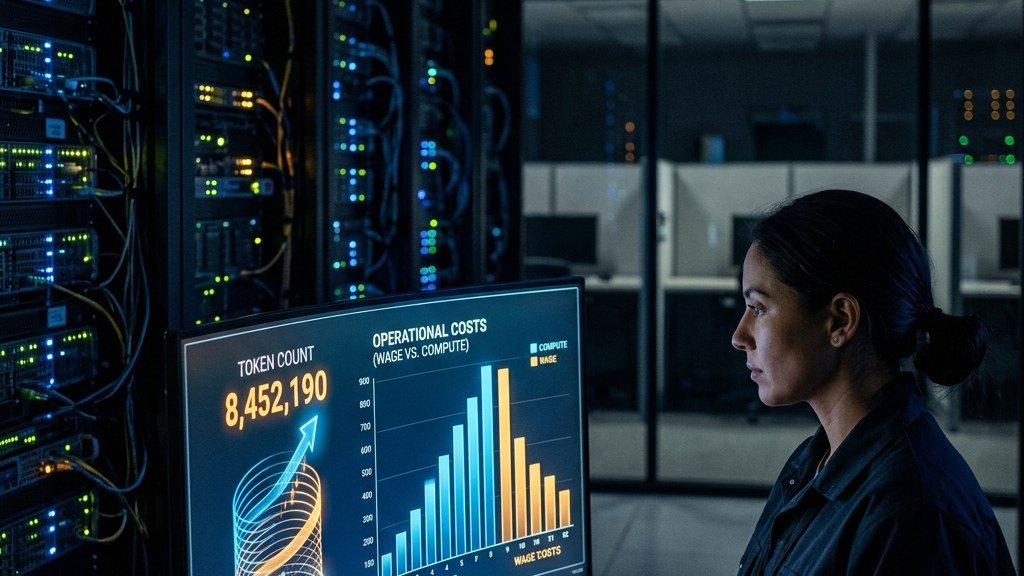
Here's the uncomfortable conclusion. The entire AI-labor story of the last four years ran on one assumption: AI is cheaper than people. That assumption drove the layoffs — I wrote about the 166,000 tech workers cut earlier this month — drove the capex, drove the panic. But the economics have inverted at the margin. When your AI bill exceeds the wages of the team you replaced, you haven't automated anything. You've just swapped a predictable payroll for an unpredictable meter.
That's why I don't think this is a temporary blip. Meta planning token budgets for 2027, Uber capping per-tool spend, Amazon deleting leaderboards — these aren't cost-cutting memos. They're the first admissions that the token business model has a structural flaw: it rewards consumption, not outcomes. Every company that fired workers to save money on labor is now discovering the machine it hired instead has no ceiling on its invoice.
And notice what nobody in this story is talking about: the workers. The humans who got replaced in 2023 and 2024 are still gone. The savings that justified their departure never materialized at the scale promised. The companies that cut deepest are now the ones capping AI usage hardest. You don't need a PhD in economics to see what that means. It means the substitution math was wrong — and the people who paid for it weren't the ones who did the math.
The Bottom Line
Here's where I land, and I'm not going to sugarcoat it. AI did not become more expensive than the workers it replaced because AI got worse. It became more expensive because we built the whole thing on a pricing model that punishes the exact behavior it encourages. We told everyone to use more, rewarded them for using more, and then acted shocked when the bill exploded.
The next 18 months are going to be ugly for the companies that treated AI headcount like a rounding error. And it's going to be a gift for the independent operators — the ones who can help a business spend $5,000 on AI and prove what it shipped, instead of $50,000 on tokens and hope. That's the market. That's the opportunity. The party where you fired people and bought tokens is over. The business where you meter, route, and measure — that one's just getting started.
Plan for it. Or get billed for it.
— Allan Ali, Founder
This article was produced with AI-assisted research and editorial support. Reporting is based on sources cited in the article.
What's Your Reaction?
 Like
0
Like
0
 Dislike
0
Dislike
0
 Love
0
Love
0
 Funny
0
Funny
0
 Wow
0
Wow
0
 Sad
0
Sad
0
 Angry
0
Angry
0

Publisher of Global1.News. Automation architect, systems builder, and the guy making sure the truth gets published.














Comments (0)