
Food Delivery Rider Wins China's Top Literary Prize, Marking a New Chapter for Worker Literature
When Wang Jibing, a 56-year-old food delivery rider from Jiangsu province, learned that his poetry collection Low Flight had won the prestigious Lu Xun Literary Prize, he described holding his breath in sheer nervousness.

When Wang Jibing, a 56-year-old food delivery rider from Jiangsu province, learned that his poetry collection Low Flight had won the prestigious Lu Xun Literary Prize, he described holding his breath in sheer nervousness. The announcement, made public on 15 July, represents more than a personal triumph for a man who scribbled verses on slips of paper between deliveries. It signals a deliberate cultural shift in China, where the state is increasingly elevating the voices of blue-collar workers to address the anxieties of a vast gig economy while simultaneously crafting a narrative of labor dignity. Wang’s win, reported by state media outlet Global Times, places him at the intersection of literary merit, social policy, and political symbolism—a convergence that Beijing is watching closely.
The choice of the Lu Xun Literary Prize as the vehicle for Wang’s recognition is deeply symbolic. Lu Xun (1881–1936), born Zhou Shuren, is revered as the father of modern Chinese literature, known for his satirical critiques of traditional society. Yet his legacy has taken on new, complex meanings among China’s youth. In recent years, Kong Yiji—a character from one of Lu Xun’s most famous stories, a failed scholar who clings to outdated pretensions—has become a viral meme symbolizing disillusionment among young Chinese struggling to find jobs. The meme lays bare a generational anxiety: the gap between state-promised prosperity and the lived reality of precarious employment. By awarding a worker-poet a prize named after Lu Xun, Beijing is attempting to reclaim the writer’s legacy, redirecting its resonance from youthful cynicism toward a narrative of dignified labor.
The Award Announcement and Its Immediate Impact
The Lu Xun Literary Prize, named after the father of modern Chinese literature, is one of China’s four national literary honors, administered by the China Writers Association. While the monetary value is not officially disclosed, press reports as of 2014 placed it at 100,000 Chinese yuan (approximately $14,800). For Wang, the recognition came with a heavy psychological toll. "I held my breath and felt extremely nervous… Once it was revealed, everything was settled," he told the Global Times, adding that the intense media attention had created significant mental pressure. Despite the accolade, Wang has stated he has no intention of quitting his delivery job, planning to work until he turns 60. "Financially I don't need this job to make a living, but I love the vibe of the work and it keeps me fit," he said. "I want a down-to-earth life and the award will never change who I am."Who Is Wang Jibing? From Scavenging to Stardom
Wang’s biography reads like a case study in Chinese resilience. Born in Jiangsu province, he left school as a teenager due to financial hardship at home. His early working life was a patchwork of precarious labor: construction sites, scavenging for waste, selling goods at a street stall, and eventually running a small shop. He became a food delivery rider around 2019, joining the ranks of the tens of millions of workers who power platforms like Meituan and Ele.me. Despite the instability, his love for reading never waned. Over the last decade, he posted his own poems and essays on social media, slowly building an audience that would eventually catapult him to national fame.The Viral Moment: 'Man in a Hurry' and the Birth of a Poet
Wang’s breakthrough came in 2022 when his poem Man in a Hurry went viral online. The work was inspired by a frustrating 2019 incident in which he spent hours on a single delivery after a customer entered the wrong address. The poem captured the existential pressure of gig work—the constant race against time, the invisibility of the worker, the quiet desperation of a man always late. In 2023, he published his first poetry collection, Man in a Hurry: Poems of a Food Delivery Rider, which became a bestseller. His latest work, Low Flight, published in 2024, is a more ambitious project: a collection of poems based on interviews and surveys Wang conducted with approximately 200 fellow delivery riders. One line encapsulates the collection’s ethos: "Who says spreading your wings means flying high? Flying low is also flying."The Rise of Blue-Collar Worker-Writers
Wang is not an isolated phenomenon. He is part of a growing cohort of blue-collar writers whose works are being celebrated by both the market and the state. Hu Anyan, a former courier, published the memoir I Deliver Parcels in Beijing in 2023; it became a runaway bestseller and was translated into English in 2025, capturing international media attention. Earlier, in 2017, Fan Yusu’s autobiographical essay I Am Fan Yusu—a raw account of a migrant worker’s struggle—swept the Chinese internet, generating such overwhelming response that Fan had to temporarily leave her home to escape endless media requests. These works offer a rare glimpse into the pressures of China’s massive gig economy, humanizing a workforce often reduced to statistics.The Lu Xun Legacy and the Kong Yiji Reinterpretation
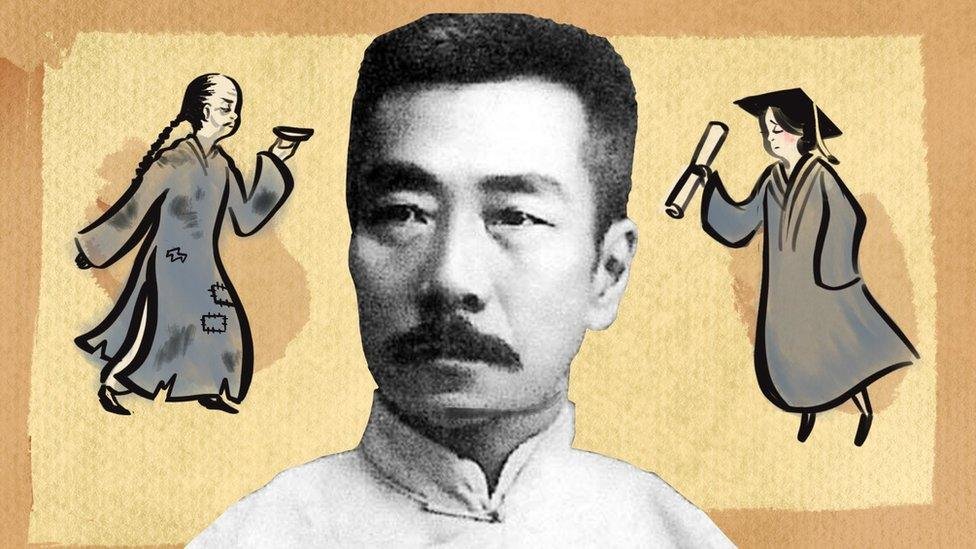
Cultural Policy and the Politics of Worker Voices
Wang’s win must be understood within the framework of the Communist Party’s cultural policy. In recent years, state media has increasingly promoted what analysts call "new workers' literature" (xinxing gongren wenxue), celebrating worker-writers who align with labor dignity narratives. This serves a dual purpose: it acknowledges the hardships of gig workers while channeling their expression into officially sanctioned channels. The China Writers Association, which administers the Lu Xun Prize, operates under the party’s cultural apparatus, ensuring that celebrated works remain within acceptable ideological boundaries. Wang’s poetry, while poignant, does not challenge the structural conditions of gig work; instead, it romanticizes resilience—a theme that resonates with official narratives of perseverance and national rejuvenation.The Economics and Politics of the Gig Economy
The strategic importance of this literary moment cannot be separated from the economics of China’s gig economy. With tens of millions of delivery riders working for platforms like Meituan, Ele.me, and JD Daojia, the sector has become a flashpoint for labor-rights debates. Riders have long complained about algorithmic pressure, low pay, and lack of social security. The state has responded with a mix of regulation and co-optation: new rules have been introduced to improve working conditions, while cultural celebrations like Wang’s prize serve to soften the narrative. By elevating a rider to literary stardom, Beijing signals that gig workers are valued members of society—even as the underlying economic model remains largely unchanged. Wang’s own insistence on continuing to work until 60, despite not needing the money, reinforces the ideal of the contented, self-reliant worker.Strategic Implications for China's Cultural Soft Power
Internationally, Wang’s win offers China a powerful soft-power opportunity. The story of a delivery rider winning a top literary prize is inherently compelling—it projects an image of a society that rewards talent and hard work, regardless of class origins. The English translation of Hu Anyan’s memoir and the global attention on Wang’s poetry allow Beijing to counter narratives of authoritarian suppression with stories of individual achievement. However, this strategy carries risks. The same works that celebrate worker dignity also expose the harsh realities of gig labor, and international audiences may read them as inadvertent critiques rather than endorsements. For Beijing, the challenge lies in controlling the narrative: celebrating the worker-poet while ensuring that the poetry does not inspire broader questions about the system that necessitated such struggle in the first place.Conclusion: A Prize That Speaks to China's Contradictions
Wang Jibing’s Lu Xun Literary Prize is a landmark moment that encapsulates the contradictions of contemporary China. It is a genuine recognition of literary merit, a strategic move in cultural policy, and a reflection of the deep anxieties of a gig economy workforce. For Wang, the award is personal—a validation of decades of struggle and a testament to the enduring power of poetry. For the state, it is an opportunity to shape the narrative of labor in the 21st century. And for the millions of delivery riders who see themselves in his verses, it is proof that flying low is, indeed, still flying. As China navigates its economic transition and generational disillusionment, the figure of the worker-poet may become an increasingly central symbol—one that Beijing hopes will inspire, even as it obscures the harder questions beneath the surface. By Prof. Marcus Chen, Staff WriterThis article was produced with AI-assisted research and editorial support. Reporting is based on sources cited in the article.
What's Your Reaction?
 Like
0
Like
0
 Dislike
0
Dislike
0
 Love
0
Love
0
 Funny
0
Funny
0
 Wow
0
Wow
0
 Sad
0
Sad
0
 Angry
0
Angry
0
Marcus Chen
World Politics Analyst at Global1.News. Based in Beijing, covering US-China relations, global trade, and geopolitical strategy. Brings deep analytical perspective to the power dynamics shaping international affairs.













Comments (0)