
After the Mecca Pact: Who Joins the Abraham Accords Next?
The Abraham Accords were once the crown jewel of Israeli foreign policy — a US-brokered breakthrough that normalized relations between Israel and four Arab and Muslim-majority states. Sudan's membership has been suspended since its 2023 civil war, but the framework survived wars, political upheavals, and diplomatic crises.
In a recent i24NEWS report, the Israeli international news channel posed a question that has defined Israeli diplomacy for half a decade: which country should be the next to join the US-brokered Abraham Accords? Six years after the White House lawn ceremony in September 2020 brought Israel together with the UAE, Bahrain, Morocco, and Sudan, the expansion agenda has been thrown into chaos by a new regional reality. The signing of the Mecca Joint Defence Agreement on August 7, 2026, by Saudi Crown Prince Mohammed bin Salman, Turkish President Recep Tayyip Erdogan, and Pakistani Prime Minister Shehbaz Sharif has fundamentally altered the calculus in Jerusalem, Riyadh, and Washington alike.
After the Mecca Pact: Who Joins the Abraham Accords Next?
Jerusalem, Israel – August 14, 2026 — The Abraham Accords were once the crown jewel of Israeli foreign policy — a US-brokered breakthrough that normalized relations between Israel and four Arab and Muslim-majority states. Sudan's membership has been suspended since its 2023 civil war, but the framework survived wars, political upheavals, and diplomatic crises. Now, with a new collective security pact explicitly modeled on NATO's Article 5 forming between three of the region's most consequential powers, Israeli officials and analysts are asking whether the Accords can still expand — and at what price.
The Expansion Agenda: Kazakhstan, Trump, and the "Who's Next" Game
Before the Mecca Pact upended the board, the Abraham Accords were quietly expanding. In early 2026, Kazakhstan became the first Central Asian country to join the framework, following its November 2025 announcement of intent. The move was significant for Jerusalem — Kazakhstan has maintained diplomatic relations with Israel since 1992, and its accession demonstrated that the Accords could reach beyond the Arab world into Muslim-majority states in Central Asia. For Israeli diplomats, it was proof that the normalization wave had not crested.
US President Donald Trump added fuel to the expansion fire in late May 2026, when he declared that any Iran deal should include a requirement for several additional Muslim-majority countries — including Saudi Arabia and Turkey — to join the Abraham Accords. Trump called the requirement "mandatory" and named Saudi Arabia, Qatar, and Pakistan as "beyond transformative" additions. The statement was vintage Trump: maximalist, transactional, and dismissive of the diplomatic complexities on the ground. But it signaled that Washington still viewed the Accords as the primary vehicle for reshaping Middle East alliances.
For Israel, the expansion question is not academic. In late July, Prime Minister Benjamin Netanyahu called Saudi Arabia joining the Accords a “historic leap forward” for Middle East peace — the latest Israeli endorsement of expanding regional normalization. Prediction markets have priced roughly 60-69% probability of a new country joining the Accords before 2027 — a bet that now looks increasingly uncertain given the Mecca Pact's gravitational pull.
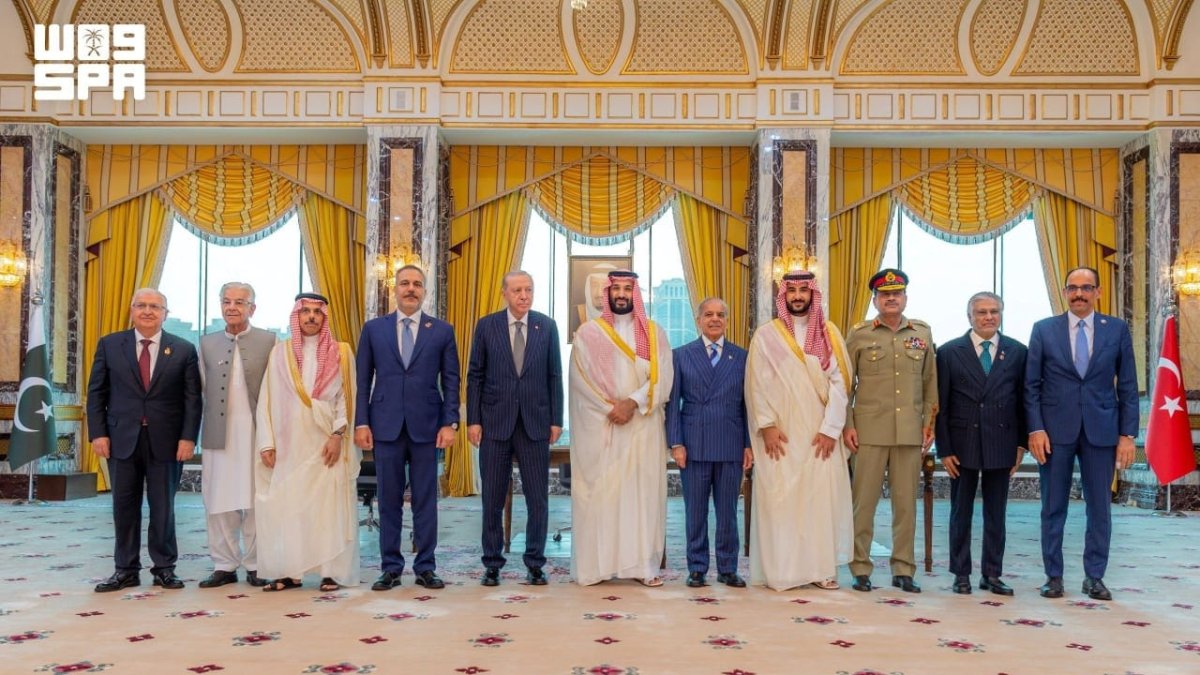
The Mecca Pact Shock: Article 5 in the Gulf
The August 7 signing in Mecca was a seismic event for Israeli defense planners. Saudi Crown Prince Mohammed bin Salman, Turkish President Recep Tayyip Erdogan, and Pakistani Prime Minister Shehbaz Sharif signed a collective security pact under which an armed attack on any one of the three is treated as an attack on all three — language that mirrors NATO's Article 5 almost verbatim. Turkish Foreign Minister Hakan Fidan confirmed the equivalence, stating that the arrangement is "technically equivalent" to NATO's collective-defense commitment and announcing that the alliance will establish a ministerial committee and a general secretariat based in Saudi Arabia.
Fidan went further, naming Egypt as a "natural next member" of the pact. Egypt's roughly 440,000 active personnel would make it a formidable addition to the alliance's military weight. The Turkish foreign minister's comments were carefully calibrated — he framed the pact as defensive, not offensive — but the message to Jerusalem was unmistakable: a new security architecture is forming in the region, and Israel is not part of it.
The Israeli security establishment's reaction was swift and sober, with analysts across the political spectrum in Jerusalem warning that the pact risks entrenching a bloc in which Israel is cast as the common enemy. The concern is not merely the pact's existence but its trajectory. A day after the signing, Pakistani Defense Minister Khawaja Asif called for "a united military front" against Israel, describing the Jewish state as "a threat to the entire Muslim world." Asif's rhetoric was the most explicit anti-Israel statement to emerge from the pact's founding, and it underscored the ideological currents running beneath the security architecture.

Why Saudi Arabia Pivoted: The Iran War and the Failing US Umbrella
The Mecca Pact did not emerge from a vacuum. Since February 28, 2026, Iran and Houthi forces have struck Saudi oil infrastructure, attacked Saudi cities, and disrupted Red Sea shipping. In March, Iran struck Prince Sultan Air Base with ballistic missiles targeting Riyadh province — a direct assault on a facility that has hosted US forces. The attacks were not abstract threats; they were concrete, repeated, and damaging. And critically, the US security umbrella had not prevented a single strike.
This failure is the backdrop against which the Mecca Pact must be understood. Kristian Coates Ulrichsen of Rice University's Baker Institute argues that the pact reflects more than a decade of regional doubt about US security guarantees. Riyadh watched Washington's withdrawal from Afghanistan, its hesitant responses to Gulf threats, and its inability to deter Iranian missile barrages — and drew its own conclusions. The Saudi calculus was not ideological but existential: if the United States cannot or will not protect Saudi cities and oil infrastructure, Riyadh must find alternative security arrangements.
Dr. Yoel Guzansky, head of Gulf Research at Israel's Institute for National Security Studies (INSS), offers a more nuanced reading. The pact, he says, "doesn't shut the door completely" on Saudi-Israel normalization but has "raised every price." Guzansky's assessment reflects the reality that Saudi Arabia has not abandoned the Abraham Accords track — it has simply made it more expensive. The Washington Institute's survey data underscores the challenge: 96% of Saudi respondents said Arab nations should cut ties with Israel. That figure now looks even more daunting for Israeli diplomats.
Sina Toossi of the Center for International Policy frames the pact in even broader terms, calling it "one of the first major geopolitical signs that the regional order is being reshaped by the US-Israeli war on Iran." Toossi's analysis points to a fundamental shift: the Iran conflict, which Israel and the United States have prosecuted militarily, has paradoxically driven the region's Sunni powers into a defensive alliance that excludes both Jerusalem and Washington.
The Candidates: Who Could Actually Be Next
Despite the Mecca Pact's shadow, the Abraham Accords expansion agenda is not dead. Several candidates remain on the table, each with distinct calculations and obstacles.
Saudi Arabia remains the prize — the largest Arab economy, custodian of Islam's holiest sites, and the linchpin of any comprehensive regional realignment. But Riyadh has consistently conditioned normalization on credible progress toward Palestinian statehood with East Jerusalem as its capital, a position Israel's current government has rejected. The Mecca Pact has only strengthened Saudi leverage; Crown Prince Mohammed bin Salman can now point to alternative security arrangements as a reason to demand more from Jerusalem.
Oman has long been the subject of quiet Israeli diplomacy. Jerusalem has hinted repeatedly that Muscat could be next to normalize, and Omani officials have maintained back-channel contacts with Israeli counterparts for years. Oman's strategic position on the Strait of Hormuz and its history of mediation between regional rivals make it an attractive candidate. But Oman has also been cautious, watching the regional turbulence before committing.
Qatar presents a more complex case. Trump named Doha as a potential Accords member, and Qatar hosts the largest US military base in the region at Al Udeid. But Qatar's relationship with Hamas and its independent foreign policy have kept it at arm's length from normalization. The Gulf state has profited from its role as a mediator and is unlikely to surrender that position lightly.
Indonesia, the world's largest Muslim-majority country, has taken gradual steps toward ties with Israel. Jakarta's diplomatic dance has been careful — incremental engagement without formal normalization — but the potential prize is enormous: a nation of nearly 280 million people and significant geopolitical weight in Southeast Asia.
Sudan offers a different kind of opportunity: restoration rather than expansion. Sudan's membership has been suspended since its 2023 civil war, but a return to stability could see Khartoum rejoin the Accords. The strategic value of Sudan — located on the Red Sea, with access to African markets — remains significant.
The Kazakhstan precedent matters here. If a Central Asian state with no historical ties to the Arab-Israeli conflict could join, the Accords' potential reach extends far beyond the Middle East. But Kazakhstan's accession also demonstrated the limits: it was a symbolic addition, not a strategic transformation.
Diplomatic and International Reactions: Washington's Silence Speaks Volumes
The Trump administration had offered no formal response to the Mecca Pact as of August 8 — a silence that analysts read as a signal of US strategic retreat in the region. For a president who has made the Abraham Accords a centerpiece of his Middle East policy, the absence of a public statement was telling. Washington's options are limited: it cannot condemn the pact without alienating Saudi Arabia, and it cannot endorse it without acknowledging the failure of its own security guarantees.
Trump's May demands linking the Iran deal to Accords expansion now look increasingly disconnected from regional realities. The president's insistence that Saudi Arabia, Qatar, and Pakistan join the Accords as part of any Iran agreement assumes a level of US leverage that the Mecca Pact has directly challenged. European and Gulf views are similarly complicated. The EU has maintained its traditional position that normalization should not come at the expense of the Palestinian track, while Gulf states are watching to see whether the Mecca Pact becomes a genuine military alliance or a symbolic gesture.
The UN and EU have issued statements on normalization and the Palestinian track, but these have been largely formulaic. The real diplomatic action is happening in bilateral channels — between Riyadh and Ankara, between Islamabad and Tehran, and between Jerusalem and its remaining partners in the Accords framework.
Analysis: What This Means for Israel
The Mecca Pact represents a fundamental challenge to Israeli strategic assumptions. For years, Jerusalem operated on the belief that normalization with Arab and Muslim states was a one-way ratchet — that the Abraham Accords would continue to expand, isolating Iran and building a regional coalition against common threats. The pact upends that logic. It offers Saudi Arabia, Turkey, and Pakistan a security framework that does not require Israeli participation, and it does so at a moment when Israel's military campaign against Iran has made it a polarizing figure in the region.
The security-versus-diplomacy tradeoff is now stark. Israel's war against Iran has achieved tactical objectives — degrading Iranian missile capabilities and disrupting its nuclear program — but it has also driven the region's Sunni powers into a defensive alliance that excludes Jerusalem. The question for Israeli policymakers is whether continued military pressure on Iran serves or undermines the normalization agenda.
Can Jerusalem offer anything that the Mecca Pact now provides Riyadh? The answer is complicated. Israel can offer advanced military technology, intelligence cooperation, and a shared threat perception regarding Iran. But it cannot offer what the Mecca Pact provides: a collective security guarantee from a Muslim-majority alliance that does not require domestic political costs. For Saudi Arabia, the choice is not between Israel and the pact — it is between a relationship that demands domestic political sacrifice and one that provides security without it.
The coming months will test whether the Abraham Accords can survive the new regional order. The 60-69% probability that prediction markets assign to a new country joining before 2027 now looks optimistic. But the Accords have surprised skeptics before. The question is whether Jerusalem can adapt its strategy to a region where security guarantees are no longer the exclusive province of Washington — and where the price of normalization has risen dramatically.
For Israeli and Middle East readers, the takeaway is clear: the regional order is being reshaped, and the Abraham Accords are no longer the only game in town. The Mecca Pact has raised the stakes, and Jerusalem must decide whether to compete on security terms it cannot match or to find new diplomatic avenues that address the region's underlying concerns. The next chapter of Middle East diplomacy will be written not in Washington or Jerusalem, but in the corridors of Riyadh, Ankara, and Islamabad — and Israel's ability to influence that narrative will determine whether the Accords remain a living framework or become a historical footnote.
By Hannah Berg, Staff Writer
This article was produced with AI-assisted research and editorial support. Reporting is based on sources cited in the article.
What's Your Reaction?
 Like
0
Like
0
 Dislike
0
Dislike
0
 Love
0
Love
0
 Funny
0
Funny
0
 Wow
0
Wow
0
 Sad
0
Sad
0
 Angry
0
Angry
0
Israel Correspondent at Global1.News. Based in Tel Aviv, covering Israeli politics, security, technology, and society. Provides balanced, deeply-sourced reporting on one of the most closely-watched regions in the world.











Comments (0)