
Yabloko Barred in Fifth Region as Federal Ban Tightens Grip Ahead of September Elections
The Sverdlovsk Regional Court has disqualified Yabloko's candidate list from the upcoming regional assembly elections, the fifth Russian region to bar the liberal party. The ruling follows the Supreme Court's rejection of Yabloko's appeal against a nationwide ban from the State Duma ballot.
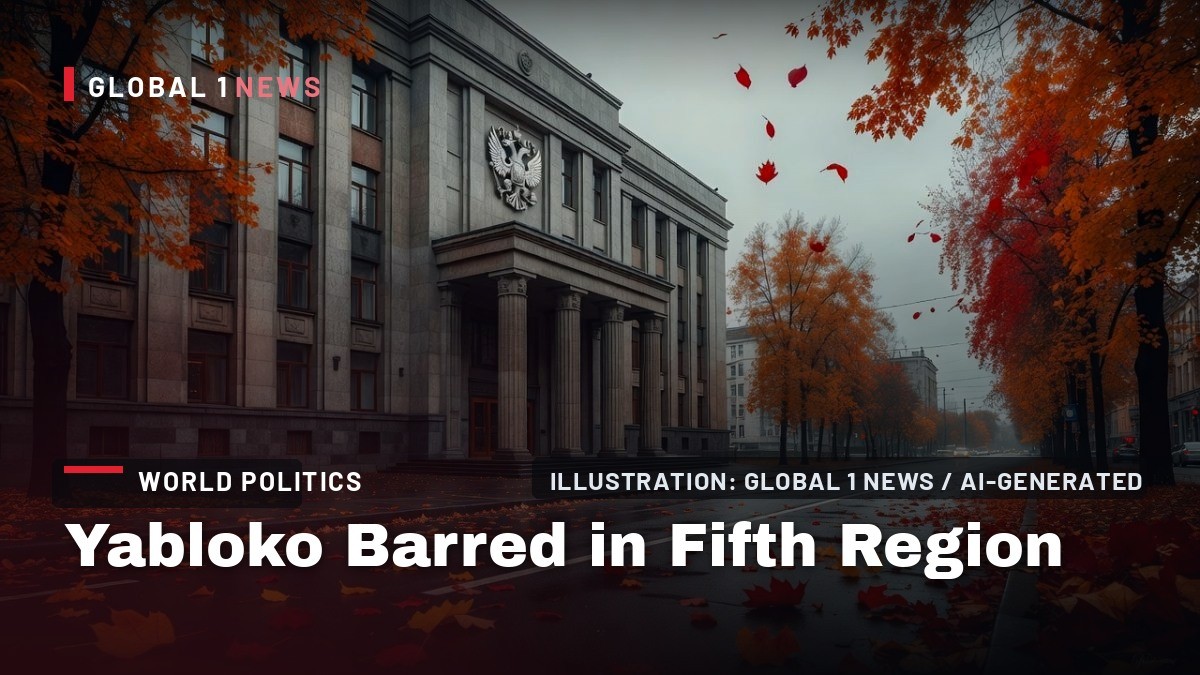
The Sverdlovsk Regional Court has disqualified the liberal Yabloko party's candidate list from the upcoming regional assembly elections, marking the fifth region where the party has been barred from the September ballot. The ruling, issued Friday in favor of a lawsuit filed by the nationalist Liberal Democratic Party (LDPR), follows last week's decision by Russia's Supreme Court to reject Yabloko's final appeal against a nationwide ban from the State Duma elections.
SVERDLOVSK REGION, Russia — Yabloko's regional election campaign has been dealt another blow as a local court disqualified the party's candidate list, deepening the political isolation of Russia's oldest liberal party ahead of the September 20 single election day.
Yekaterinburg, August 28 — A judge in the Sverdlovsk region ruled Friday to bar Yabloko's list of candidates from the regional assembly elections, the court confirmed. The decision came in response to a lawsuit filed by LDPR, which accused Yabloko of a series of violations that mirror those cited in the Supreme Court's nationwide ban.
The LDPR Lawsuit and Its Accusations
LDPR's legal challenge against Yabloko's Sverdlovsk regional list centered on three main allegations: copyright infringement, overspending of campaign funds, and the sharing of content on banned platforms including Instagram and Facebook, both of which are designated as extremist organizations in Russia. The nationalist party, led in the region by its local structures, argued that these violations disqualified Yabloko from participating in the regional assembly race.
The lawsuit's timing is notable. It was filed and adjudicated within days of the Supreme Court's ruling against Yabloko's federal list, suggesting a coordinated legal pressure campaign across multiple regions. LDPR, a party that has positioned itself as a loyal opposition force within Russia's managed political system, has emerged as a frequent litigant against Yabloko in regional courts.
Yabloko's Response in Court
Konstantin Kiselyov, who leads Yabloko's Sverdlovsk region candidate list, mounted a vigorous defense in court, arguing that the accusations leveled against his party could apply equally to every other political force in the race. "Each party and their leaders are on these banned social networks. I come across official state agencies there, and they can't live without them," Kommersant quoted Kiselyov as saying during the hearing.
Kiselyov's argument highlights a fundamental contradiction in Russian election law enforcement: while platforms like Instagram and Facebook are officially banned, state institutions and pro-Kremlin politicians continue to maintain active presences on them. The selective application of these restrictions, Yabloko argues, reveals the true purpose of the legal challenges — not electoral integrity, but political exclusion.
Yaroslav Shcherbakov, another Yabloko member in the Sverdlovsk region, went further, accusing LDPR of openly calling for the elimination of its political competitor. Yabloko's Yekaterinburg branch has announced it will appeal the ruling, though the party's legal options are narrowing rapidly.
The Broader Pattern of Regional Bans
The Sverdlovsk ruling is not an isolated incident. Yabloko has now been barred from regional assembly races in five Russian regions, either through court rulings or rejections by local election commissions. This coordinated pattern suggests a deliberate strategy to exclude the party from all levels of electoral politics ahead of the September elections.
The regions where Yabloko has been disqualified span different parts of the country, indicating that the legal challenges are not driven by local political dynamics but rather by a centrally coordinated effort. In each case, the lawsuits have been filed by rival parties — primarily LDPR and Rodina — using similar legal arguments and citing similar alleged violations.
This regional campaign mirrors the federal-level assault on Yabloko. In August, Russia's Supreme Court barred Yabloko from running in the State Duma election following a lawsuit by the Rodina party. The court accepted Rodina's arguments that Yabloko had committed violations including copyright infringement and the use of banned social media platforms.
The Federal Ban and Supreme Court Appeal
Last week's Supreme Court ruling to reject Yabloko's final appeal against the nationwide ban effectively ended the party's hopes of participating in the State Duma elections scheduled for September 18-20. The court's decision means Yabloko will not appear on the federal ballot, leaving voters without a party that openly opposes the war in Ukraine.
Yabloko is widely described as the only party in Russia that has taken an explicit anti-war stance. The party planned to run under an anti-war slogan in the 2026 legislative election, a position that made it a target for legal challenges from pro-Kremlin parties. The Supreme Court's ruling, combined with the regional bans, effectively removes the anti-war voice from Russia's electoral landscape.
The party's leadership, including its longtime figurehead Grigory Yavlinsky, has condemned the rulings as politically motivated. Yavlinsky, who founded Yabloko in the 1990s and led it for decades, has argued that the legal challenges are designed to eliminate the last remaining opposition force from Russia's managed democracy.
The Registration-Risk Analysis
Beyond the immediate electoral impact, the regional bans pose an existential threat to Yabloko's legal status. According to exiled journalist Farida Rustamova, Yabloko faces the risk of being stripped of its official registration due to legal requirements to field candidates in at least 20% of regional assembly elections or 10% of gubernatorial races every seven years.
This regulatory mechanism, ostensibly designed to ensure parties maintain active political engagement, has become a powerful tool for political exclusion. If Yabloko cannot field candidates in enough regions, it could lose its status as a registered political party, making it even harder to contest future elections or even to operate legally.
The seven-year window is critical. Yabloko must demonstrate electoral participation across a significant portion of Russia's regions to maintain its registration. With five regions already barring the party's lists, and more potentially following suit, the party's ability to meet these thresholds is in serious jeopardy.
What This Means for the September Elections
The September 20 single election day will feature State Duma legislative elections for the 9th convocation, with 450 seats at stake, alongside 11 gubernatorial elections and 39 regional parliamentary elections. Yabloko's exclusion from both the federal and multiple regional ballots significantly narrows the choices available to Russian voters.
For ordinary Russians, the practical effect is a ballot dominated by parties loyal to the Kremlin: United Russia, LDPR, Rodina, and other systemically integrated political forces. The absence of Yabloko removes the most prominent anti-war voice from the electoral process, leaving voters who oppose the war with no meaningful electoral option.
The regional bans also affect the composition of local legislatures. In the Sverdlovsk region, voters will elect a new regional assembly without the possibility of voting for Yabloko's candidates, including Kiselyov and other prominent local figures. This shapes not only the immediate election outcome but also the long-term political landscape of the region.
Analysis and Implications
The coordinated legal assault on Yabloko signals a significant consolidation of Russia's managed democracy. By using courts and election commissions to exclude the last credible opposition party, the Kremlin is reducing electoral politics to a controlled competition among system-loyal parties. This could indicate a shift toward a more openly authoritarian model, where even the appearance of electoral competition is increasingly managed.
Analysts suggest this pattern reflects the Kremlin's assessment that allowing Yabloko to participate — particularly with an anti-war platform — poses unacceptable risks during a period of ongoing military conflict. The war in Ukraine has made political opposition more dangerous to the authorities, and the legal system has been mobilized to prevent anti-war sentiment from finding electoral expression.
The implications extend beyond Yabloko itself. The precedent set by these rulings — that parties can be disqualified for using banned social media platforms or for minor campaign finance discrepancies — could be applied to any political force that steps out of line. This creates a chilling effect on political activity across the spectrum, as parties must navigate an increasingly restrictive legal environment.
For Yabloko, the path forward is uncertain. The party has announced it will appeal the Sverdlovsk ruling, but given the Supreme Court's recent decision, the prospects for success appear limited. The party's longer-term survival depends on its ability to meet the registration requirements, which now seem increasingly difficult to achieve.
The broader picture is one of narrowing political space in Russia. As the September elections approach, the ballot will offer voters a choice among parties that share a fundamental consensus on the war and on the basic parameters of Russia's political system. The exclusion of Yabloko removes the most visible alternative to that consensus, raising questions about the legitimacy and meaning of the electoral process itself.
By Irina Volkov, Staff Writer
This article was produced with AI-assisted research and editorial support. Sources: The Moscow Times, Kommersant, RFE/RL, Wikipedia.
What's Your Reaction?
 Like
0
Like
0
 Dislike
0
Dislike
0
 Love
0
Love
0
 Funny
0
Funny
0
 Wow
0
Wow
0
 Sad
0
Sad
0
 Angry
0
Angry
0
Russia/Eastern Europe Correspondent at Global1.News. Covering Russian politics, energy, security, and the shifting dynamics of the post-Soviet space. Provides clear-eyed analysis on one of the world's most opaque regions.











Comments (0)