
US Democratic senators urge Israel to halt settlement plan in occupied West Bank
In a significant escalation of congressional pressure on Israel, a group of 29 Democratic senators has formally urged Prime Minister Benjamin Netanyahu to cancel a planned settlement project in the occupied West Bank, warning that the development would effectively sever the Palestinian territory and
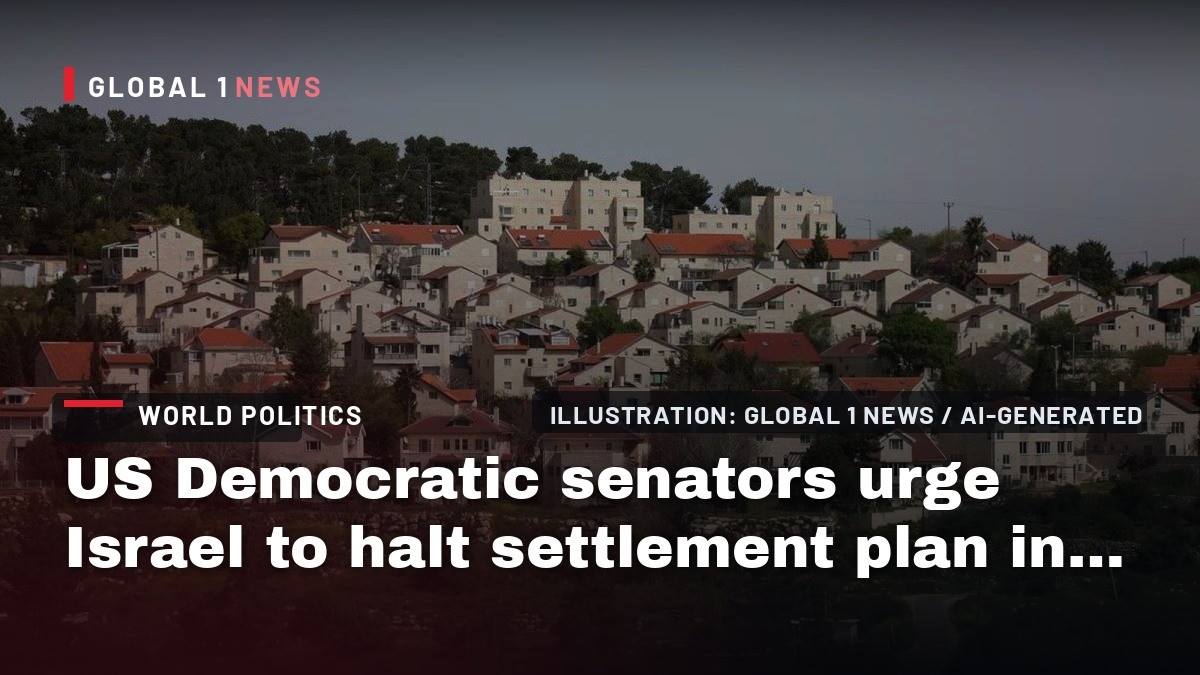
In a significant escalation of congressional pressure on Israel, a group of 29 Democratic senators has formally urged Prime Minister Benjamin Netanyahu to cancel a planned settlement project in the occupied West Bank, warning that the development would effectively sever the Palestinian territory and undermine any prospect of a two-state solution. The letter, led by Arizona Democratic Sen. Ruben Gallego and reported by The Hill, directly challenges Israel's recent decision to open bidding for construction in the E1 area east of Jerusalem, a region long considered a critical linchpin for Palestinian territorial contiguity.
The senators' intervention comes at a moment of heightened tension in the occupied territories, where settlement expansion and reported settler violence against Palestinian communities have drawn increasing international condemnation. The E1 project, which has been stalled for decades amid regional and international opposition, represents one of the most sensitive flashpoints in the Israeli-Palestinian conflict, with its potential to bisect the West Bank and isolate occupied East Jerusalem from its Palestinian hinterland.
Senators Demand Rescission of E1 Tenders
The Democratic lawmakers' statement, released Friday, explicitly calls on the Israeli government to "immediately rescind these tenders, halt settlement expansion in the West Bank, and take urgent action to rein in settler violence." The letter frames the E1 construction as a direct threat to the viability of a future Palestinian state, arguing that "construction in E1 would take us further away from that goal."
The senators emphasized the bipartisan historical consensus on this issue, noting that "for decades, Republican and Democratic administrations have recognized that development in E1 would seriously jeopardize the prospects for a Palestinian state." They added that "that concern remains just as urgent today," signaling that the current administration's stance has not diminished congressional anxiety over the project's implications.
Project Details: 1,234 Housing Units in Seven Compounds
According to the senators' letter, the proposed development includes seven residential compounds totaling 1,234 housing units. Israel's Construction and Housing Ministry opened bidding on Aug. 18, with a deadline of Oct. 19, a timeline that suggests the project could move forward rapidly if tenders are awarded. The scale of the construction would represent a major physical footprint in the E1 corridor, an area that has been deliberately kept undeveloped for decades precisely because of its strategic significance.
The E1 area, located between the Israeli settlement of Ma'ale Adumim and occupied East Jerusalem, has long been identified by Palestinian and international observers as a critical zone. Development there would effectively close the last remaining land corridor connecting the northern and southern parts of the West Bank, further fragmenting an already geographically disjointed Palestinian territory.
Isolation of East Jerusalem from Palestinian Population Centers
The senators specifically warned that the development could further isolate occupied East Jerusalem from Palestinian population centers such as Bethlehem and Ramallah. This geographic reality has profound implications for Palestinian daily life, affecting everything from access to healthcare and education to family visits and economic activity. For Palestinians in the West Bank, East Jerusalem is not merely a symbolic capital but a vital urban center where many work, study, and receive medical treatment.
The physical separation that E1 construction would create threatens to transform the West Bank into a series of isolated enclaves, undermining the social and economic fabric that binds Palestinian communities together. Human rights organizations have repeatedly documented how settlement infrastructure, including bypass roads and checkpoints, has already fragmented Palestinian movement, and the E1 project would represent a qualitative escalation of this fragmentation.
Historical Background: Decades of Stalled Development
The E1 project has a long and contentious history, having been repeatedly postponed in the face of international pressure. Successive Israeli governments have floated plans for development in the area since the 1990s, but each attempt has been met with fierce opposition from the international community, including the United States. The project's sensitivity stems from its location, which would complete a ring of Israeli settlements around East Jerusalem and effectively cut off the northern West Bank from the southern West Bank.
Previous American administrations, both Republican and Democratic, have consistently opposed E1 construction, viewing it as a red line that would make a contiguous Palestinian state nearly impossible to achieve. The current senators' letter draws explicitly on this legacy, noting that the concern about E1's impact "remains just as urgent today" as it was when earlier administrations raised objections.
Settler Violence and Congressional Action
The letter on E1 construction was accompanied by a separate statement referencing a broader letter signed by 44 Democratic senators and independent Sen. Angus King, which called for action over reported violence by Israeli occupiers against Palestinians in the occupied West Bank. This dual-track approach reflects growing congressional concern about the overall trajectory of Israeli policy in the occupied territories, encompassing both settlement expansion and the security situation for Palestinian communities.
The senators' warning that failure to change course risked weakening Israel's international standing speaks to a broader shift in how Israel's actions in the occupied territories are being perceived globally. As settlement expansion continues and violence against Palestinians persists, the senators argue, Israel's position in the international community becomes increasingly precarious, potentially undermining the very security that the two-state solution is meant to guarantee.
Human Impact: Palestinian Communities Under Pressure
For Palestinians living in the West Bank, the E1 project represents more than a political abstraction. The proposed construction would directly affect communities in Bethlehem and Ramallah, cities that serve as economic and cultural hubs for the Palestinian population. The isolation of East Jerusalem would sever thousands of Palestinians from their places of work, worship, and family connections, compounding the difficulties already imposed by the occupation.
Local Palestinian residents have long expressed anxiety about the cumulative impact of settlement expansion on their daily lives. The physical barriers created by settlements and their associated infrastructure have made it increasingly difficult for Palestinians to move freely within their own territory, access their agricultural lands, or maintain social and economic ties across the West Bank. The E1 project would add another layer to this already burdensome reality.
International Law and the Two-State Solution
The senators' letter implicitly invokes the framework of international law, which regards Israeli settlements in the occupied West Bank, including East Jerusalem, as illegal under the Fourth Geneva Convention. The two-state solution, which the senators explicitly endorse, requires a viable and contiguous Palestinian state alongside Israel, a vision that E1 construction would directly contradict.
The United States has historically played a mediating role in the Israeli-Palestinian conflict, and the senators' intervention suggests that some members of Congress are seeking to reassert that role in the face of what they view as provocative Israeli actions. Whether the Israeli government will heed the senators' call remains uncertain, but the letter represents a notable moment of congressional assertiveness on an issue that has often been treated with caution in Washington.
As the Oct. 19 bidding deadline approaches, the international community will be watching closely to see whether Israel proceeds with the E1 project or responds to the mounting pressure to halt it. The senators' letter adds to a growing chorus of voices, including from within the United States, urging restraint and a return to the path of negotiation and mutual recognition.
By Fatima Al-Rashid, Staff Writer
This article was produced with AI-assisted research and editorial support. Sources: Middle East Monitor, Anadolu Agency, The Hill.
What's Your Reaction?
 Like
0
Like
0
 Dislike
0
Dislike
0
 Love
0
Love
0
 Funny
0
Funny
0
 Wow
0
Wow
0
 Sad
0
Sad
0
 Angry
0
Angry
0

Gulf/MENA Correspondent at Global1.News. Based in Doha, covering Gulf politics, energy markets, diplomacy, and development across the Middle East and North Africa. Tracks the economic transformation of the Gulf states.












Comments (0)