
US-Backed Board of Peace 'Failing' Gaza, Aid Chief Tells UN
In a recent Middle East Eye report, the head of a coalition of international aid agencies delivered a stark indictment of the US-backed Board of Peace before the UN Security Council, describing its work in Gaza as "failing" and accusing it of entrenching Israel's unlawful presence in the territory.
In a recent Middle East Eye report, the head of a coalition of international aid agencies delivered a stark indictment of the US-backed Board of Peace before the UN Security Council, describing its work in Gaza as "failing" and accusing it of entrenching Israel's unlawful presence in the territory. Athena Rayburn, executive director of the Association of International Development Agencies (AIDA), told the council that the body created to stabilise the enclave has instead become a mechanism for violating the most fundamental rights of Palestinians.
US-Backed Board of Peace Accused of 'Failing' Gaza as Aid Blocked and Death Toll Mounts
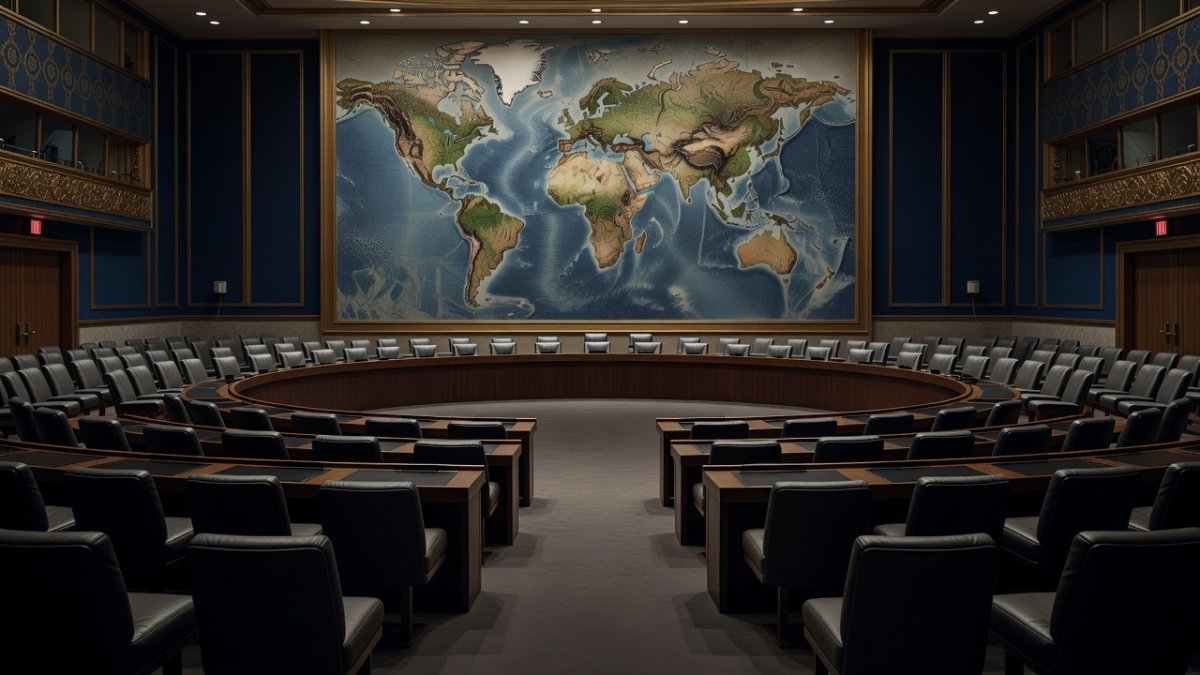
New York, United States – 27 August 2026 — The United Nations Security Council heard this week that the Board of Peace, established by US President Donald Trump and mandated by the council in November 2025, has "functioned to further entrench Israel's unlawful presence" in Gaza. The testimony from Athena Rayburn, executive director of AIDA — a coalition of international aid groups — came as the enclave marked nearly a year under a ceasefire that has failed to bring relief to its two million residents.
A Direct Challenge to the Council's Mandate
Rayburn's address to the Security Council was unambiguous in its criticism of the Board of Peace, a body that was meant to oversee the implementation of the ceasefire and coordinate reconstruction efforts. Instead, she argued, it has become complicit in Israel's ongoing obstruction of humanitarian assistance. "What is unclear is why the mandate handed by this council to the Board of Peace is being used to violate the most fundamental rights of the Palestinians in Gaza and the most basic rules of humanitarian law," Rayburn said. "This cannot be the new status quo."
The remarks mark one of the most direct public condemnations of the Board of Peace by a major aid coalition since its inception. AIDA represents dozens of international and local NGOs operating across the occupied Palestinian territory, and its leadership rarely speaks in such stark terms before the Security Council. The fact that Rayburn chose this forum to issue her warning underscores the depth of frustration among humanitarian actors who say they are being systematically prevented from doing their work.
What Is the Board of Peace?
The Board of Peace was established by Trump and given a formal mandate by the UN Security Council in November 2025, following months of intense diplomatic pressure to create a mechanism that could oversee the fragile ceasefire between Israel and Hamas. Its creation was hailed at the time as a breakthrough — a US-led initiative that would bring together international stakeholders to manage the transition from war to reconstruction in Gaza.
But nearly a year on, critics say the Board has become a vehicle for legitimising Israel's military control over the enclave. Israel now controls more than 60 percent of Gaza, and Prime Minister Benjamin Netanyahu said earlier this month that the aim is to increase that to around 70 percent. The Board of Peace has linked any Israeli withdrawal beyond the Yellow Line — the de facto boundary dividing areas under Israeli and Palestinian control — to the complete disarmament of Hamas. Palestinians, for their part, reject any discussion of Hamas disarmament before a full Israeli withdrawal from the territory.
This circular logic, aid workers say, has created a political deadlock that serves Israel's territorial ambitions while leaving Palestinians in a state of perpetual limbo. The Board, rather than pushing for a resolution, has effectively endorsed the status quo by conditioning any movement on terms that Palestinians have repeatedly rejected.
The Absurdity of the Aid Blockade
Rayburn detailed a litany of Israeli restrictions on humanitarian goods that she said were being enabled by the Board of Peace's failure to intervene. Among the most egregious examples: Israel is rejecting scissors, crutches, wheelchairs and prosthetic limbs as "dual-use" instruments — items that could theoretically have military applications but are essential for daily civilian life in a territory where tens of thousands have been maimed by more than two years of war.
Specialised medical staff have been barred from entering Gaza, leaving hospitals to operate with severely depleted teams. Restrictions on engine oil have been so severe that its price has skyrocketed to 45 times its normal cost, crippling the operation of water pumps, ambulances, and generators that hospitals depend on for power. In what Rayburn described as a particularly inexplicable decision, Israel has also rejected shipments of watermelon and onions under an unpublished "humanitarian policy" that aid groups say appears designed to maximise suffering rather than address any genuine security concern.
The Human Toll in Gaza
The numbers behind Rayburn's testimony are staggering. At least 1,303 Palestinians have been killed in Gaza since the supposed ceasefire began in October 2025 — a figure that demonstrates the extent to which the cessation of hostilities has failed to translate into safety for civilians. The total death toll since the start of the war in October 2023 now stands at 73,438, according to figures cited in the Security Council session.
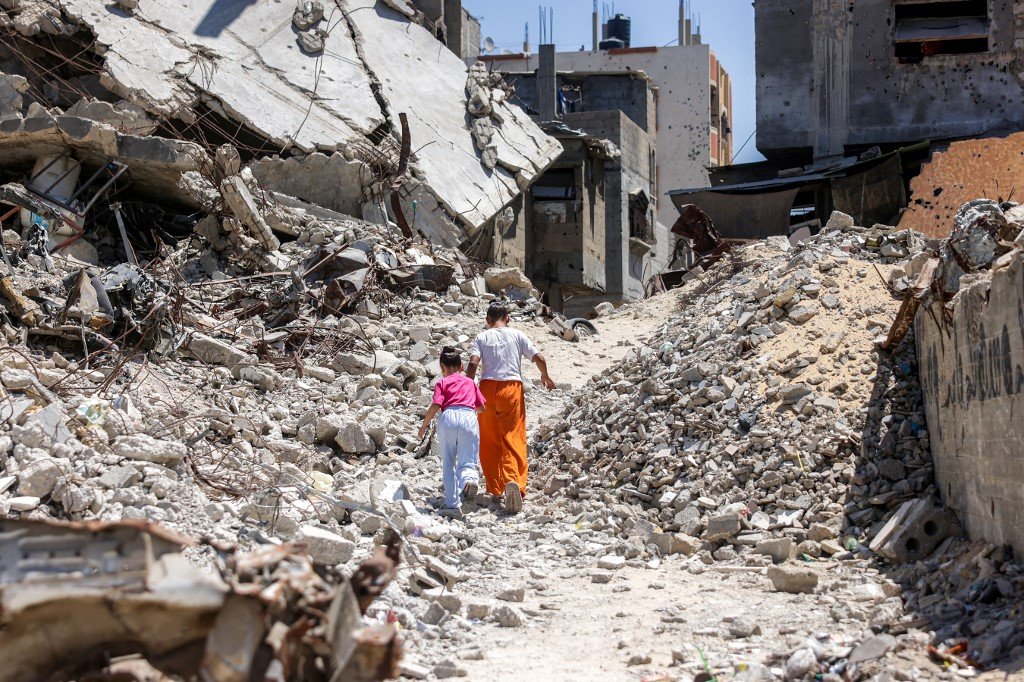
The image accompanying this report shows two girls walking amid the rubble in Khan Younis in southern Gaza on 25 August 2026 — a scene that has become emblematic of daily life in the enclave. Entire neighbourhoods remain flattened, with reconstruction yet to begin in any meaningful way. The International Stabilisation Force, which was supposed to deploy to Gaza to oversee security arrangements, has yet to arrive, leaving a vacuum that has been filled by continued Israeli military operations and Hamas's residual presence.
For the children of Gaza, the ceasefire has meant little more than a change in the nature of the threat. Instead of bombs falling from the sky, they now face malnutrition, untreated injuries, and the psychological trauma of living in a landscape of ruins. Aid groups say children are among the hardest hit by the restrictions, with essential items such as wheelchairs and prosthetic limbs blocked from entry alongside the medical staff needed to treat the wounded.
A Ceasefire on the Brink of Collapse
The UN's high representative for Gaza, Nickolay Mladenov, delivered an even more dire warning to the Security Council, cautioning that the region is approaching a "point of no return" if the ceasefire collapses. "There will be no roadmap to return to, there will be no administration to deploy, and there will be nothing left on the ground to rebuild," Mladenov said. "That would not be a setback. It would be a point of no return for everyone."
Mladenov's warning was coupled with a pointed reminder that Hamas has not fully met its commitments under the roadmap agreed on 30 July. "Hamas has committed to cease all military activities. That commitment is still to be met in full," he said. "Every weapon carried, every tunnel still worked on, and every convoy still obstructed sets the process back and hands an argument to those who want to resume war."
The roadmap agreed by Hamas on 30 July stated that the decommissioning of weapons would be supervised by the International Stabilisation Force, which has yet to deploy. This has created a chicken-and-egg problem: Israel refuses to withdraw without disarmament, Hamas refuses to disarm without withdrawal, and the force that was supposed to bridge this gap has not materialised. The Board of Peace, which was meant to resolve this impasse, has instead become another party to it.
Analysis: A Mechanism for Entrenchment, Not Peace
The testimony from Rayburn and Mladenov paints a picture of a peace process that has been hollowed out by political expediency. The Board of Peace, rather than acting as an honest broker, has aligned itself with Israeli positions on the key issues of withdrawal and disarmament. By conditioning any Israeli pullback on Hamas's complete disarmament — a demand that Palestinians view as a precondition for surrender rather than a step toward peace — the Board has effectively endorsed Israel's territorial expansion.
Netanyahu's stated goal of expanding Israeli control to 70 percent of Gaza suggests that the current trajectory is not toward Palestinian self-determination but toward permanent Israeli annexation of large parts of the enclave. The Board's mandate, as interpreted by its US backers, appears to be facilitating this outcome rather than preventing it.
For Palestinians on the ground, the implications are devastating. The ceasefire has not brought an end to killing, the blockade has not been lifted, and the political process has not produced a credible path toward a Palestinian state. Instead, they are being asked to accept a future in which their territory is carved up, their movement is restricted, and their basic needs are subject to the whims of an unpublished "humanitarian policy" that rejects onions and watermelons while allowing the machinery of occupation to expand.
What Comes Next
As the Security Council digests Rayburn's testimony, the question on everyone's mind is whether the Board of Peace can be reformed or whether it must be replaced. Aid groups are calling for the Board's mandate to be re-examined, arguing that a body that has "functioned to further entrench Israel's unlawful presence" cannot be trusted to oversee a just peace. But with the United States holding veto power in the Security Council, any attempt to restructure the Board is likely to face insurmountable political obstacles.
In the meantime, the people of Gaza continue to endure. The girls walking through the rubble of Khan Younis are not statistics — they are the human cost of a political process that has failed them at every turn. The scissors, crutches, wheelchairs, and prosthetic limbs that Israel rejects as "dual-use" are not abstract policy debates; they are the difference between a child being able to walk and being confined to a bed for the rest of her life.
The Board of Peace was supposed to bring peace. Instead, it has become another instrument of a war that has already claimed more than 73,000 Palestinian lives. If the international community cannot find the will to hold it accountable, the "point of no return" that Mladenov warned about may not be a warning — it may be a description of where Gaza already is.
By Fatima Al-Rashid, Staff Writer
This article was produced with AI-assisted research and editorial support. Sources: Middle East Eye, United Nations Security Council, AFP.
What's Your Reaction?
 Like
0
Like
0
 Dislike
0
Dislike
0
 Love
0
Love
0
 Funny
0
Funny
0
 Wow
0
Wow
0
 Sad
0
Sad
0
 Angry
0
Angry
0

Gulf/MENA Correspondent at Global1.News. Based in Doha, covering Gulf politics, energy markets, diplomacy, and development across the Middle East and North Africa. Tracks the economic transformation of the Gulf states.













Comments (0)