
UK Wildfires: Six Homes Destroyed in Stourbridge Heatwave
Folks, let me tell you something. We have been talking about this all summer. We have been warning about it. We have been watching the grass turn to straw and the reservoirs turn to dust. And now, right here in the heart of England, it has come knocking on people's front doors. This is not a drill. This is not a "just a bit of heathland burning." This is homes gone. This is families displaced. This is the reality of a summer that refuses to let up.
Folks, let me tell you something. We have been talking about this all summer. We have been warning about it. We have been watching the grass turn to straw and the reservoirs turn to dust. And now, right here in the heart of England, it has come knocking on people's front doors. This is not a drill. This is not a "just a bit of heathland burning." This is homes gone. This is families displaced. This is the reality of a summer that refuses to let up.
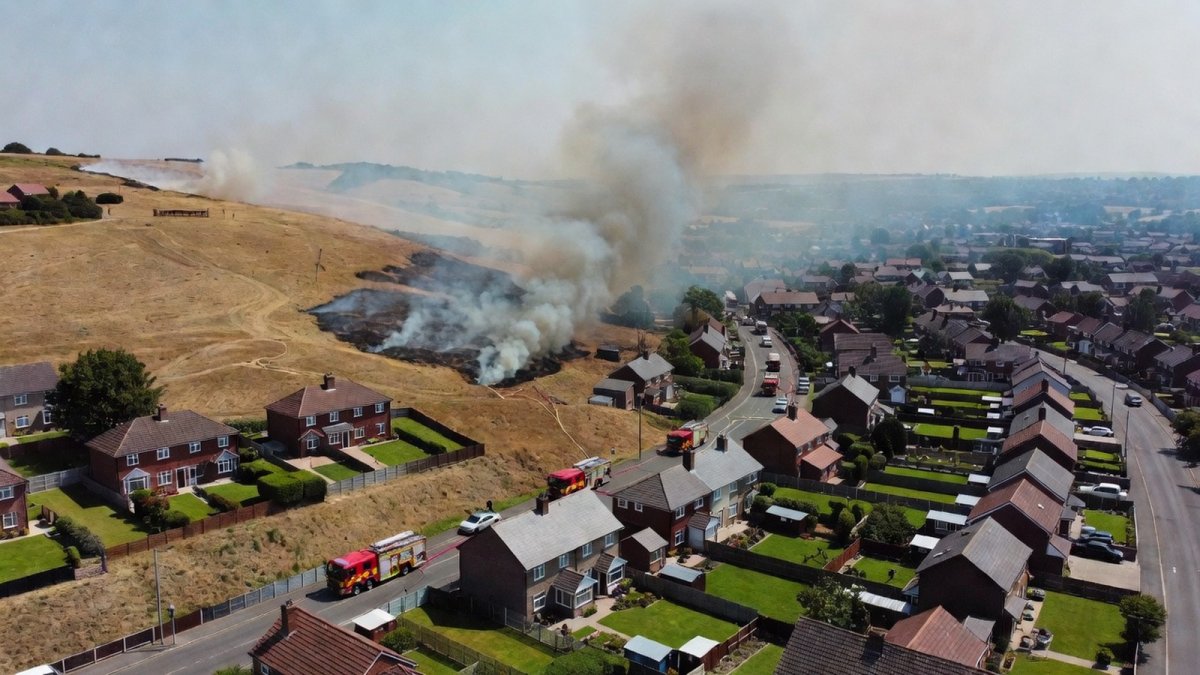
I want you to picture Stourbridge. A lovely, solid, West Midlands town. Golf courses, residential streets, community spirit. And on Thursday, shortly before half past one in the afternoon, that community was thrown into chaos. A grass fire broke out near Stourbridge Golf Course, in the Racecourse Lane area. And folks, it did not creep. It did not smoulder. It exploded. Tinder-dry grassland, a spark, and a wind that just kept pushing it straight into the places where people live.
We are looking at a scene that looks like something out of a disaster movie, but it is real. Drone footage from the scene shows the aftermath, and it is gut-wrenching. At least six properties have been destroyed. Six homes. Six families' worth of memories, photos, and furniture, gone. And it is not just those six. Several more homes have been badly damaged. This is not a statistic. This is someone's kitchen. Someone's kid's bedroom. Someone's safe place, turned to ash in a matter of hours.
The Race Against The Flames
Let me set the scene for you, because the speed of this thing is what should terrify everyone. This fire was not a slow burn. It was a sprint. It tore through the grassland and jumped onto residential streets with a ferocity that left even seasoned firefighters taken aback. We are talking about more than 60 firefighters deployed to the scene. Sixty. That is not a small crew. That is a full-scale military-style operation on British soil.
And here is the part that really gets me. It was not just houses that had to be evacuated. It was care homes. Think about that for a second. The most vulnerable people in our society, elderly residents, people with mobility issues, people who need round-the-clock care, being rushed out of their beds and their lounges because a wall of fire was bearing down on them. That is a logistical nightmare. That is a human crisis. And the firefighters and the paramedics and the police, they did not blink. They got them out.
By Friday morning, the fire chiefs were able to say that most of the flames were out. But do not breathe that sigh of relief yet, folks. They were very clear: it is still not safe for residents to return to some streets. The ground is unstable. There are hotspots. There are structural risks. Those people who lost everything, and those who are waiting to see if their homes are still standing, they are in limbo. They are sleeping in temporary accommodation, or with relatives, just waiting for a knock on the door that tells them something, anything, about what is left.
Leadership On The Ground
Now, I want to talk about leadership, because in a crisis, you see who shows up. Cat Eccles, the MP for Stourbridge, was not hiding in Westminster. She was at the town hall, sleeves rolled up, helping coordinate support for residents. That is what a public servant looks like. That is what it means to represent people when the chips are down. She was there, on the ground, in the thick of it, making sure that the council and the emergency services were talking to each other and that residents had a place to go.
And then we had the Prime Minister. Andy Burnham made the trip to the West Midlands Fire Service incident command unit in Stourbridge on Friday. He did not stand at a podium and give a press conference from a safe distance. He went to the command unit. He sat with the people who are running this operation. He wanted to see, first-hand, what the response looks like and what the region needs. That is the kind of presence that matters. It sends a message to the firefighters and to the residents that this is being taken seriously at the highest level.
But let me be brutally honest with you. A visit is welcome. A visit is symbolic. But what we need is action. Because this is not just a Stourbridge problem. This is a national problem, and it is burning out of control across the entire country.
Beyond The West Midlands: A Nation On Fire
Stourbridge is the headline today, but it is far from the only blaze. Warwickshire fire crews have been battling their own outbreaks. Over in Liverpool, Sefton Park saw a large grass fire that had locals and authorities scrambling. Down in Dorset, a heathland fire near the A31 drew more than 20 fire engines after a vehicle fire spread into the brush. Twenty engines. That is a massive resource drain, and it is happening everywhere, all at once.
This is the picture of a country that is stretched to its absolute limit. Fire services are not designed for this. They are designed for house fires and car crashes and the occasional kitchen fire. They are not designed to fight a war against a landscape that has become a tinderbox. And yet, that is exactly what they are doing. They are fighting on multiple fronts, with limited resources, in extreme heat, and they are doing it with a professionalism that should make every single one of us proud.
And do not forget the Suffolk coast. Earlier this summer, a major heathland wildfire near the Sizewell B nuclear power station, Britain's biggest nuclear plant, burned an area equivalent to around 210 football pitches. Let that sink in. Two hundred and ten football pitches of land, on fire, right next to a nuclear power station. Hundreds of locals and holidaymakers had to flee. A major incident was declared. It took firefighters three days to stabilise. Officials said it posed no risk to the plant, but the sheer scale of that event should have been a wake-up call. And what did we do? We moved on to the next heatwave.
The Human Factor: A 12-Year-Old Boy
Now, I need to talk about something that is going to make your blood boil. On the Suffolk coast, during that heatwave, a 12-year-old boy was seen starting four separate fires in woods just metres from homes. Four. Separate. Fires. A child. A child who, for whatever reason, thought it was a game. Thought it was fun. Thought it was nothing. And those fires were metres from where people live.
I am not going to sugarcoat this. That is not a prank. That is not mischief. That is criminal stupidity that could have killed people. It could have burned down homes. It could have trapped families. It could have turned a holiday destination into a funeral pyre. And it is a symptom of a broader problem: we are not taking this seriously enough. We are not teaching our kids about the danger. We are not instilling the fear of God into people about what a dropped cigarette or a discarded glass bottle can do in these conditions.
Fire chiefs have said it. The data backs it up. Firefighters have responded to 966 wildfires across England this summer. Nine hundred and sixty-six. That is not a busy season. That is a national emergency. And one fire chief has said it outright: the UK is effectively in a state of wildfire "national emergency" during the summer of 2026. He is right. And we need to start acting like it.
The Heat Is The Story
Let's talk about the weather, because the weather is the villain here. This is the fifth heatwave of summer 2026. The fifth. We are not talking about a hot week in July. We are talking about a relentless, punishing, record-breaking assault of heat. The Met Office has forecast highs of 36 to 38 degrees Celsius. An extreme heat warning has been issued for large parts of England. The UK Health Security Agency has issued a heat health alert. This is not a "nice day at the beach" forecast. This is a "stay inside and check on your gran" forecast.
The Telegraph reported that 2026 has seen four days at or above 36 degrees Celsius. That is the most in a single year in records. Records, folks. We are breaking records that have stood for decades, and we are breaking them in a way that is making the ground crack and the vegetation turn to fuel. And it is not just this week. The context is staggering. Two record-breaking heatwaves in May and June led to more than 2,800 excess deaths. Let me repeat that. More than 2,800 people died because of the heat. That is not a statistic. That is a national tragedy.
July was the driest July in England and Wales since records began in 1836. 1836! The Environment Agency has declared drought across more than half of England and all of Wales. All of Wales. And we have had a fourth heatwave starting July 28, a fifth on August 2, and a sixth on August 9. This is not a fluke. This is a pattern. This is the new normal, and we are not prepared for it.
Europe Is Burning Too
And before anyone thinks this is just a British problem, let me burst that bubble. The Guardian's live blog has been tracking the situation across Europe, and it is apocalyptic. Thousands have been evacuated and dozens injured in Croatian wildfires. Blazes are also affecting Greece and France. Extreme heat is gripping the entire continent. This is a pan-European crisis. This is not a localised weather event. This is a continental shift, and it is happening in real time.
We are seeing the same scenes playing out from the Mediterranean to the North Sea. Parched landscapes, overwhelmed fire services, and communities on the edge. The difference is, some countries have dealt with this for decades. They have the infrastructure, the aircraft, the specialised units. We do not. We are learning on the job, and we are learning the hard way, with people's homes and lives at stake.
What You Need To Do Right Now
So, what do we do? We do not panic. We do not bury our heads in the sand. We act. And I am going to give it to you straight, because that is what I do.
First, if you are in an affected area, listen to the authorities. They have told residents to "stay away" from affected zones, keep windows closed, follow local alerts, and report any fire immediately. Do not be a hero. Do not go and gawp at the flames. Do not try to get a closer look for your Instagram. You are not helping. You are getting in the way. You are putting yourself and the emergency services at risk. Stay away. Let them work.
Second, for everyone else, the heat health guidance is simple and it is life-saving. Stay hydrated. Drink water, not just tea and coffee. Check on your vulnerable neighbours. The elderly, the isolated, the sick. A quick phone call or a knock on the door could be the difference between life and death. Avoid the hottest part of the day. If you do not need to go out between 11am and 3pm, do not go out. Reschedule your run. Do your shopping early. This is not weakness. This is common sense.
Third, and this is the big one, we need to have a national conversation about this. We cannot keep pretending that this is a one-off. We cannot keep being surprised when the heat arrives and the fires start. We need investment in fire services. We need more specialist wildfire units. We need water-bombing aircraft. We need a strategy that matches the threat. And we need it now, not after the next disaster.
This is not about politics. This is about survival. This is about protecting our communities. This is about making sure that the scenes we saw in Stourbridge, the homes destroyed, the care homes evacuated, the families left with nothing, do not become a weekly occurrence. We have the knowledge. We have the technology. We have the resources. What we need is the will.
Folks, this summer has been a brutal teacher. But we can learn. We can adapt. We can build a future where we are not caught off guard every single time the mercury rises. It starts with each of us taking responsibility. It starts with us looking out for each other. And it starts with us demanding better from those in power. We are not helpless. We are not victims. We are a resilient people, and we will get through this. But we have to do it together, and we have to do it smart.
Stay safe. Stay hydrated. And stay informed. We will be here, watching, reporting, and holding people to account. Because that is what we do. That is who we are.
By Jessica Ali, Staff Writer
This article was produced with AI-assisted research and editorial support. Sources: Sky News, The Guardian, ITV News Central, Manchester Evening News, Birmingham Live, Metro, The Mirror, The Telegraph, Daily Star, UK Health Security Agency, Met Office.
What's Your Reaction?
 Like
0
Like
0
 Dislike
0
Dislike
0
 Love
0
Love
0
 Funny
0
Funny
0
 Wow
0
Wow
0
 Sad
0
Sad
0
 Angry
0
Angry
0

Editor-in-Chief at Global1.News. Atlanta-based journalist who cuts through the BS and tells it like it is. Lead anchor, host, and the voice you hear when the spin stops and the truth starts.










Comments (0)