
Trump's Polysilicon Tariff Escalates US-China Technology Rivalry
President Donald Trump has signed an executive order imposing a 15% tariff on polysilicon imports, targeting China's near-monopoly on a material critical to semiconductors and solar panels. Beijing has called the move an abuse of state power and signaled countermeasures.
Trump's Polysilicon Tariff Escalates US-China Technology Rivalry
Washington, DC — Article continues below.
President Donald Trump's decision to impose a 15% tariff on polysilicon imports marks the first major trade salvo in the US-China technology rivalry since the two sides paused their tit-for-tat tariff war in May 2025. By targeting the raw material at the heart of both the semiconductor and solar industries, Washington is aiming at a chokepoint where China holds a near-monopoly — a move with consequences that reach far beyond a single tariff line.
The Executive Order
US President Donald Trump signed an executive order on Thursday imposing a 15% tariff on imported products made from polysilicon. The order also established minimum import prices on polysilicon and related products following a national security investigation into overseas production of the material. Trump accepted recommendations from Secretary of Commerce Howard Lutnick to implement these measures alongside incentives aimed at boosting domestic output.
The policy directly addresses competition from China's chip sector, a central point of friction between the two largest economies. By targeting polysilicon imports, the administration seeks to shield American manufacturers from what it views as unfair foreign practices that have eroded US industrial capacity over time.
Why Polysilicon Matters
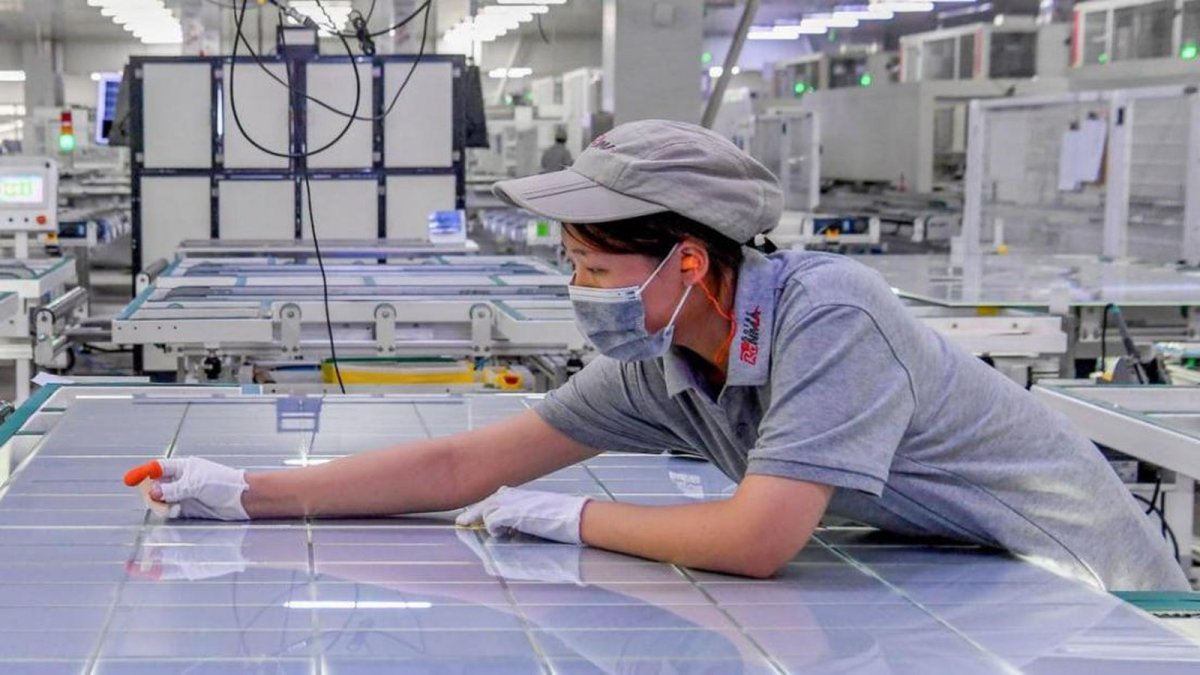
Polysilicon serves as a critical input for semiconductors, solar panels, and military equipment. China maintains a near monopoly on its global production, giving Beijing substantial leverage over supply chains essential to both commercial electronics and defense technologies. This concentration has heightened concerns in Washington about vulnerabilities in strategic sectors.
The material's role in advanced manufacturing underscores why the tariff targets this specific input. Disruptions here could affect everything from consumer devices to AI infrastructure and national security systems, making control over polysilicon production a high-stakes priority for both nations.
Polysilicon occupies a distinctive position at the intersection of commercial electronics and defense applications because the same base material feeds both semiconductor fabrication and solar photovoltaic production. China’s dominance stems from decades of state-supported capacity expansion that leveraged low-cost energy in regions such as Xinjiang and Inner Mongolia, combined with vertical integration across the entire solar and electronics supply chain. This structural advantage allowed Chinese producers to scale output far beyond any competitor, resulting in global market shares that now exceed 80 percent for solar-grade material and a still-substantial though slightly lower share for higher-purity grades.
Quality distinctions matter decisively for chipmakers. Solar-grade polysilicon tolerates higher impurity levels, whereas electronic-grade material must meet stringent purity thresholds measured in parts per trillion to support advanced node logic and memory production. The United States’ decline from roughly half of world output in 2005 to under 2 percent today illustrates how loss of electronic-grade capacity creates a single-point vulnerability for domestic foundries and defense contractors. As AI data-center construction accelerates demand for leading-edge chips, any sustained restriction on electronic-grade polysilicon imports directly constrains wafer starts and, by extension, the pace of AI infrastructure deployment in the United States and allied economies.
The Strategic Context
Computer chip production lies at the heart of the US-China contest to lead in artificial intelligence development. The two countries remain engaged in a tit-for-tat tariff conflict that has stayed on hold since May 2025, even as each side continues to pursue measures restricting access to critical technologies and materials.
Washington's latest action fits into broader efforts to limit China's position within key technology supply chains. Previous restrictions on Chinese drones, humanoid robots, and other tech products illustrate the ongoing pattern of targeted interventions designed to reduce dependence on Chinese sources.
The US-China contest over artificial intelligence leadership supplies the organizing principle behind successive technology controls. Semiconductors function as the physical substrate for model training and inference, prompting both governments to treat chip supply chains as instruments of national power rather than ordinary commercial goods. The 15 percent polysilicon tariff therefore operates alongside existing export-control mechanisms, including entity-list designations and advanced-node equipment restrictions, to form a layered defensive architecture that seeks to slow China’s progress while rebuilding domestic resilience.
Because the broader tariff truce has remained in place since May 2025, the new measure marks a selective resumption of pressure through a different policy channel. Washington has repeatedly framed such interventions as responses to supply-chain concentration that could be exploited during geopolitical crises. This pattern now extends from rare-earth magnets and drone components to foundational inputs such as polysilicon, indicating that US strategy prioritizes chokepoint materials whose disruption would impair both commercial AI development and military systems.
Beijing's Response
The Chinese embassy in Washington stated that the tariff seriously disrupts bilateral trade and that Beijing will take steps to protect its companies. Officials described the move as an abuse of state power against Chinese businesses and warned that protectionist policies will not enhance US competitiveness in the long run.
China has already announced countermeasures this week, including tighter export controls on drones. Beijing has also initiated a national security review of imported printers and copiers, signaling its readiness to respond symmetrically to US actions in technology-related trade.
Chinese officials have characterized the tariff as an abuse of state power that distorts normal trade flows and unfairly targets competitive Chinese enterprises. In practice, Beijing’s response repertoire has shifted toward calibrated export restrictions and inbound regulatory reviews that mirror the legal instruments Washington has employed. The recent tightening of drone export controls and the initiation of a national security examination of imported printers and copiers illustrate how the Ministry of Commerce coordinates retaliatory steps across multiple agencies to impose symmetric costs on US and allied firms.
This evolving playbook reveals an important asymmetry: while the United States restricts imports to protect domestic producers, China can restrict exports of critical minerals and intermediate goods where it holds processing dominance. The willingness to activate such levers signals that Beijing views its own supply-chain advantages as usable bargaining assets rather than passive endowments. Continued escalation therefore risks converting isolated tariff actions into a sustained contest over access to both finished technology products and the raw materials required to manufacture them.
Market and Industry Impact
The tariff order stands to benefit established US and allied producers such as Hemlock Semiconductor and Wacker Chemie, the primary domestic manufacturers of polysilicon. These firms could gain market share as import barriers rise and minimum pricing takes effect across related product categories.
Analysts cited in Chinese state media have characterized the tariff as the latest step in Washington's campaign to constrain China's role in critical technology supply chains. The policy may accelerate shifts in global sourcing patterns while raising costs for downstream industries reliant on affordable polysilicon inputs.
Historical Pattern
Trump noted that for decades the United States permitted foreign firms to weaken domestic polysilicon producers. US global production share declined sharply from 50% in 2005 to less than 2% in 2024, a trend the administration attributes to unchecked import competition and insufficient protective measures.
The current order follows the established approach of using national security investigations to justify trade interventions. This method allows the government to frame industrial support as essential to defense readiness rather than routine economic policy.
Escalation Dynamics
The polysilicon tariff follows recent US restrictions on imports of drones, humanoid robots, and additional Chinese tech products. Each round of measures has prompted reciprocal actions from Beijing, creating a cycle of targeted controls that affect multiple segments of the technology sector.
Further rounds appear likely as both governments continue to prioritize supply chain security. The pattern suggests that disputes over materials like polysilicon will remain central to bilateral economic relations and influence decisions by firms across Asia and Europe seeking stable sourcing options.
Strategic Implications
The tariff reflects Beijing's broader push for technological self-sufficiency while highlighting Washington's determination to rebuild domestic capacity in foundational materials. Both capitals view control over polysilicon as integral to long-term competitiveness in AI and advanced manufacturing.
Second-order effects will likely extend to ASEAN economies and the Global South, where companies must navigate higher costs and shifting trade rules. The trajectory points toward deeper decoupling in critical technology areas, with multilateral institutions facing pressure to adapt to these bilateral confrontations.
The polysilicon order accelerates the trajectory toward selective decoupling in materials essential to both AI hardware and renewable-energy equipment. Downstream manufacturers in Europe, Japan, South Korea, and Southeast Asia now confront higher input costs and must decide whether to absorb margins, relocate capacity, or diversify sourcing toward higher-cost but politically safer suppliers. Solar-module producers face particular pressure because their cost structures remain sensitive to polysilicon price movements, while chip foundries must weigh the reliability of long-term contracts against potential future tightening of US import rules.
Reshoring incentives for firms such as Hemlock Semiconductor and Wacker Chemie are clear, yet the capital intensity and multi-year construction timelines of polysilicon plants imply that meaningful capacity additions will require sustained policy support beyond a single tariff order. Markets and governments should therefore monitor three near-term indicators: the pace of new domestic plant announcements, the scope of any Chinese export-control expansion into silicon-related chemicals, and the reaction of third-country governments seeking to avoid being caught between the two largest economies’ supply-chain strategies.
By Prof. Marcus Chen, Staff Writer
This article was produced with AI-assisted research and editorial support. Reporting is based on sources cited in the article.
What's Your Reaction?
 Like
0
Like
0
 Dislike
0
Dislike
0
 Love
0
Love
0
 Funny
0
Funny
0
 Wow
0
Wow
0
 Sad
0
Sad
0
 Angry
0
Angry
0

World Politics Analyst at Global1.News. Based in Beijing, covering US-China relations, global trade, and geopolitical strategy. Brings deep analytical perspective to the power dynamics shaping international affairs.















Comments (0)