
Trump Calls Canada 'Nasty' — Carney Defends Canadian Jobs as Trade Talks Intensify
U.S. President Donald Trump called Canada 'nasty' during a Las Vegas speech on Aug. 5. PM Mark Carney responded at a Quebec aluminum plant, defending Canadian workers. With 50 per cent tariffs looming Aug. 19, officials met in Washington as opposition critics questioned Ottawa's approach.
The CBC News video opens with striking footage from inside the Red Rock Casino Resort and Spa in Las Vegas, capturing U.S. President Donald Trump repeating the word "nasty" five times while targeting Canada and its leadership during remarks on Wednesday evening, August 5, 2026, as he promoted his administration's tax-relief initiative, immediately raising questions about the future of Canada-U.S. trade relations that affect workers from Ontario assembly plants to Quebec aluminum facilities.
Trump's 'Nasty' Rhetoric Escalates Canada-U.S. Trade Dispute
Ottawa, Ontario — Prime Minister Mark Carney defended Canadian workers and businesses on Thursday after U.S. President Donald Trump labelled Canada and its leadership "nasty" during a Las Vegas speech, as officials on both sides of the border pressed ahead with trade talks ahead of the Aug. 19 tariff deadline.
Trump's Las Vegas Speech Targets Canadian Leadership
During his address at the Red Rock Casino Resort and Spa in Las Vegas on Wednesday evening, August 5, 2026, U.S. President Donald Trump stated, "Canada's nasty. They are. They're nasty," and added, "I love the people, but they're nasty. Nasty leadership."
Trump linked his comments to tariffs, saying, "I love tariffs, right? Because we've been screwed by tariffs used against us for years. By China, by Japan, by South Korea, by Germany, by everybody, by Canada."
The remarks came as part of his promotion of tax-relief measures and followed months of tit-for-tat tariffs between the two countries that have already reduced total Canada-U.S. trade by C$1.9 billion, or 0.6 per cent, in the first quarter of 2026 compared with the same period in 2024.
These statements from the Las Vegas stage highlight how U.S. tariff policy now directly intersects with Canadian federal priorities on Parliament Hill, where the Prime Minister's Office must balance domestic industry protection against broader North American supply chain stability.
The repetition of pointed language in a single speech underscores the personal tone Trump has injected into bilateral disputes, forcing Canadian negotiators to respond through both public statements and private channels rather than routine diplomatic notes.
Canadian exporters in energy and manufacturing sectors now face renewed uncertainty, as the rhetoric coincides with existing trade contractions that have already trimmed revenues in Alberta's oil fields and Ontario's vehicle assembly lines.
Prime Minister Carney Defends Canadian Workers in Saguenay
Prime Minister Mark Carney responded on Thursday, August 6, at an aluminum plant in Quebec's Saguenay region, stating, "Whatever adjective is used, yes, we're standing up for Canadian workers, for Canadian businesses, as we always have from the start."
In French, Carney added that the negotiations involve jobs and the future of Canadian businesses, noting the talks remain tough regardless of the language chosen to describe them.
Carney confirmed he had spoken directly with Trump by phone the previous week and said further calls would occur as needed to address the August 19 deadline for new 50 per cent U.S. tariffs on roughly five per cent of Canadian exports, including alcohol, hockey sticks and cement.
Carney's choice of the Saguenay aluminum facility as the venue for his reply ties the federal response directly to Quebec's industrial base, where employment depends on stable access to U.S. markets under the existing Canada-U.S.-Mexico Agreement framework.
The Prime Minister's emphasis on defending workers reflects longstanding Canadian federal-provincial dynamics, in which Ottawa coordinates with provincial governments to shield sectors such as dairy and aluminum from external pressure while preserving overall trade volumes.
By confirming ongoing phone contact with Trump, Carney signals that the Liberal government intends to manage the August 19 deadline through established bilateral channels rather than allowing public exchanges to derail scheduled negotiations.
Trade Officials Extend Washington Meetings Beyond Schedule
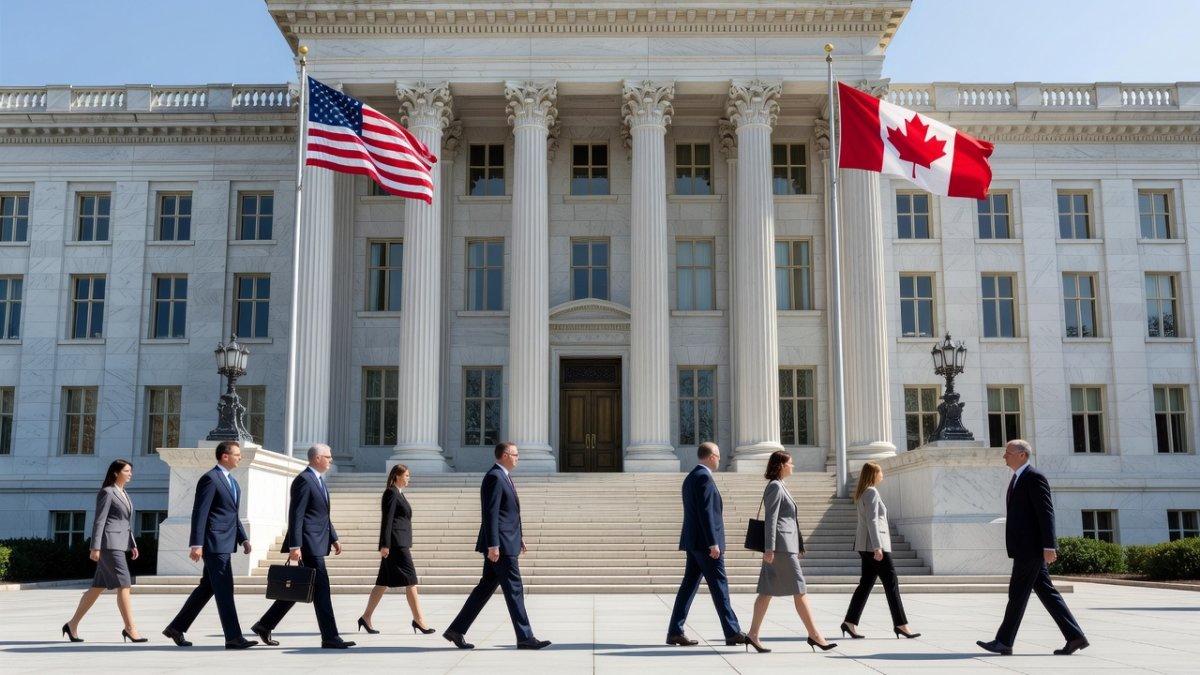
Canada-U.S. Trade Minister Dominic LeBlanc and chief trade negotiator Janice Charette met U.S. Trade Representative Jamieson Greer in Washington on Thursday afternoon, less than 24 hours after Trump's Las Vegas comments, with the session running more than one hour and 30 minutes instead of the planned 30 minutes.
On Tuesday, LeBlanc and Charette met Jay Timmons, CEO of the National Association of Manufacturers, while on Wednesday morning LeBlanc held separate meetings with North Dakota Republican Senator Kevin Cramer and Tennessee Republican Senator Bill Hagerty.
These discussions occur as the two countries continue official free-trade talks to adapt the Canada-U.S.-Mexico Agreement, under which a large portion of Canadian goods remain exempt from current U.S. tariffs despite the U.S. refusal to renew the pact on July 1.
The extended duration of the Washington session illustrates how Canadian trade officials are adapting their schedule in real time to counter the effects of Trump's public statements on the pace of CUSMA adaptation talks.
Meetings with Republican senators from North Dakota and Tennessee demonstrate Ottawa's strategy of engaging directly with U.S. lawmakers who represent states with strong agricultural and manufacturing ties to Canada, aiming to build support ahead of the August 19 tariff deadline.
Coordination between LeBlanc, Charette and Greer continues to focus on preserving exemptions for the majority of Canadian exports, a priority that aligns with federal efforts to stabilise the economy amid housing pressures and cost-of-living concerns across the country.
Economic Data Shows Sharp Declines in Key Sectors
Between January 2025 and May 2026, the U.S. collected around US$269 billion in gross customs revenue from Trump administration tariffs, according to University of Pennsylvania estimates, though US$100 billion in refunds followed the Supreme Court striking down reciprocal tariffs in February.
Canadian trade figures reveal autos fell 18.9 per cent, or $6.7 billion, iron and steel dropped 43.5 per cent, and mineral fuels and oils declined 3.3 per cent in the first quarter of 2026 versus 2024, directly affecting manufacturing centres in Ontario and Alberta's energy sector.
The August 19 tariff round is framed by the White House as retaliation for Canada's dairy protectionism and provincial boycotts of American alcohol in government-run liquor stores, measures that have already cut U.S. spirits exports to Canada by 63 per cent last year.
The documented drops in automotive and steel shipments underscore the vulnerability of Ontario's manufacturing corridor, where plant schedules and supplier contracts now hinge on the outcome of talks between Ottawa and Washington.
Alberta's energy exports face parallel pressure from the 3.3 per cent decline in mineral fuels and oils, illustrating how federal trade policy decisions reverberate through provincial economies that rely on cross-border pipelines and rail shipments.
Provincial liquor control boards in multiple provinces have already absorbed the 63 per cent reduction in U.S. spirits imports, forcing adjustments in revenue forecasts that affect public finances at both the federal and provincial levels.
Poilievre Questions Carney's Concession Approach
Conservative Leader Pierre Poilievre, speaking in St. John's, criticised the Liberal strategy, stating, "I don't understand the strategy of making concession after concession after concession before even getting to the negotiating table."
Poilievre cited Carney's decision to drop the digital services tax after Trump threatened to end trade talks in June 2025, the Liberal push to eliminate the CRTC streaming contribution requirement, and Carney's July admission that Trump "won the argument" on military spending increases for Canada and European allies.
Poilievre argued that concessions should be traded for reciprocal gains rather than presented empty-handed, leaving Canada in a weaker bargaining position ahead of the August 19 deadline.
Poilievre's critique from St. John's places the Conservative opposition in direct conversation with Atlantic Canadian concerns over how tariff threats could affect fisheries and related processing industries that depend on stable U.S. market access.
The listed concessions, including the June 2025 removal of the digital services tax, now form part of the public record that opposition parties use to question whether the Liberal government has secured equivalent commitments from Washington in return.
By highlighting the July admission on military spending, Poilievre connects the trade file to broader federal budget priorities, arguing that Canadian taxpayers may face higher defence outlays without corresponding relief on tariff fronts.
Analysts View Rhetoric as Sign of Effective Canadian Leverage
CTV News U.S. political analyst Eric Ham expressed surprise at the language, noting he initially thought Trump might be referring to Iran or Russia, and stated the vitriol suggests a comprehensive trade deal remains distant.
Political analyst Lori Turnbull observed that Trump's comments indicate Canada's retaliation measures, particularly the provincial moratorium on U.S. liquor sales, are effective leverage points that have disrupted American exporters.
Turnbull added that the Distilled Spirits Council of the United States has labelled the bans devastating, confirming the measures are pressuring the U.S. side in ongoing CUSMA adaptation talks.
Ham's initial misreading of the target country underscores how unusual it remains for a U.S. president to direct such language at Canada, a development that Canadian diplomats must now factor into their public messaging on Parliament Hill.
Turnbull's assessment of the liquor moratorium as effective leverage points to the success of coordinated federal-provincial action, where provincial governments control retail channels and can therefore influence the negotiating table without direct federal legislation.
The Distilled Spirits Council statement provides concrete evidence that Canadian countermeasures are registering with U.S. industry groups, giving Ottawa additional data points to cite when defending its approach to domestic audiences concerned about rising costs.
Implications for Canadian Households and Federal-Provincial Coordination
The 50 per cent tariffs scheduled for August 19 on alcohol, hockey sticks and cement will raise costs for consumers in provinces reliant on imported building materials and will further strain government-run liquor store revenues already reduced by last year's 63 per cent drop in U.S. spirits imports.
Bank of Canada interest-rate decisions will face added pressure from the 0.6 per cent overall trade decline and the 18.9 per cent automotive contraction, affecting employment in Ontario assembly plants and Quebec aluminum facilities visited by Carney on Thursday.
Federal-provincial coordination on dairy protections and liquor-store policies remains central to Canada's negotiating position, reflecting longstanding Canadian values of protecting domestic industries while maintaining fair trade relations with its largest partner.
The direct phone contact between Carney and Trump last week, combined with extended meetings involving LeBlanc, Charette and Greer, shows Ottawa continuing to organise responses through established diplomatic channels rather than public escalation.
The exchange underscores how tariff deadlines and provincial countermeasures now shape daily economic decisions for Canadian workers and businesses from Saguenay to St. John's.
These pressures also intersect with federal efforts to address housing affordability, as higher costs for imported cement could slow construction timelines in major urban centres already grappling with supply shortages.
What Happens Next
With the August 19 deadline approaching, Canadian negotiators led by Dominic LeBlanc and Janice Charette will continue their Washington schedule while Prime Minister Mark Carney maintains direct contact with Donald Trump to seek extensions or exemptions on the targeted five per cent of exports.
Provincial governments are expected to hold firm on liquor-store policies that have already cut U.S. spirits imports by 63 per cent, using that leverage to press for concessions on dairy and aluminum before any final CUSMA adaptation agreement.
Opposition scrutiny from Pierre Poilievre will intensify if further concessions surface without reciprocal U.S. commitments, shaping the domestic political debate ahead of the next federal election cycle.
Bank of Canada officials will monitor the 0.6 per cent trade contraction and sector-specific declines when setting interest rates, recognising that prolonged tariff uncertainty could dampen investment across Ontario and Alberta manufacturing and energy corridors.
By Alex Thompson, Staff WriterThis article was produced with AI-assisted research and editorial support. Reporting is based on sources cited in the article.
What's Your Reaction?
 Like
0
Like
0
 Dislike
0
Dislike
0
 Love
0
Love
0
 Funny
0
Funny
0
 Wow
0
Wow
0
 Sad
0
Sad
0
 Angry
0
Angry
0

Canada Correspondent at Global1.News. Based in Toronto, covering Canadian politics, energy, trade, and US-Canada relations. Provides the Canadian perspective on North American and global affairs.












Comments (0)