
Trump Approves Saudi Nuclear Programme Without Gold Standard
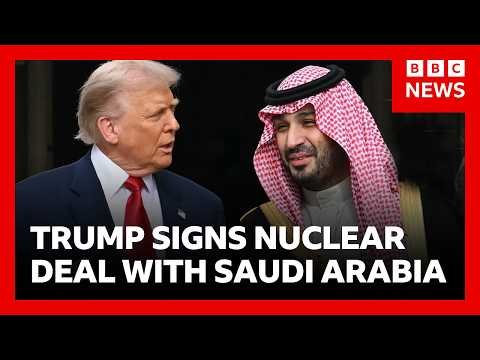
In a recent BBC News report, the implications of President Donald Trump's approval of a landmark nuclear cooperation agreement with Saudi Arabia came under scrutiny as the administration confirmed it had signed a deal that would allow American companies to build commercial nuclear power plants on Saudi soil — without requiring the kingdom to forgo its own uranium enrichment capability. Trump Approves Saudi Nuclear Deal Without Nonproliferation 'Gold Standard' Washington, D...
In a recent BBC News report, the implications of President Donald Trump's approval of a landmark nuclear cooperation agreement with Saudi Arabia came under scrutiny as the administration confirmed it had signed a deal that would allow American companies to build commercial nuclear power plants on Saudi soil — without requiring the kingdom to forgo its own uranium enrichment capability.
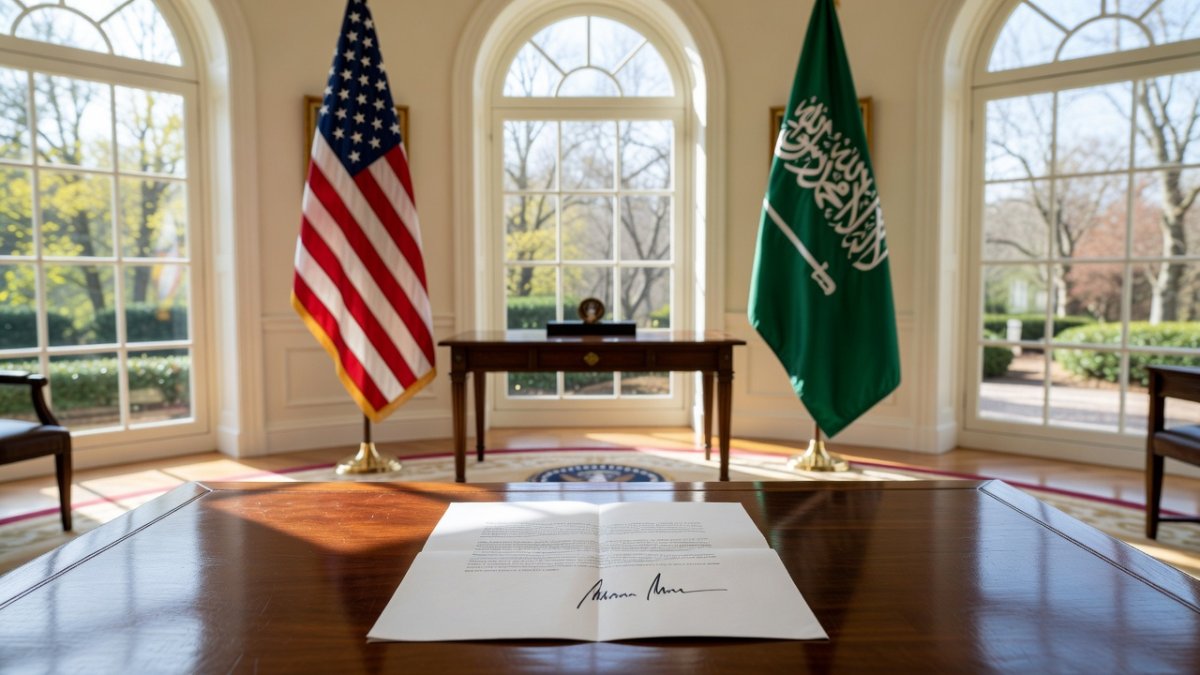
Trump Approves Saudi Nuclear Deal Without Nonproliferation 'Gold Standard'
Washington, D.C. – 23 July 2026 — President Donald Trump has approved a landmark nuclear cooperation agreement with Saudi Arabia that would allow American companies to build commercial reactors in the kingdom while permitting Riyadh to pursue domestic uranium enrichment — a significant departure from decades of US nonproliferation policy that has drawn sharp criticism from lawmakers and arms control experts. The 30-year agreement, signed by Energy Secretary Chris Wright and Saudi Energy Minister Prince Abdulaziz bin Salman on Wednesday, must now survive a 90-day congressional review period during which opponents will need a two-thirds majority to block it.
The Deal: A 30-Year Nuclear Partnership
On Wednesday, Energy Secretary Chris Wright and Saudi Energy Minister Prince Abdulaziz bin Salman signed a Section 123 nuclear cooperation agreement at the Department of Energy, formalising what officials described as a decades-long partnership in civilian nuclear energy. The agreement, which must now undergo a 90-day congressional review period, would grant American companies — including Pittsburgh-based Westinghouse — priority access to develop and operate nuclear power plants across the kingdom.
The Department of Energy confirmed the deal is expected to be worth billions of dollars and last thirty years. In a statement announcing the signing, Secretary Wright said the agreements "uphold the highest standards of nuclear safety and nonproliferation, while relying on the world's best nuclear technology and scientists, designed right here in the United States."
According to an administration memo seen by NPR, the agreement gives American firms exclusive priority access to the Saudi nuclear energy programme, effectively blocking competitors from Russia and China from winning contracts in the kingdom's emerging civilian nuclear sector.
Departure from the 'Gold Standard'
Unlike the 2009 agreement Washington signed with the United Arab Emirates — widely regarded as the "gold standard" of nuclear cooperation because Abu Dhabi voluntarily agreed to forgo domestic enrichment and reprocessing — the Saudi deal contains no such prohibition. According to the administration memo seen by NPR, the agreement does not include provisions barring the kingdom from enriching uranium or reprocessing spent nuclear fuel on its own soil.
The most significant provision permits Saudi Arabia to pursue domestic uranium enrichment following a joint US-Saudi feasibility study. This marks a significant departure from long-standing US nonproliferation policy, as enrichment technology capable of producing fuel for civilian reactors can also be used to produce highly enriched uranium suitable for nuclear weapons if taken to higher levels.
Additionally, reports indicate the agreement may not require Saudi Arabia to adopt the IAEA Additional Protocol, which grants international inspectors broader powers to verify that nuclear material is not being diverted for military purposes. Michael Horowitz, a geopolitical analyst, described this as "very consequential," noting that a deal "that falls both below the gold standard and doesn't include the Additional Protocol" raises serious questions about its nonproliferation safeguards.
Timing and Iran Contradiction
The timing of the deal is likely to prove deeply controversial. The United States is currently conducting a military campaign against Iran in which one of the stated objectives is preventing Tehran from acquiring the capability to build a nuclear weapon. Critics argue that simultaneously approving a deal that could provide Saudi Arabia with enrichment capabilities fundamentally undermines that message. Matthew Bunn, a nuclear proliferation expert at Harvard's Kennedy School of Government, told NPR that the agreement "may make negotiating a reasonable deal with Iran more difficult." Bunn argued that Iran would be far less likely to agree to intrusive international inspections of its nuclear programme if Saudi Arabia, its regional rival, was not also bound by such commitments.
Nonproliferation experts have highlighted how this dual-track approach creates immediate contradictions in US policy. While military operations target Iranian enrichment sites to curb Tehran's breakout capacity, the Saudi agreement opens a parallel pathway for enrichment in Riyadh. Rep. Brad Sherman has noted that such inconsistency weakens Washington's leverage in any future talks with Tehran. From the Saudi perspective, Crown Prince Mohammed bin Salman views the deal as essential for energy security under Vision 2030, yet Iranian officials have already signaled that Riyadh's new capabilities would justify expanded Iranian activities. This dynamic risks accelerating a regional arms race.
Russian and Chinese actors stand to benefit from any erosion of US credibility on nonproliferation. Moscow has long positioned Rosatom as a reliable partner willing to offer enrichment services without stringent political conditions, while Beijing advances its own Belt and Road nuclear projects. The Saudi deal could push Gulf states toward these alternatives if congressional resistance stalls implementation, reshaping great-power competition across the Middle East and affecting broader global security architecture by normalizing lower nonproliferation standards.
Why Washington Said Yes
The Trump administration has framed the deal as a strategic necessity. In a report submitted to Congress earlier this year, the administration argued that expanding civilian nuclear cooperation would strengthen US influence in the Gulf while preventing strategic competitors from gaining a foothold in the kingdom. Without a US-led agreement, Saudi Arabia would almost certainly turn to Russia's Rosatom or Chinese companies to build its nuclear infrastructure.
The administration also pointed to Saudi Arabia's rapidly growing electricity demand — driven by economic diversification under Crown Prince Mohammed bin Salman’s Vision 2030 plan — as a practical justification for nuclear energy. While the kingdom sits on vast oil reserves and enjoys some of the world's best conditions for solar power, officials argue that nuclear energy provides the baseload capacity needed for industrial development. Prince Abdulaziz bin Salman has emphasized that the partnership secures American technology and expertise, reducing dependence on external suppliers amid volatile global energy markets.
Analysts suggest this decision reflects calculations in great-power competition. By locking in US firms, Washington aims to limit Russian and Chinese penetration into critical infrastructure across the Gulf. Yet nonproliferation experts warn that short-term commercial and geopolitical gains may erode long-term leverage over enrichment technology, with ripple effects on efforts to constrain Iran's programme and maintain stability in a region already strained by proxy conflicts.
Congressional Battle and Regional Fallout
The agreement now faces a 90-day review period in Congress, where opposition is already forming. Representative Brad Sherman, a California Democrat on the House Foreign Affairs Committee, warned that Congress should "approve only if the deal has the same gold-standard safeguards as our deal with the UAE." He added pointedly that "a president waging war to prevent nuclear proliferation in the Middle East should not facilitate proliferation just because US companies stand to make a profit."
Blocking the agreement would require a two-thirds majority in both chambers to override a certain presidential veto — a high bar in the current political climate. Andrea Stricker, deputy director of the Foundation for Defense of Democracies' Nonproliferation Program, urged Congress to block the deal outright, warning that failure to do so would set a dangerous precedent for other states seeking enrichment capabilities.
Crown Prince Mohammed bin Salman has previously stated that if Iran were to develop a nuclear weapon, Saudi Arabia would seek one as well. While Tehran insists its nuclear programme is peaceful, the parallel track of military confrontation with Iran and nuclear cooperation with Saudi Arabia creates a volatile dynamic in the world's most strategically sensitive region. From Moscow's viewpoint, any dilution of US-led nonproliferation norms opens space for alternative suppliers and shifts the balance of influence in the Middle East.
Analysis — A Proliferation Precedent
The Saudi nuclear deal represents what analysts describe as a fundamental shift in American nonproliferation policy. By permitting uranium enrichment in a volatile region where two of Washington's partners — Saudi Arabia and the UAE — sit on opposite sides of the nonproliferation spectrum, the United States is effectively abandoning the "gold standard" that shaped its nuclear cooperation agreements for nearly two decades.
This could have cascading effects. Other countries in the region and beyond — Turkey, Egypt, perhaps even Gulf states — may now demand similar terms, arguing that if Saudi Arabia can enrich uranium without the Additional Protocol, so should they. The administration memo insists the deal does not obligate the US to transfer fuel cycle capabilities, but the political precedent has been set.
The coming 90 days will determine whether this agreement survives congressional scrutiny. What is already clear is that on Wednesday, the United States crossed a threshold it had carefully avoided for years — opening the door to nuclear enrichment in the kingdom that sits at the crossroads of the Middle East's most volatile conflicts.
By Irina Volkov, Staff Writer
This article was produced with AI-assisted research and editorial support. Reporting is based on sources cited in the article.
What's Your Reaction?
 Like
0
Like
0
 Dislike
0
Dislike
0
 Love
0
Love
0
 Funny
0
Funny
0
 Wow
0
Wow
0
 Sad
0
Sad
0
 Angry
0
Angry
0

Russia/Eastern Europe Correspondent at Global1.News. Covering Russian politics, energy, security, and the shifting dynamics of the post-Soviet space. Provides clear-eyed analysis on one of the world's most opaque regions.














Comments (0)