
Thousands march in France against ‘licence to kill’ draft law
On Sunday, a wave of demonstrators filled the streets of Paris and several other French cities, converging to oppose a draft law that would grant police and gendarmes a presumption of legality when they employ firearms.
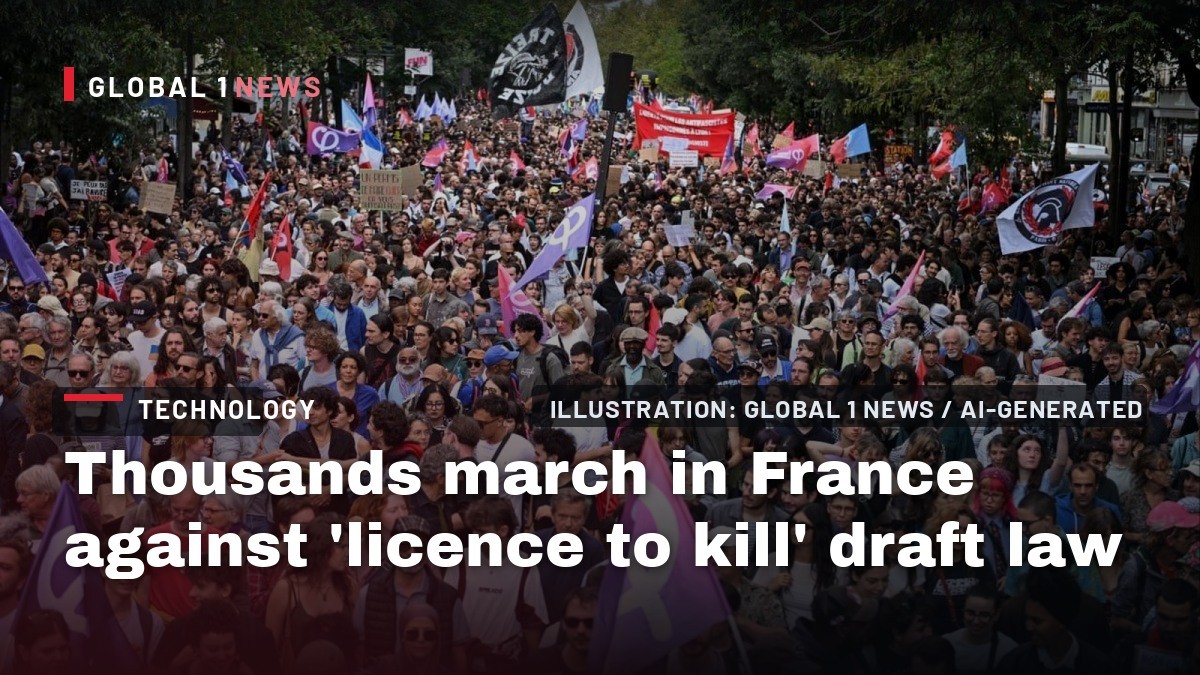
On Sunday, a wave of demonstrators filled the streets of Paris and several other French cities, converging to oppose a draft law that would grant police and gendarmes a presumption of legality when they employ firearms. The protest, described by participants as a stand against a “licence to kill,” underscores a growing tension in France between security policy and civil liberties, a debate that has reverberated across Europe in recent years.
Background of the draft legislation
The proposal at the centre of the protests originated in the National Assembly, where deputies approved the bill in July. The core provision stipulates that any police official who uses force is presumed to have acted within the bounds of the law when employing their weapon. This legal presumption effectively shifts the burden of proof onto the accused officer, a shift that critics argue undermines accountability mechanisms traditionally embedded in French policing.
Proponents of the measure argue that it is intended to protect officers who must make split‑second decisions in volatile situations, thereby reducing the risk of legal repercussions that could deter decisive action. However, the language of the draft law, as reported, does not specify safeguards or criteria for evaluating the proportionality of force, raising concerns among rights groups about potential overreach.
Scale and composition of the protests
The demonstrations were notable for their breadth, drawing participants from a range of political and civil‑society backgrounds. In Paris, the crowd included members of the hard‑left France Unbowed (LFI) party, alongside a broader coalition of rights organisations and individual activists. The presence of Mathilde Panot, a prominent LFI figure, highlighted the political dimension of the opposition, with Panot explicitly linking the draft law to an existing pattern of police violence.
While exact attendance figures were not disclosed, the description of “thousands” marching in multiple cities suggests a significant mobilisation. The geographic spread of the protests, extending beyond the capital, indicates that concerns over the proposed legal framework resonate across diverse urban and regional contexts within France.
Political reactions and parliamentary trajectory
Having cleared the lower house, the draft law now faces a decisive vote in the Senate. The Senate’s composition, traditionally more conservative than the National Assembly, makes its upcoming deliberations a focal point for both supporters and opponents of the measure. Politicians from the left, as exemplified by Panot’s remarks, have framed the bill as an erosion of civil rights, while right‑leaning legislators are likely to stress the necessity of legal protections for law‑enforcement personnel.
The parliamentary debate is expected to centre on the balance between operational security and the principle of accountability. The presumption of legality clause, as currently drafted, is poised to become a litmus test for how French lawmakers reconcile these competing priorities in a climate of heightened public scrutiny of police conduct.
Historical context of police use‑of‑force legislation in France
France’s legal framework governing police use of force has evolved through a series of reforms, particularly in the wake of high‑profile incidents that sparked public outcry. Historically, French law has required officers to demonstrate that any force employed was necessary and proportionate, with judicial oversight serving as a check against abuse. The proposed amendment represents a departure from this tradition by embedding a presumption of legality, a shift that could recalibrate the legal standards applied to police actions.
Comparatively, other European jurisdictions have grappled with similar dilemmas, often opting for stricter oversight mechanisms rather than presumption clauses. The French proposal thus stands out as a distinctive approach, prompting observers to consider whether it signals a broader trend toward privileging law‑enforcement discretion over civilian protections.
Public sentiment and civil‑society perspectives
Beyond the parliamentary arena, the protests reflect a deep‑seated unease among segments of the French populace regarding police authority. The rallying cry of “licence to kill” encapsulates a perception that the draft law could embolden excessive force, potentially exacerbating existing tensions between communities and law‑enforcement agencies. Rights groups, which joined the demonstration, have historically advocated for transparent investigations and independent oversight of police conduct, arguing that such mechanisms are essential to maintaining public trust.
The involvement of political parties, particularly those on the left, underscores the intersection of policy and ideology in shaping public discourse. By framing the legislation as a direct threat to civil liberties, these actors aim to galvanise broader societal opposition, leveraging the protest to pressure legislators ahead of the Senate vote.
Implications for future policing and legal standards
If enacted, the presumption of legality clause could have far‑reaching consequences for how police operations are conducted and reviewed. The shift in evidentiary burden may affect internal disciplinary processes, potentially leading to fewer prosecutions of officers accused of misconduct. Conversely, law‑enforcement agencies might argue that the legal shield encourages decisive action in dangerous situations, thereby enhancing public safety.
From a judicial perspective, courts would be tasked with interpreting the scope of the presumption, a process that could generate a body of case law clarifying—or complicating—its application. The legal community is likely to monitor the Senate’s deliberations closely, as the outcome may set a precedent for future legislative attempts to modify accountability frameworks in France and possibly influence other jurisdictions contemplating similar reforms.
Outlook and potential developments
The upcoming Senate vote will be a decisive moment for the draft law and for the broader debate over police accountability in France. Should the Senate reject the proposal, it would signal a reaffirmation of existing accountability standards and could embolden civil‑society groups to continue advocating for stronger oversight mechanisms. Conversely, passage of the bill would likely intensify protests and could catalyse further legal challenges, potentially reaching the Constitutional Council for review.
In the interim, the protests of September 2026 serve as a vivid illustration of the contested terrain surrounding law‑enforcement powers in contemporary France. The mobilisation of thousands across multiple cities demonstrates that the issue resonates beyond parliamentary chambers, touching on fundamental questions about the relationship between state authority and individual rights. As the debate unfolds, both domestic and international observers will be watching closely to gauge how France navigates this delicate balance in an era marked by heightened scrutiny of police conduct worldwide.
This article was produced with AI-assisted research and editorial support. Reporting is based on the source material cited below. Sources: South China Morning Post; scmp.com; Global1.News (21 September 2026).
By Kenji Tanaka, Staff Writer
What's Your Reaction?
 Like
0
Like
0
 Dislike
0
Dislike
0
 Love
0
Love
0
 Funny
0
Funny
0
 Wow
0
Wow
0
 Sad
0
Sad
0
 Angry
0
Angry
0

Japan Correspondent at Global1.News. Tokyo-based voice covering Japanese politics, technology, economy, and culture. Tracks the intersection of tradition and innovation in one of the world's most dynamic societies.















Comments (0)