
The AI Infrastructure Money Just Went Global — and the Cynics Are Buying In
Firmus nearly doubles its valuation to $10.5 billion in four months as Nvidia, Blackstone, Coatue and Jane Street pour $2 billion into AI factories across Australia and Indonesia. The AI infrastructure capital cycle has gone global — and hosting providers need to watch.
The AI Infrastructure Money Just Went Global — and the Cynics Are Buying In
Let me tell you something that's been on my mind since the news crossed my desk this morning. A company most people in the United States have never heard of just raised $2 billion to build AI factories in Australia and Indonesia, and it nearly doubled its valuation in four months doing it. The investors writing those checks aren't some clueless momentum funds chasing buzzwords. They're Blackstone. They're Coatue. They're Nvidia itself. And — this is the part that should genuinely make you sit up — they're Jane Street, the quant trading firm that makes its money arbitraging the hell out of every market inefficiency on the planet.
I've been running hosting infrastructure for over a decade, and I've watched this AI buildout move through phases: first it was chips, then it was power, then it was land. Now it's something else entirely. The money has gone global, and the most risk-averse, most cynical capital on Wall Street is now betting billions on physical data center infrastructure in the South Pacific. That's not a hype signal. That's a structural signal.
The Raise That Should Make Every Hosting Provider Pay Attention
Firmus Technologies — Sydney-based, trading as Firmus Grid Limited — announced Friday that it had received full commitments for a $2 billion strategic equity investment round. The round includes follow-on participation from Coatue and Nvidia, fresh money from funds managed by Blackstone Tactical Opportunities and other Blackstone vehicles, and additional participation from Jane Street.
Here's the number that should stop you cold: the round values Firmus at above $10.5 billion post-money. Its previous round, in April — four months ago — valued the company at $5.5 billion. That's nearly a doubling of a private valuation in 120 days, before a single new gigawatt of capacity came online. Total equity raised by Firmus over the past year is now north of $3 billion.
Co-CEO Oliver Curtis put it plainly: "This investment allows us to move on multiple fronts at once." Translation: they've got more money than they can spend in one country, and that's exactly the problem they want to have.
Four Months, Double the Valuation — This Is What Capital Velocity Looks Like
Let's put that re-rating in context, because I don't think most people grasp how fast private capital is moving in this market. In April, Firmus raised $505 million led by Coatue at a $5.5 billion valuation, with Nvidia participating. By June, it had locked an eight-year compute partnership with Nvidia running through 2034 — the deal is structured so Firmus buys Nvidia infrastructure and resells Nvidia-powered cloud services. And now, in August, Blackstone and Jane Street come in at $10.5 billion.
That's the pattern that matters: the same investors who are publicly agonizing over hyperscaler capex and asking whether the AI bubble is popping are privately paying 90 percent premiums for AI infrastructure builders every few months. Emanuel Ajay Datt, managing director at investment manager Datt Group, nailed it in a Reuters interview: "The pace at which Firmus has re-rated demonstrates how private capital views AI infrastructure as one of the few capital-scarce opportunities in global markets right now."
Capital-scarce. That's the phrase. In a market flooded with money chasing AI, the physical layer — the actual buildings, power, and cooling — is what private capital considers scarce. That's a very different read than the public market's panic.
The Counter-Signal — KOSPI Crashed 22 Percent and the Crowd Is Running
Now let's look at the other side of the same coin, because you can't understand this raise without it. South Korea's KOSPI index shed 22.2 percent in July alone — its worst monthly loss since the depths of the 2008 global financial crisis. Korean retail investors, who'd piled into AI and semiconductor names with record leverage, got margin-called and ran. In July, as the KOSPI sagged, retail buying of U.S. stocks hit $4.6 billion, according to Korea Securities Depository data.
So you've got two completely different markets telling you two completely different stories about the same industry. The public equity market says AI is a crowded, overpriced trade that's unwinding violently. The private market says AI infrastructure is a scarce asset that deserves premium valuations. Both can be right — and that's the insight, not the confusion.
The public market is pricing the crowded trades — the chip makers, the hyperscaler stocks that everyone owns. The private market is pricing the physical layer — the AI factories that don't exist yet but have locked-in demand. Those are different assets with different risk profiles. When the crowd runs from the crowded trade, the uncrowded trade gets more attractive. That's Jane Street's entire business model in one sentence.
Why Australia? Why Indonesia? — The Same Bottlenecks, Different Continent
The second thing that should make you pay attention is geography. The US buildout is hitting walls — power queues, transformer shortages, community consent fights, state moratoriums. So where does the smart money go? It goes where the bottlenecks are different.
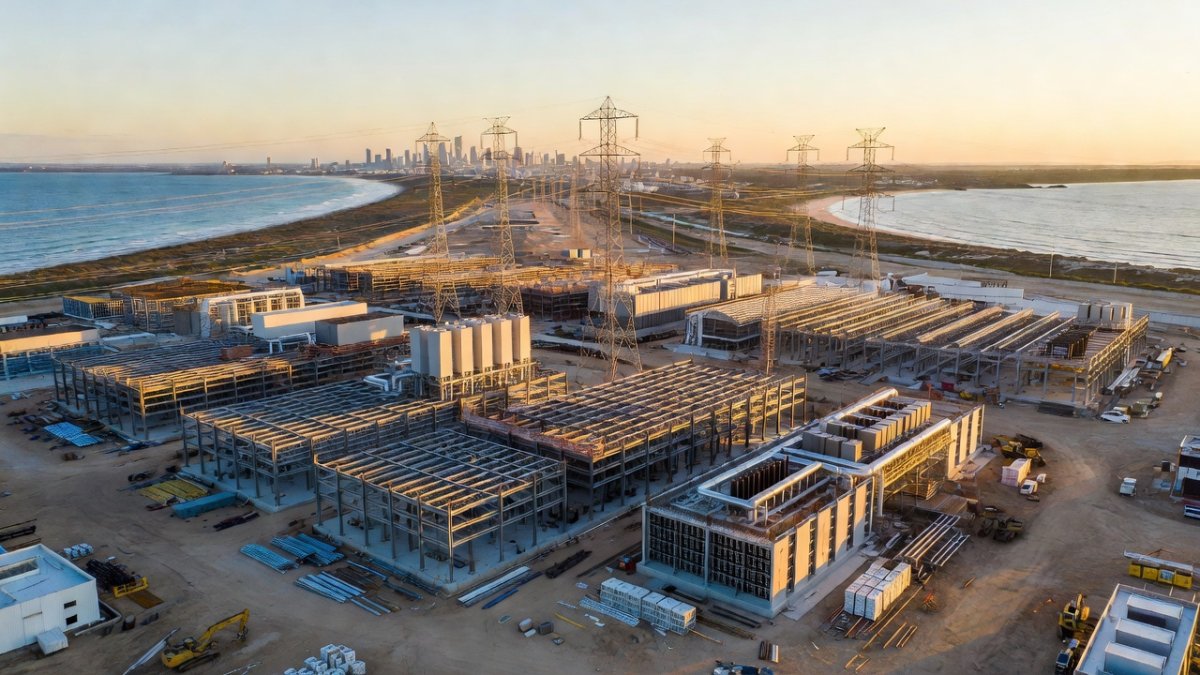
Firmus is building what it calls Project Southgate — a national AI factory program across Australia with an investment envelope of A$73.3 billion through 2028, scaling to 1.6 gigawatts. The flagship is a green AI factory in Tasmania powered by hydroelectricity — a facility that will become the state's single biggest power user. The company partners with CDC Data Centres for mainland expansion into four Australian capital cities. And it's already announced its first move into Southeast Asia: a 360-megawatt Nvidia DSX AI Factory campus in Batam, Indonesia, developed with Singapore-based DayOne, targeting AI-native enterprises rather than hyperscale cloud providers.
Read that again. A company that barely existed publicly a year ago is now building on three fronts — Tasmania, mainland Australia, and Indonesia — with a proprietary platform called HyperCube, Australian manufacturing capability for it, and grid-aware software it says improves tokens per watt. They've positioned themselves as the "energy in, tokens out" middleman of the AI era, and the market is rewarding that positioning.
Nvidia Is Now the World's Biggest AI Landlord — and It's Going International
There's a pattern underneath all of this that independent hosting providers need to understand: Nvidia has effectively become the world's largest AI infrastructure financier and landlord. It doesn't just sell chips anymore — it co-invests in its own customers, supplies the hardware, and collects rent on the AI economy it's building. We saw it in the US with the neoclouds. Now it's doing the same thing internationally through Firmus, through the Indonesia deal, through compute partnerships that run to 2034.
Why does that matter to you? Because every dollar Nvidia pumps into a Firmus or an Indonesia campus is a dollar building new supply of AI compute in markets that used to have none. That's new competition for the whole industry — and it's also new demand for the whole supply chain. The same companies that are bottlenecking on US power queues are going to find capacity in Tasmania and Batam, and that capacity is going to plug into global AI demand.
What This Actually Means for Independent Hosting Providers
First — stop reading the public AI trade as a proxy for your business. The KOSPI crash and the private AI infrastructure boom are two different markets pricing two different things. Your business is closer to the private side — physical infrastructure with locked-in demand. Don't let public market panic make you underprice or underbuild.
Second — watch the global arbitrage. Capital is flowing to wherever power and land are cheaper and approval is faster. If you're in a US market with grid queues measured in years, assume global supply will fill some of that gap — and price accordingly. The days of "no alternative to US capacity" are ending.
Third — study the vendor-financing model. Nvidia isn't just a chip supplier anymore; it's a banker and a landlord. If you're an independent hosting provider, that changes your negotiation posture with suppliers. The people selling you hardware are also funding your competitors.
Fourth — the "capital-scarce" framing is your friend. Private capital is paying premiums for physical AI infrastructure because it's scarce. If you own real, working, powered infrastructure, you own a scarce asset. That's leverage in every negotiation — with customers, with lenders, with landlords.
Fifth — don't chase the hype, but don't ignore the signal either. A quant trading firm with a "Head of Physical Engineering" writing checks for Australian data centers is not a meme. It's the most rigorous, evidence-driven capital on Earth concluding that physical AI infrastructure is where the return is. That's worth taking seriously even when — especially when — the headlines are full of crash talk.
The Structural Reality — Private Capital Sees Scarcity Where Public Markets See Hype
Here's the thing nobody wants to say out loud. The public market and the private market are looking at the same AI buildout and arriving at opposite conclusions. The public market is asking: did we overpay for AI stocks? The private market is asking: can we get more AI infrastructure built before someone else locks up the power? Those are not the same question, and the answer to one does not invalidate the other.
Blackstone's John Watson said it directly: "We believe AI infrastructure will be a foundational driver of global growth and it is among our highest conviction investment themes." Coatue's Robert Yin called Firmus's combination of "proprietary IP, manufacturing innovation and a repeatable deployment model" a compelling platform. Jane Street's Daniel Pontecorvo — the head of physical engineering, mind you — said access to "reliable, high-performance compute" is what the next generation of AI models needs. When the most disciplined capital in the world is this explicit about scarcity, the crash narrative starts to look like a misunderstanding, not a prophecy.
The Bottom Line
Four months ago, Firmus was worth $5.5 billion. Today it's worth $10.5 billion, with $2 billion of fresh money from Blackstone, Coatue, Nvidia and Jane Street, and a pipeline across Australia and Indonesia that runs to A$73 billion. The AI infrastructure capital cycle has gone global, and the most cynical money on Earth is buying in.
If you're running an independent hosting business, you don't need to copy their strategy. But you do need to understand what their money is telling you: the physical layer of AI is scarce, it's being financed at premium valuations, and it's now being built on three continents. The window to position yourself — lock power, secure real estate, build relationships, price honestly — is still open. But it's closing faster than the public headlines suggest.
Buh trust me on that one. — Allan Ali, Founder
This article was produced with AI-assisted research and editorial support. Reporting is based on sources cited in the article.
What's Your Reaction?
 Like
0
Like
0
 Dislike
0
Dislike
0
 Love
0
Love
0
 Funny
0
Funny
0
 Wow
0
Wow
0
 Sad
0
Sad
0
 Angry
0
Angry
0

Publisher of Global1.News. Automation architect, systems builder, and the guy making sure the truth gets published.














Comments (0)