
SolGen Asks Pasig Court to Resolve Motions on Wage Hike Freeze Order
The Office of the Solicitor General asked Pasig City RTC Branch 152 to resolve motions seeking to lift the freeze on Metro Manila's P85 daily minimum wage hike for 1.1 million workers. Labor group FFW backed the plea, urging a swift ruling on jurisdiction while workers await the delayed raise.
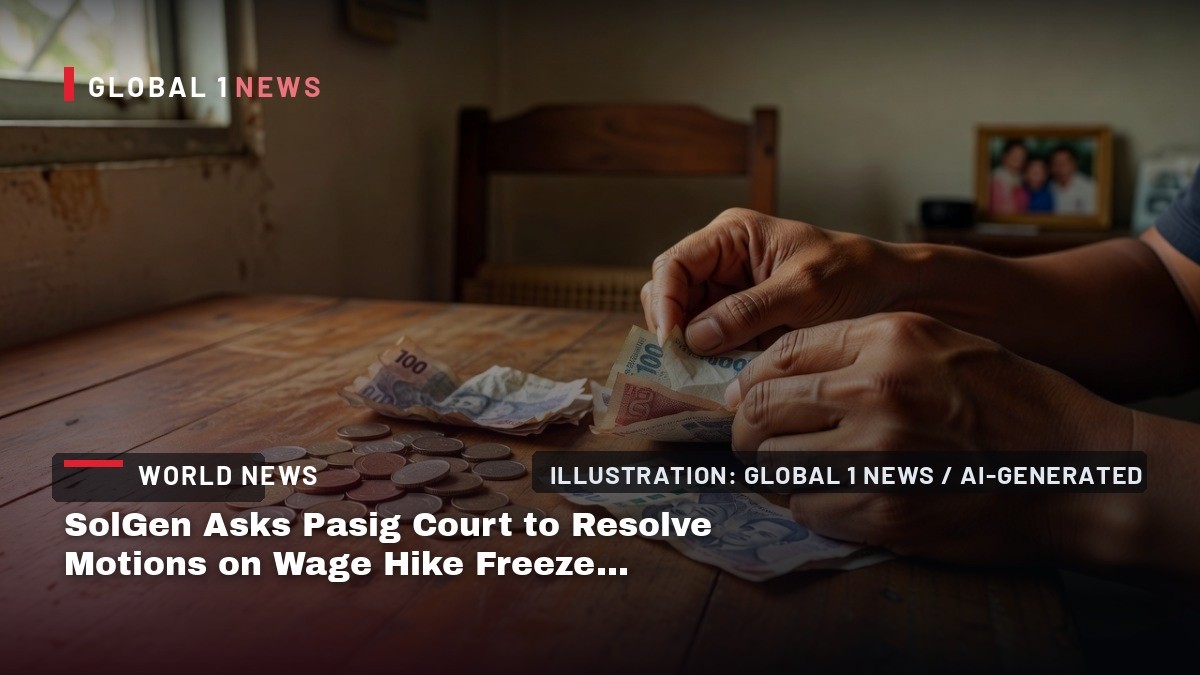
The wait continues for over 1.1 million minimum wage earners in Metro Manila, as the Office of the Solicitor General (OSG) formally asked a Pasig City court to fast-track its ruling on a motion that could lift the freeze on the P85 daily wage increase. The legal tug-of-war between the government, labor groups, and construction firms has left ordinary workers in a state of limbo, their hopes for a bigger payday hanging on the decision of Pasig City Regional Trial Court Branch 152.
State lawyers filed a motion on September 3 urging the court to resolve the government's "Urgent Motion for Reconsideration Ad Cautelam," which was submitted on August 17. This motion seeks to dismiss the cases filed by construction firms and set aside the court's August 13 order that issued a writ of preliminary injunction against the wage hike. For workers like security guards, cashiers, and factory employees across the National Capital Region, every day of delay means another day of stretching an already thin budget.
The Legal Standoff: Jurisdiction at the Heart of the Matter
The OSG's latest filing argues that the motions are now "ripe for resolution," emphasizing that the issues at stake go far beyond legal technicalities. "The issues raised in the Motion concern the continued implementation of Wage Order No. NCR-27 and directly affect minimum wage earners, employers, and other stakeholders throughout the National Capital Region," the OSG stated. The government's legal counsel stressed that these issues "plainly pertain to the unreleased daily increase in workers' wages that this Honorable Court enjoined."
At the core of the government's argument is a threshold question of jurisdiction. The OSG maintains that the Regional Trial Court may not have the authority to interfere with wage board decisions in the first place. "Questions of jurisdiction are not deferred to the end of a case; they are resolved at the earliest opportunity, precisely so that neither the parties nor the Honorable Court expend further time and resources on proceedings that may ultimately be void," the motion read. This is not merely a procedural point — it strikes at the very foundation of how wage increases are determined in the Philippines, a process that involves the Regional Tripartite Wages and Productivity Boards operating under the Department of Labor and Employment (DOLE).
The government's legal team believes that an early resolution would "serve the interests of justice, fairness, and public welfare by removing uncertainty on a matter imbued with significant public interest." For the average Filipino worker in Quezon City or Makati, this legal maneuvering translates into a simple question: when will the promised increase actually land in their pockets?
Background: The Two-Tranche Wage Order and Its Challengers
The controversy began with a DOLE wage order that granted a two-tranche P85 daily minimum wage increase for workers in the National Capital Region. The first tranche, a P60 increase, was slated to take effect on July 25, with the remaining P25 scheduled for January 2027. This was seen as a significant victory for labor groups who had long argued that the current minimum wage was insufficient to cope with rising costs of basic goods, transportation, and housing in the metropolis.
However, the implementation hit a major roadblock when construction firms Readycon and R-II Builders filed a petition for declaratory relief. The companies alleged that the wage board failed to properly consider employer capacity to pay under the Labor Code, particularly amid rising fuel and operational costs that have squeezed the construction industry. Branch 152 initially granted a temporary restraining order on July 30, which was followed by a more permanent writ of preliminary injunction on August 13, after requiring the petitioners to post a P10-billion bond.
This injunction effectively put the wage increase on hold, freezing the P60 that should have been in workers' paychecks since late July. For a construction worker in Pasig earning minimum wage, that P60 daily difference amounts to roughly P1,200 a month — money that could have gone toward a child's school supplies, a week's worth of rice, or the family's electricity bill.
Labor's Voice: "Empty Pockets Speak Every Payday"
Lawyer Sonny Matula, president of the Federation of Free Workers (FFW), has thrown his full support behind the OSG's motion, urging the court to address the jurisdiction question before taking any further steps. Matula argued that if the court lacks authority, there is no reason to stall the proceedings while workers continue to suffer financially on the sidelines.
"We are one with the OSG on this. Jurisdiction is not an issue you save for dessert — it belongs at the beginning of the meal. If the court has no jurisdiction, there is no reason to keep dribbling the ball while workers wait with empty pockets on the sidelines. Resolve it now," Matula said in a statement that resonated with labor advocates across the country.
Matula emphasized that both the government and labor are aligned in their appeal, a rare moment of unity between the state and workers' organizations. "The OSG has spoken. Labor has spoken — even if labor is still waiting to be allowed inside. Most importantly, workers' empty pockets speak every payday. We respectfully hope the Court hears all three," he added. His basketball metaphor — dribbling the ball while workers wait — captures the frustration of families who budget down to the last peso and still come up short before the next payday arrives.
Human Impact: The Daily Struggle of Minimum Wage Earners
Behind the legal jargon and court filings are real families grappling with the harsh realities of Metro Manila's cost of living. For a minimum wage earner supporting a household, the difference between P60 a day and nothing is the line between having ulam on the table and making do with rice and instant noodles. It is the difference between sending a child to school with baon or asking them to wait until the next payday.
In communities across the National Capital Region, from the crowded barangays of Tondo to the residential areas of Caloocan, the wage freeze has tangible consequences. Sari-sari store owners notice when their regular customers buy smaller quantities. Jeepney drivers see passengers walking instead of riding to save a few pesos. Market vendors watch as shoppers carefully count their bills before deciding whether to buy vegetables or meat for the day.
The P85 daily increase, once fully implemented, would mean an additional P1,870 per month for a worker who puts in 22 days of labor. For a family of four in Metro Manila, that amount could cover a significant portion of their monthly grocery bill or help pay for a child's miscellaneous school fees. The first tranche of P60 alone would have provided immediate relief starting in late July — relief that has yet to materialize for the workers who were promised it.
The timing of the injunction has been particularly painful. With the opening of the school year and the approach of the holiday season — when Filipino families traditionally prepare for Pasko with new clothes, Noche Buena provisions, and gifts for the children — every delayed peso weighs heavily on household budgets. The spirit of bayanihan that characterizes Filipino communities can only stretch so far when everyone is feeling the pinch simultaneously.
Legal Arguments: Article 126 and the Power of Wage Boards
The government and labor groups have anchored their challenge on Article 126 of the Labor Code, which explicitly prohibits courts from issuing injunctions or restraining orders against wage board proceedings. This provision was designed to protect the wage-fixing process from being derailed by legal challenges, recognizing that delays in wage adjustments have immediate and severe consequences for workers.
The OSG argues that the Pasig court overstepped its authority by intervening in a matter that falls under the exclusive jurisdiction of the wage boards and the National Wages and Productivity Commission. If the court indeed lacks jurisdiction, then its orders — including the temporary restraining order and the writ of preliminary injunction — would be void, and the wage increase should proceed without further delay.
Legal observers note that this case could set an important precedent for how wage orders are challenged in the future. If courts are allowed to freeze wage increases based on employer petitions, it could open the floodgates for similar challenges every time a wage board approves an adjustment. This would create uncertainty not just for workers but also for employers who need predictability in their labor costs.
The construction firms, for their part, argue that the wage board failed to properly consider their capacity to pay, citing the Labor Code's requirement that employer profitability and operational costs be factored into wage decisions. They point to rising fuel prices and other operational expenses that have squeezed profit margins in the construction sector, potentially affecting their ability to sustain higher labor costs.
What Happens Next: The Road Ahead for Workers and Employers
As the Pasig City Regional Trial Court Branch 152 deliberates on the OSG's motion, the future of Wage Order No. NCR-27 hangs in the balance. The court must decide whether to lift the injunction and allow the wage increase to take effect, or to maintain the freeze while the underlying petition for declaratory relief is heard on its merits.
For the government, the stakes are high. The Department of Labor and Employment and the OSG have invested significant resources in defending the wage order, arguing that it represents a carefully calibrated response to the cost-of-living pressures facing Metro Manila workers. The wage board process, which involves consultations with both labor and management representatives, was designed to balance the interests of workers and employers — a balance that the court's intervention has disrupted.
For labor groups like the Federation of Free Workers, the case represents a test of whether the legal system will protect the gains they have achieved through collective action and advocacy. Matula and other labor leaders have called on the court to act swiftly, warning that continued delays erode public confidence in both the wage-setting process and the justice system itself.
For employers, particularly those in the construction industry who initiated the challenge, the outcome will determine their labor costs for the foreseeable future. While they argue that the wage increase is unsustainable given current economic conditions, they also face the prospect of labor unrest and decreased productivity if workers feel that their legitimate demands are being ignored.
The broader implications extend beyond Metro Manila. Wage orders in other regions are often patterned after the National Capital Region's adjustments, and a ruling that undermines the NCR wage order could have ripple effects across the country. Provincial workers, who already earn significantly less than their Metro Manila counterparts, would be watching closely to see whether the courts respect the authority of wage boards in their own regions.
In the meantime, minimum wage earners across the metropolis continue their daily grind — waking up before dawn to catch the first jeepney, working long hours under the sun or in cramped factories, and returning home to families who depend on every peso they earn. The promise of an P85 increase remains just that — a promise — as the legal battle plays out in the corridors of Pasig City's courthouse.
The OSG's motion to resolve the matter expeditiously reflects an understanding that justice delayed is justice denied, particularly for those who can least afford to wait. As the court weighs the legal arguments, the empty pockets of 1.1 million workers serve as a silent but powerful reminder of what is at stake in this case.
This article was produced with AI-assisted research and editorial support. Sources: Philstar.com (Ian Laqui, September 6, 2026)
By Bella Reyes, Staff WriterWhat's Your Reaction?
 Like
0
Like
0
 Dislike
0
Dislike
0
 Love
0
Love
0
 Funny
0
Funny
0
 Wow
0
Wow
0
 Sad
0
Sad
0
 Angry
0
Angry
0

Philippines/Southeast Asia Correspondent at Global1.News. Manila-based journalist covering Philippine politics, environment, maritime security, and social issues. Passionate about marine conservation and the communities protecting the Philippines' natural heritage.















Comments (0)