
Sidi Bou Said's UNESCO Inscription Leaves Residents Walking on Air
Two weeks after the world's heritage guardians gathered in South Korea and placed one of North Africa's most beloved cliffside villages on the global map, the people of Sidi Bou Said are still glowing with pride.
Two weeks after the world's heritage guardians gathered in South Korea and placed one of North Africa's most beloved cliffside villages on the global map, the people of Sidi Bou Said are still glowing with pride. When UNESCO's World Heritage Committee met in Busan and inscribed the village on the World Heritage List on July 25, 2026, it was more than a certificate for postcard-perfect streets — it was recognition of centuries of spiritual, architectural and cultural meaning that Tunisia has carried along the shores of the Mediterranean.
Sidi Bou Said's UNESCO Inscription Leaves Residents Walking on Air
Tunis, Tunisia — The blue-and-white village perched on a cliff overlooking the Gulf of Tunis has become Tunisia's tenth World Heritage property, and its residents say the honour belongs to everyone who has ever loved the village. From the Sufi saint whose name it carries to the artists it inspired and the visitors who now cross oceans to see it, Sidi Bou Said's story is one of heritage alive in everyday life.
A Village Built Around a Saint: The Spiritual Heart of Sidi Bou Said
The village carries the name of Abou Saïd Khalaf Ibn Yahya El Tamimi El Beji, a Sufi master and saint who lived between the 12th and 13th centuries. His mausoleum sits at the heart of the settlement, and it was around this sacred tomb that the entire village gradually grew, stone by stone, alley by alley. For the people of this region, the saint was not a distant historical figure but a living presence whose spiritual legacy shaped the very layout of their homes and public squares.
Beginning in the 16th century, Tunisia's ruling dynasties understood something profound about this place. They linked their political legitimacy to the baraka, the spiritual blessing, attributed to the saint. Royal patronage ensured the sanctuary's continuity, with rulers funding repairs, expansions and ceremonies that kept the site vibrant across generations. This was not mere superstition — it was statecraft woven into faith, a recognition that spiritual authority and political power could reinforce each other in the public imagination.
UNESCO's decision recognised this deep relationship. The official name inscribed on the World Heritage List is "Village of Sidi Bou Saïd," and the site's Outstanding Universal Value lies in its testimony to the Maghrebi tradition of sanctuary villages. These are settlements that grew around religious figures, becoming centres of pilgrimage, learning and community life that radiated influence far beyond their physical boundaries.
Walking through the village today, one feels that spiritual layer beneath the tourist bustle. The mausoleum remains a place of quiet devotion, where locals still come to pay respects, light candles and seek blessings. The saint's presence is not a museum exhibit; it is woven into the daily rhythm of a community that has lived alongside his memory for eight centuries.
For African readers, this pattern will feel familiar. Across the continent, from the Sufi brotherhoods of Senegal to the maraboutic traditions of the Sahel, spiritual figures have anchored communities and shaped urban landscapes. Sidi Bou Said is a North African expression of a broader continental truth: faith builds cities, and cities carry faith forward.
Blue and White on the Cliff: Why UNESCO Said Yes
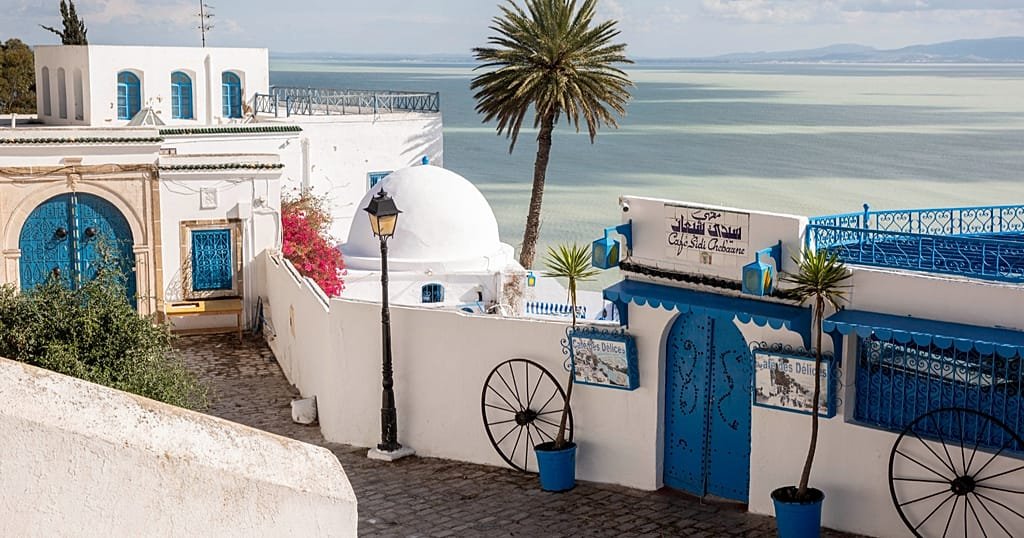
The village sits on a steep cliff overlooking the Gulf of Tunis, about 20 kilometres northeast of the capital, next to the ancient ruins of Carthage. From this elevated perch, residents and visitors alike gaze across the Mediterranean, watching the light shift from morning gold to afternoon silver to evening amber. The setting alone is breathtaking, but it is the human handiwork that makes Sidi Bou Said extraordinary.
Whitewashed walls, studded blue doors, mashrabiyas — those intricate wooden lattice screens — sloping alleyways and Mediterranean light combine to create a visual harmony that has captivated travellers for centuries. The blue and white palette is not accidental; it reflects both practical choices (white to deflect heat, blue to ward off insects and evil spirits) and an aesthetic sensibility that has become the village's signature.
The listed property covers 76.54 hectares, with an additional 84.44-hectare buffer zone protecting the surrounding landscape from inappropriate development. This is a substantial area, encompassing not just the famous postcard views but the full urban fabric of the village — its residential quarters, public spaces, religious buildings and the natural cliff edges that define its character.
UNESCO inscribed the village under Cultural Criterion (iii), which recognises exceptional testimony to a cultural tradition or civilisation. The decision at the 48th session of the World Heritage Committee in Busan, South Korea, held from July 19 to 29, 2026, was unanimous. Every member state on the committee agreed that Sidi Bou Said met the highest standards of global heritage significance.
This inscription makes Tunisia's tenth World Heritage property. The country now holds nine cultural sites and one natural site, Ichkeul National Park. Sidi Bou Said joins an illustrious list: Carthage, the Medina of Tunis, Kairouan, El Jem, Dougga, Kerkuane, the Medina of Sousse and Djerba. Each of these sites tells a different chapter of Tunisia's story, and together they form one of Africa's richest heritage portfolios.
From Sanctuary to Seaside Retreat: Centuries of History
Between the 18th and 20th centuries, the Husainid beys and leading families of Tunis discovered Sidi Bou Said as a summer retreat. They built elegant residences here, drawn by the cool sea breezes, the spiritual atmosphere and the stunning views. The village retained its religious centre while becoming a sought-after destination for political and urban elites who wanted to escape the heat and bustle of the capital.
Palaces, aristocratic residences, fountains, public spaces and holiday homes enriched the urban fabric over these centuries. The Arab-Islamic urban layout, organised around the religious complex, merged seamlessly with 19th and 20th century residential architecture. The result is a layered townscape where different eras coexist without conflict, each generation adding to the beauty rather than detracting from it.
About 7,900 residents live in Sidi Bou Said today. This is not a ghost town or a preserved relic; it is a living community where families raise children, run shops, celebrate weddings and bury their dead. The UNESCO listing recognises that the village's harmony of topography, architecture, urban layout, emblematic colours and spiritual atmosphere is a rare achievement — one that has survived centuries of change.
For centuries, Sidi Bou Said has been a meeting point of power, spirituality and urban space. The beys built their palaces here, the Sufis maintained their rituals, and ordinary Tunisians made their homes in the winding streets. This convergence of different social worlds in a single small village is part of what makes it so remarkable.
The village's evolution mirrors broader patterns in North African urban history. As cities grew and modernised, many historic quarters were lost or degraded. Sidi Bou Said, perhaps because of its beauty and its spiritual significance, managed to preserve its character while adapting to new times. That resilience is exactly what UNESCO seeks to protect and celebrate.
'It Is the Face of Tunisia': Residents and Visitors Celebrate
Aymen Ghamrasni, a resident of the village, cannot hide his joy. "I know many foreigners and Tunisians who come from different regions specifically to visit Sidi Bou Said," he says. "Everyone envies us for having it. They tell us we are lucky to have this village." His words capture the pride that has swept through the community since the UNESCO announcement.
Ahmed Achouilia, an Iraqi tour guide who has brought many groups to the village, puts it even more simply. "It is the face of Tunisia," he declares. "Anyone who goes to Tunisia should visit Sidi Bou Said. It has become a global destination, and that is how we think in Iraq." For Achouilia, the village represents everything that makes Tunisia special — beauty, history, warmth and welcome.
Yassine Rhimi, a Syrian tourist visiting in recent weeks, is equally effusive. "Sidi Bou Said is the most beautiful village in Tunisia," he says, "distinguished, even by Guinness (World Records), with its blue and white colors. Tunisia has a beautiful and wonderful heritage." His reference to Guinness reflects how the village's fame has spread far beyond North Africa.
Tour guides across Tunisia say the village has become increasingly popular with visitors from across the world. European tourists, Gulf Arabs, Americans, Asians and Africans all make the short journey from Tunis to experience the blue-and-white magic. The UNESCO inscription is expected to accelerate this trend, bringing even more international attention to a site that was already beloved.
The inscription came as a two-week-old joy still fresh in the village. Residents speak of it with the excitement of a family celebrating a wedding — the initial shock, the flood of congratulations, the slow settling into a new reality of global recognition. And the pride extends across the country, as Tunisians from different regions make pilgrimages to the village to share in the honour.
An Artists' Village That Inspired the World
Sidi Bou Said has long attracted artists and intellectuals drawn by its unique light and colour. The German painter Paul Klee visited the village and was profoundly inspired by what he saw, incorporating its palette and forms into his revolutionary artistic vision. His fellow painters August Macke and Louis Moilliet also worked here, creating works that would influence the development of modern art in Europe.
The French artist Gustave-Henri Jossot went further — he made Sidi Bou Said his home, converting to Islam and living out his days in the village he had fallen in love with. His presence symbolises the deep connection between this small Tunisian village and the wider world of creative expression. The village's palette of white and blue has influenced art, photography and design far beyond Tunisia's borders.
This artistic tradition connects to broader African creative currents. Just as Senegal's Saint-Louis and Gorée have inspired painters, musicians and writers, Sidi Bou Said shows how African and Arab heritage villages feed global creativity. The colours, the light, the architecture, the atmosphere — these are raw materials that artists transform into works that speak to people everywhere.
The village's atmosphere of serenity and beauty continues to attract contemporary creators. Young Tunisian photographers use its streets as backdrops for fashion shoots. Musicians compose songs about its charm. Filmmakers choose it as a location for productions seeking authentic Mediterranean beauty. The creative energy that Paul Klee felt in the early 20th century is still alive today.
UNESCO noted that the unique setting has inspired artists and continues to attract visitors seeking beauty and serenity. This is not a static heritage site but a living source of inspiration. The blue doors that artists painted a century ago are the same blue doors that today's Instagram photographers capture for audiences of millions.
What UNESCO Recognition Means for Tunisia's Cultural Heritage
The inscription brings international recognition but also responsibility. UNESCO provides countries with technical support and professional training to maintain listed locations, helping local authorities develop the skills needed to protect and manage heritage sites. For Tunisia, this means access to expertise that can help preserve Sidi Bou Said for future generations.
Tunisia must now protect the village from several threats. Unstable cliffs along the coastline require ongoing geological monitoring and intervention. Incompatible construction, alterations to historic homes and the impact of tourism that has at times become excessive all pose challenges. Landslide protection work is expected to begin in the coming weeks, a concrete sign that the UNESCO listing is already translating into action.
Cultural elements associated with the village — malouf music, the Issaouia tradition, jasmine craftsmanship and the Kharja procession held on the night of the Prophet's birthday (Mawlid) — were not separately inscribed as Intangible Cultural Heritage. But they contribute to the site's living identity, giving it a cultural depth that goes beyond bricks and mortar. The UNESCO listing recognises a living tradition, not a museum piece.
For Tunisia, the tenth site adds to a heritage economy that matters for jobs, tourism and national pride. Heritage tourism is a significant employer in Tunisia, supporting guides, hotel workers, artisans, restaurateurs and countless others. Each UNESCO listing strengthens the country's brand as a destination where history is not just preserved but lived.
The recognition also sends a signal to the international community that Tunisia remains open, stable and proud of its identity. In a region that has faced turbulence, the unanimous UNESCO decision is a vote of confidence in the country's ability to protect and celebrate its heritage.
What to Watch For
The coming weeks will bring the first concrete protection works, including landslide stabilisation along the vulnerable cliff edges. These engineering interventions are essential to ensure that the village's physical fabric remains intact. Residents will be watching closely to see that the work is done sensitively, without damaging the very character that earned UNESCO recognition.
How Tunisia balances tourism growth with preservation will be watched across the continent. Sidi Bou Said is not the first African heritage site to face the challenge of popularity — from Zanzibar's Stone Town to Mali's Djenné, the tension between welcoming visitors and protecting authenticity is a recurring theme. Tunisia's approach will offer lessons for other countries navigating the same path.
The village's example is a lesson for other African heritage sites seeking UNESCO recognition. The Comoros medinas were inscribed in the same year, showing that the World Heritage Committee is increasingly attentive to African heritage. African countries increasingly use UNESCO listing to protect and promote cultural identity, and each success story strengthens the case for others.
The recognition gives Sidi Bou Said a stronger platform for sustainable tourism. With UNESCO backing, the village can attract visitors who value authenticity and are willing to support preservation efforts. This is a different kind of tourism from mass-market beach holidays — it is cultural tourism that generates revenue while respecting the community's way of life.
For African readers, the story is a reminder that heritage is not just the past but a living asset that communities protect together. Sidi Bou Said's blue doors now open onto a new chapter of global recognition. The village that has inspired artists, welcomed pilgrims and sheltered generations of Tunisians now belongs to the world — while remaining, above all, home to the people who love it most.
By Amara Diop, Staff Writer
This article was produced with AI-assisted research and editorial support. Reporting is based on sources cited in the article.
What's Your Reaction?
 Like
0
Like
0
 Dislike
0
Dislike
0
 Love
0
Love
0
 Funny
0
Funny
0
 Wow
0
Wow
0
 Sad
0
Sad
0
 Angry
0
Angry
0

West Africa/Sahel Correspondent at Global1.News. Dakar-based journalist covering politics, security, climate, and development across Francophone and Anglophone West Africa. Tells the stories of a region undergoing profound transformation.











Comments (0)