
Schengen Under Siege: Migration, Hybrid Warfare, and the Return of Europe's Internal Borders
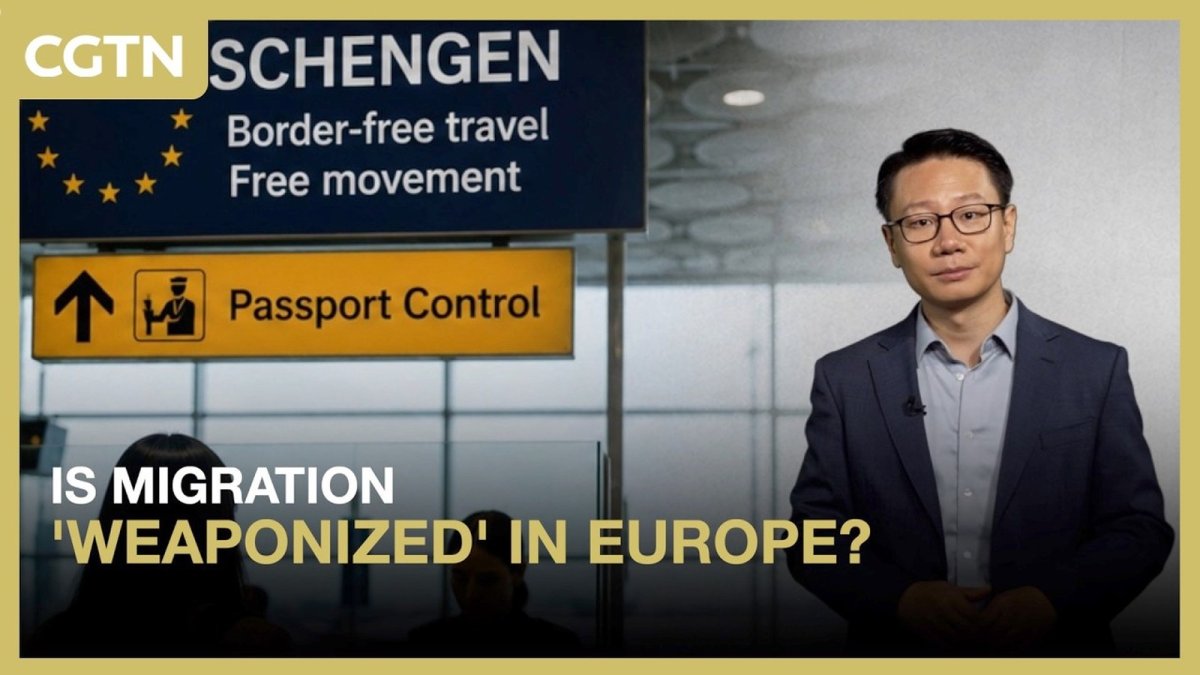
CGTN's Li Jianhua asks whether migration is being "weaponized" in Europe as eight Schengen states keep internal border checks through late 2026. The report examines the Ceuta crisis, Brussels' EES/ETIAS pushback, Russia-Belarus hybrid tactics, and Germany's border paradox.
In a recent CGTN Europe report, correspondent Li Jianhua travels from the sun-scorched fences of Ceuta to the congested commuter crossings of the German-Polish border, posing a question that has moved from the fringes to the center of European politics: Is migration being "weaponized," and can the Schengen Area survive the strain? The report captures a continent grappling with a paradox—a border-free zone increasingly defined by its internal barriers. As of August 2026, eight Schengen member states maintain internal border checks, a patchwork of controls that threatens to unravel the bloc's most tangible achievement. This is not merely a logistical inconvenience; it is a geopolitical stress test for the European Union, with implications that reach far beyond the continent's shores.
 The Commission's argument rests on two technological pillars. The Entry/Exit System (EES), fully operational since April 2025, digitally registers non-EU travelers at external borders using facial images and fingerprints. The European Travel Information and Authorisation System (ETIAS), expected to be operational by the end of 2026, will require visa-exempt third-country nationals to obtain pre-travel authorization. Together, these systems are designed to provide the oversight that internal checks were meant to deliver, but without the friction. The Commission recommends replacing stationary border posts with "non-systematic police checks or mobile biometric identification and vehicle tracking technologies." This is a technocratic solution to a deeply political problem, and its success is far from assured.

A Promise Under Pressure: The Fragmentation of Free Movement
The Schengen Area, which guarantees passport-free travel for over 400 million people across 29 countries, is legally designed to operate without internal borders. However, the European Commission's notifications of August 3, 2026, confirm that Austria, France, Germany, Italy, Netherlands, Norway, Poland, and Sweden have all extended internal checks through late 2026. These are not temporary aberrations but have become semi-permanent fixtures of European life. Germany, for instance, has maintained some form of control almost continuously since September 2015, when it first reintroduced checks at its Austrian border during the peak of the migrant crisis. The legal basis for these measures lies in Articles 25-28 of the Schengen Borders Code (SBC), which permit the temporary reintroduction of controls in the event of a serious threat to public policy or internal security. The provisions are meant to be a last resort, limited in time and scope. Yet the current situation stretches the definition of "temporary" to its breaking point. The mid-2024 amendment to the SBC clarified the rules and, notably, added explicit language addressing the "instrumentalization of immigration"—a recognition that migration flows can be deliberately engineered by hostile actors. This legal evolution reflects a broader shift in Brussels, where the language of crisis management has replaced the idealism of open borders.The Ceuta Catalyst: Spain's Exclave and the Limits of Schengen
The immediate trigger for the latest round of border restrictions is the 2026 Ceuta crisis. Since late July, an estimated 80,000 people—predominantly young men—have breached the border from Morocco into the Spanish autonomous city of Ceuta, according to Spanish and international estimates, with smaller numbers attempting the crossing at Melilla, some 400 kilometers along the Mediterranean coast. The influx has overwhelmed local reception facilities and sent shockwaves through Madrid and Brussels. Notably, Spain's interior ministry data shows irregular arrivals to the rest of Spain actually fell from 17,990 in the first half of 2025 to 12,138 in the first half of 2026, making the Ceuta surge a stark anomaly that has nonetheless dominated the political agenda. The crisis directly prompted Italy's decision, effective August 1, 2026, to impose air and sea border checks on its borders with Spain. Rome's notification explicitly cites the Ceuta situation and the risk of secondary movements within Schengen—the fear that migrants who reach Spanish soil will simply board a flight or ferry to another member state. This cascading effect is the nightmare scenario for the Commission: a localized crisis at the EU's southern periphery triggering a domino effect of internal controls across the continent. The Ceuta episode also echoes the May 2021 crisis, when roughly 8,000 to 10,000 migrants entered the exclave within days after Morocco loosened border controls amid a diplomatic row over Western Sahara. The pattern is familiar, but the scale is unprecedented.Brussels Pushes Back: EES, ETIAS, and the Commission's Case
The European Commission is fighting back against the fragmentation of Schengen. On June 2, 2026, it formally asked nine member states—France, Germany, Sweden, Austria, Italy, Denmark, Norway, Slovenia, and the Netherlands—to "work towards phasing out and gradually lifting internal border controls." Magnus Brunner, the EU Commissioner for Internal Affairs and Migration, framed the request as a logical step in the bloc's migration management overhaul. "The European Union is putting in place the largest reform of our migration management system," Brunner stated. "We are rolling out the most modern border management systems in the world. With these conditions in place, Member States are in the position to work towards phasing out controls at internal borders."
The Commission's argument rests on two technological pillars. The Entry/Exit System (EES), fully operational since April 2025, digitally registers non-EU travelers at external borders using facial images and fingerprints. The European Travel Information and Authorisation System (ETIAS), expected to be operational by the end of 2026, will require visa-exempt third-country nationals to obtain pre-travel authorization. Together, these systems are designed to provide the oversight that internal checks were meant to deliver, but without the friction. The Commission recommends replacing stationary border posts with "non-systematic police checks or mobile biometric identification and vehicle tracking technologies." This is a technocratic solution to a deeply political problem, and its success is far from assured.
The Weaponization Question: Hybrid Warfare and the Instrumentalization of Migration
The term "weaponization" carries a double meaning in the current debate. The first is literal: since 2021, Belarus and Russia have deliberately engineered migration flows as a hybrid warfare tactic against the EU. The European Parliament, in a 2025 written question (E-001633/2025), confirmed that "multiple credible sources confirm that foreign state actors, among them the Russian Federation and Belarus, have deliberately weaponised illegal migration as part of their hybrid warfare strategy, targeting EU Member States such as Finland, Poland, Lithuania and Latvia, as well as Norway." The Council of the Baltic Sea States (CBSS), in a June 2026 policy brief, documented how these actors have "turned vulnerable people in migration into leverage against neighbouring states" through simplified visa procedures, charter routes, and organized facilitation. Finland's response was drastic: it fully closed its eastern land border with Russia from November 2023 to April 2024 over suspected orchestration of migrant arrivals. Poland built a physical wall on its border with Belarus following the 2021 crisis. These are not abstract threats; they are concrete security challenges that have reshaped the EU's eastern flank. The second meaning of "weaponization" is domestic: political parties across Germany, France, the Netherlands, Austria, and Sweden are using migration to mobilize voters, eroding the cross-party consensus that built Schengen. The June 2024 European Parliament elections shifted the political center of gravity rightward, and the New Pact on Migration and Asylum, agreed in 2024, has done little to cool the rhetoric.Germany's Border Paradox: Security, Commuters, and Political Calculus
Germany sits at the heart of the Schengen dilemma. Its controls, in place since March 16, 2026, cover land borders with France, Luxembourg, Belgium, Netherlands, Denmark, Austria, Switzerland, Czechia, and Poland—a near-total ring around the country. The official justification cites high irregular migration, smuggling networks, and strain on the asylum system. But the Commission's opinion on Germany's measures is pointedly critical: "Despite the efforts by the German authorities to mitigate the impact of internal border control, the Commission has received many complaints from citizens and businesses… Especially at the German-Luxembourgish, German-Polish and the German-Dutch borders, the reintroduction of internal border controls have caused difficulties to local border communities, in particular cross-border workers." The human cost is significant. Cross-border commuters—from Luxembourg's banking corridor to Poland's industrial belt—face daily bottlenecks that disrupt businesses and personal lives alike. Yet Berlin's calculus is political as much as practical. Chancellor Friedrich Merz's centre-right government has made border control a signature issue: his five-point plan, rolled out after the coalition took office, tightens Germany's borders and accelerates deportations while fast-tracking skilled-worker visas to fill critical labour gaps. For the government, the checks are a visible demonstration of control, even if their efficacy is debated. The paradox is that Germany—the country that opened its borders to over a million refugees in 2015—now presides over the most extensive internal controls in the bloc.
What a Fragmented Schengen Means for Europe and China
The stakes extend far beyond European borders. A fragmented Schengen weakens the EU's single market, undermines labor mobility, and erodes the bloc's image as a "normative power" that projects values of openness and cooperation. For the Global South, the message is troubling: the West's commitment to free movement is conditional and reversible. For Beijing, the developments are watched with keen interest. A Europe preoccupied with internal border disputes is a less cohesive actor on the world stage, which aligns with China's multipolar agenda. The CGTN framing highlights the contradictions in Western governance—the tension between liberal ideals and sovereign prerogatives—while implicitly contrasting Europe's struggles with China's own managed migration model. The second-order effects are already visible. Cross-border regions are suffering economic losses, and the EU's credibility in negotiating migration partnerships with African and Middle Eastern countries is diminished. If internal controls become permanent, the Schengen Area will cease to be a border-free zone and become a patchwork of semi-permeable frontiers. The Commission's push for EES and ETIAS is a bet that technology can replace trust, but technology cannot address the underlying political dynamics. The question Li Jianhua poses—can Europe keep its internal borders open?—remains unanswered. What is clear is that the answer will shape not only Europe's future but also the global order's trajectory. By Prof. Marcus Chen, Staff WriterThis article was produced with AI-assisted research and editorial support. Reporting is based on sources cited in the article.
What's Your Reaction?
 Like
0
Like
0
 Dislike
0
Dislike
0
 Love
0
Love
0
 Funny
0
Funny
0
 Wow
0
Wow
0
 Sad
0
Sad
0
 Angry
0
Angry
0

Marcus Chen
World Politics Analyst at Global1.News. Based in Beijing, covering US-China relations, global trade, and geopolitical strategy. Brings deep analytical perspective to the power dynamics shaping international affairs.













Comments (0)