
Russia Says Syria Base Deal Will Boost Ties, Source Says Some Russian Forces Will Stay
Russia and Syria have signed a memorandum of understanding reshaping Moscow's Mediterranean military footprint, converting the Tartus naval base and Khmeimim air base into joint training centers while civilian facilities return to Damascus.
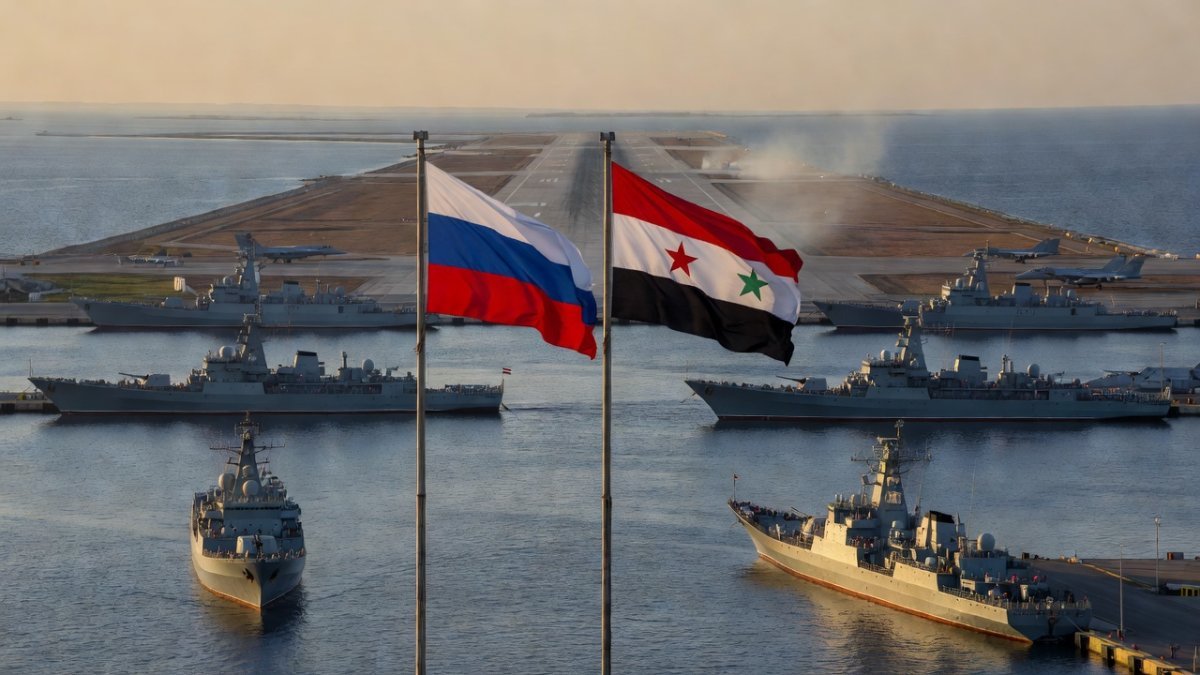
Moscow and Damascus Sign Memorandum Reshaping Russia's Mediterranean Military Footprint
MOSCOW — Russia and Syria have concluded a memorandum of understanding that fundamentally restructures the status of Moscow's two strategic military installations on Syria's Mediterranean coast, ending roughly 18 months of delicate negotiations that have carried profound implications for the balance of power in the Eastern Mediterranean.
The agreement, announced on Sunday by Syria's Foreign Ministry, transforms the naval facility at Tartus and the Khmeimim air base into joint Russia-Syrian training and rehabilitation centers. The arrangement is designed to protect the mutual interests of both states, according to the ministry's official statement, and marks the first formal redefinition of Russia's military presence in Syria since the fall of former President Bashar Assad in December 2024.
Syrian Foreign Minister Asaad al-Shaibani personally visited both installations on Sunday "to inspect the facilities and installations included in the historic memorandum of understanding," according to Syria's state news agency SANA. The visit underscores the political weight Damascus attaches to the agreement, which comes as Syria's interim government seeks to balance its relationships with Russia, the West, and regional powers.
The Core Terms: What Changes and What Remains
Under the terms of the memorandum, civilian infrastructure at both bases will be handed over to Syrian control. Damascus will assume operation of the civilian facilities at Khmeimim Airport, including its commercial terminal and associated infrastructure. At Tartus port, the Syrian side will take over the fourth commercial berth and its associated warehouses, according to the General Authority for Land and Sea Ports and Customs.
The handover of commercial sites previously operated by Russia inside Tartus Port, including berth No. 4, has already been completed, the authority confirmed. This represents a tangible, immediate shift in operational control that goes beyond the symbolic framework of the memorandum.
However, a Syrian source familiar with the terms told reporters that Russian forces will remain stationed at the newly designated training centers. The source did not provide specific numbers, and neither Moscow nor Damascus has publicly disclosed the scale of the residual Russian military presence. This ambiguity is likely deliberate, allowing both governments to calibrate their public messaging for domestic and international audiences.
Russia's Defense Ministry: A Boost to Bilateral Ties
Russia's Defense Ministry responded to the agreement with a brief statement asserting that the deal "will boost ties" between Moscow and Damascus. The ministry's characterization is notable for its restraint; there is no triumphalist language, no mention of permanent basing rights, and no reference to Russia's broader strategic posture in the region.
This measured tone reflects the reality that Moscow's position in Syria has shifted dramatically since the fall of Assad. Russia did not intervene when rebel forces advanced on Damascus in December 2024, a decision that dealt a major blow to Moscow's credibility as a security guarantor in the region. In the aftermath, Russian troops gradually withdrew from most of Syria, leaving only the contingents stationed at Tartus and Khmeimim.
The two bases represent Russia's only official military installations outside the territory of the former Soviet Union. Tartus serves as Moscow's sole Mediterranean repair and replenishment hub, a critical asset for projecting naval power into the region. Khmeimim has functioned as a staging post for Russian military contractors rotating in and out of Africa, where Moscow has expanded its influence through the Africa Corps and other paramilitary entities.
The Negotiating Context: Eighteen Months of Delicate Diplomacy
The memorandum follows approximately 18 months of negotiations that began in earnest after Syria's interim President Ahmed al-Sharaa consolidated power in Damascus. Al-Sharaa has visited Moscow twice and met with Russian President Vladimir Putin on both occasions, with the future of the two bases consistently topping the agenda.
These high-level meetings reflect a pragmatic calculation on both sides. Russia needs its Mediterranean foothold and its logistics route to Africa, where it has invested significant political and military capital. Syria, for its part, needs investment, leverage, and diplomatic cover as it confronts Western sanctions and the enormous costs of reconstruction after more than a decade of civil war.
Analysts familiar with the negotiations note that "they need each other," a formulation that captures the mutual dependency underlying the agreement. Russia cannot easily replicate the strategic value of Tartus and Khmeimim elsewhere in the region, while Syria cannot easily replace the diplomatic and economic benefits that Moscow provides on the international stage.
Strategic Implications for the Eastern Mediterranean
The agreement could mark a significant change in Russia's military footprint in the Eastern Mediterranean, though the precise nature of that change remains unclear. The transformation of the two bases into joint training and rehabilitation centers suggests a reduced Russian operational presence, but the continued stationing of Russian forces at these facilities indicates that Moscow retains a meaningful military foothold.
Washington, Israel, and Turkey are all watching the arrangement closely, given their own interests in Syria and the broader region. The United States maintains a limited military presence in eastern Syria, primarily focused on counter-ISIS operations and supporting its Kurdish allies. Israel has conducted repeated strikes against Iranian-linked targets inside Syria and views any foreign military presence with suspicion. Turkey, which has backed opposition forces and maintains its own military positions in northern Syria, has a direct stake in the balance of power in the country.
The redefinition of Russia's role at Tartus and Khmeimim could also affect Moscow's ability to project naval power into the Mediterranean. The Tartus facility has been essential for the repair and replenishment of Russian warships operating in the region, and any reduction in its operational capacity would constrain Russia's naval options.
Russia's Broader Position: From Assad's Fall to Pragmatic Accommodation
The agreement must be understood within the broader context of Russia's diminished position in the Middle East following Assad's ouster. Moscow's decision not to intervene during the final advance on Damascus in December 2024 was a strategic choice that preserved Russian forces but cost Moscow significant political capital among its allies in the region.
Since then, the Kremlin has pursued a policy of pragmatic accommodation with Syria's new leadership. Putin's two meetings with al-Sharaa signal a willingness to work with the new government in Damascus, even as Moscow maintains its relationships with other regional actors. The memorandum on the bases represents the most concrete manifestation of this approach.
For the Kremlin, the agreement also carries domestic significance. Russia's military presence in Syria has been presented to the Russian public as a demonstration of Moscow's global reach and its willingness to defend its interests abroad. The transformation of the bases into joint facilities allows the Kremlin to claim a continued presence while acknowledging the changed political reality in Damascus.
What Comes Next: Implementation and Verification
The memorandum of understanding is an initial framework agreement, and the details of its implementation remain to be worked out. The Syrian source familiar with the terms indicated that Russian forces would remain at the training centers, but the absence of specific numbers suggests that this issue remains sensitive and potentially unresolved.
The handover of civilian facilities at both bases has already begun, with Syrian authorities taking control of commercial operations at Tartus port. The pace and scope of further implementation will be closely monitored by regional capitals and by Moscow's domestic audience.
Questions also remain about the legal status of the Russian forces that will remain at the facilities. The memorandum transforms the bases into joint training and rehabilitation centers, but the precise legal framework governing Russian military personnel in Syria has not been publicly detailed. This ambiguity could create complications in the future, particularly if the security situation in Syria deteriorates or if regional tensions escalate.
Regional Reactions and the Road Ahead
Initial reactions to the agreement have been measured, with regional governments adopting a wait-and-see approach. Turkey, which has its own complex relationship with both Russia and Syria, will be watching the implementation closely. Israel, which has consistently opposed any foreign military presence in Syria that could threaten its security, has not yet issued a formal response.
The United States, which has maintained sanctions on Syria and has limited diplomatic engagement with the new government in Damascus, has not commented publicly on the memorandum. Washington's position on Russia's military presence in Syria has been consistent: the United States opposes any foreign military intervention that undermines Syrian sovereignty or regional stability.
For Moscow, the agreement represents a pragmatic accommodation with the new political reality in Damascus. Russia has preserved a military foothold in the Mediterranean and maintained its logistics route to Africa, while accepting a reduced role in Syria's internal affairs. For Damascus, the agreement provides a measure of diplomatic cover and the prospect of continued Russian investment and cooperation.
The coming months will reveal whether this memorandum translates into a stable, long-term arrangement or whether it represents merely the first step in a longer process of renegotiation. Both Moscow and Damascus have demonstrated a capacity for pragmatic deal-making, but the underlying tensions and competing interests in the region remain unresolved.
By Irina Volkov, Staff Writer
This article was produced with AI-assisted research and editorial support. Sources: The Moscow Times, SANA, AP, Al Jazeera.
What's Your Reaction?
 Like
0
Like
0
 Dislike
0
Dislike
0
 Love
0
Love
0
 Funny
0
Funny
0
 Wow
0
Wow
0
 Sad
0
Sad
0
 Angry
0
Angry
0

Russia/Eastern Europe Correspondent at Global1.News. Covering Russian politics, energy, security, and the shifting dynamics of the post-Soviet space. Provides clear-eyed analysis on one of the world's most opaque regions.










Comments (0)