
Pakistan's solar revolution has been so successful the national grid is crumbling
In the months since his wedding, Faisal Shahzad of rural Punjab has turned a modest 340‑watt solar panel into a household staple, powering an air‑cooler from sunrise to sunset and allowing his family to forgo the national grid during daylight hours.
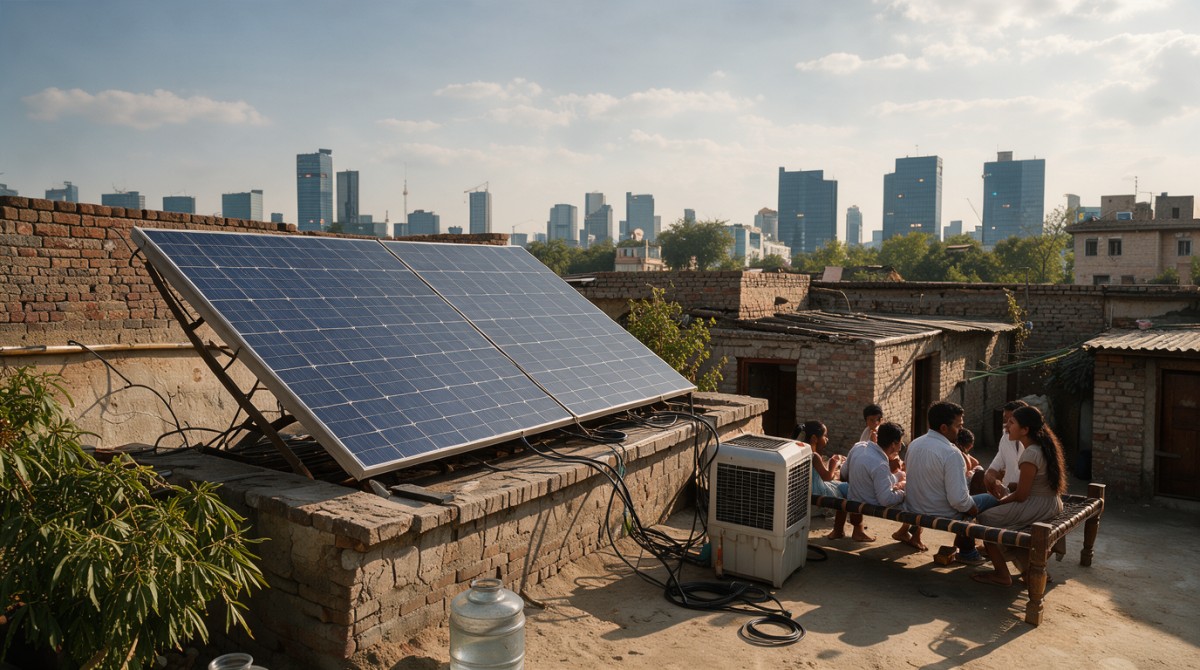
In the months since his wedding, Faisal Shahzad of rural Punjab has turned a modest 340‑watt solar panel into a household staple, powering an air‑cooler from sunrise to sunset and allowing his family to forgo the national grid during daylight hours. His experience mirrors a sweeping transformation across Pakistan, where the share of electricity generated from solar power has surged from a marginal 1 % in 2018 to roughly 28 % in 2025, according to the domestic think‑tank Renewables First. An estimated seven million households now own solar panels, and the technology has become a common dowry item, often replacing traditional gifts such as motorbikes or silverware.
From Luxury to Necessity: The Rise of Household Solar
The rapid uptake of solar panels has been driven less by top‑down policy than by the pressing need of ordinary Pakistanis to escape soaring electricity bills. Average monthly wages sit just under 40,000 rupees, while household electricity charges have climbed to between 15,000 and 18,000 rupees, rendering the grid increasingly unaffordable. In response, families have turned to inexpensive Chinese‑made panels, whose prices have fallen dramatically – Renewables First notes a 93 % decline in cost over recent years. This price collapse, combined with unreliable grid supply, has turned solar installation into an economically rational survival strategy.
Energy Minister Awais Ahmad Leghari acknowledges the shift, describing it as “a very healthy thing” and emphasizing that the public has adapted in an “economically viable and efficient manner.” Yet the minister also warns that the rapid transition creates a structural dilemma for the state‑owned utility, which now faces a shrinking customer base and mounting pressure to maintain its extensive transmission network.
The Emerging Utility Death Spiral
When households purchase less electricity from the grid, the fixed costs of maintaining transmission lines, substations and generation assets must still be covered by the remaining customers. This dynamic can trigger a feedback loop: reduced demand forces the utility to raise tariffs to meet its cost base, prompting even more consumers to install solar panels, further eroding the utility’s revenue. Renewables First’s industry liaison, Muhammad Hassan Dajana, warns that this “utility death spiral” could create a two‑tier system in which those unable to afford panels face ever‑rising bills while the grid becomes a financial burden on the state.
Leghari quantifies the fiscal impact, stating that the exodus from the grid has cost other consumers more than $500 million (approximately £378 million) per year over the past two years. The government therefore seeks to keep solar attractive for households while making the grid more competitive, aiming to avoid a scenario where the utility becomes a “white elephant” requiring extensive public subsidies.
Policy Shifts and Their Consequences
Initially, the government encouraged rooftop solar by allowing owners to feed excess electricity back into the grid and receive credits against future consumption. Earlier this year, however, that arrangement was altered: the purchase price for surplus solar generation was lowered, while the rate at which households could draw from the grid was increased. Arif Ehsan Malik, president of the Faisalabad Chamber of Commerce, describes the change as a “big difference” for small and medium enterprises, noting that the new rates diminish the financial incentive for solar adoption.
Leghari defends the revision, arguing that the original scheme was unsustainable because the electricity exported by solar producers was cheaper than the power they later drew from the grid. He estimates that without the regulatory adjustment, the rest of the grid’s consumers would have faced an additional burden of 150 to 200 billion rupees annually within two years. The policy shift thus reflects a balancing act between fostering renewable uptake and protecting the utility’s financial health.
Industrial Adoption and the Limits of Solar
Beyond residential rooftops, large industrial users are also embracing solar. Kohinoor Textiles Mills in Islamabad has installed an extensive array of blue solar panels that now power its manufacturing lines during daylight, allowing the plant to mothball its heavy‑fuel oil generators. Sabawoon Khan, the mill’s utilities manager, calls the installation his “baby,” highlighting the company’s commitment to reducing energy costs.
Nevertheless, solar’s intermittency remains a constraint. Cloudy weather, pollution and nighttime periods force the mill to draw power from the national grid. To mitigate this, the company plans to deploy industrial‑scale batteries in the coming weeks, storing surplus daytime generation for later use. CEO Taufique Sayeed Saigol stresses that the goal is not total disconnection from the grid but a hybrid approach that blends solar, storage and conventional supply to achieve cost efficiency.
Government Strategies for a Cleaner Energy Mix
Leghari has articulated an ambitious target: by the end of 2036, Pakistan should generate up to 90 % of its electricity from clean sources, including renewables and nuclear power. Achieving this would also reduce the country’s reliance on imported energy from the current 26 % to a projected 4 %. To move toward this vision, the government is renegotiating costly contracts with private power producers, improving grid maintenance, and investing in storage technologies to curb waste and enhance efficiency.
While the push for clean energy aligns with global climate commitments – notably the discussions at COP31 – the domestic challenge lies in reconciling rapid solar adoption with the financial viability of the national utility. The government’s approach seeks to preserve the benefits of cheap rooftop solar for households while ensuring that the grid remains a reliable backbone for industrial and urban consumers.
Social Implications of a Solar‑Centric Society
The cultural shift toward solar power is evident in everyday life. At weddings, panels and air‑coolers are now standard gifts, reflecting a broader perception of energy independence as a status symbol. For families like the Shahzads, a single panel can offset a substantial portion of daytime electricity consumption, reducing reliance on an increasingly expensive grid.
However, the transition also raises equity concerns. Households that cannot afford the upfront cost of panels may find themselves trapped in a cycle of higher tariffs, while wealthier families reap the savings of self‑generation. This disparity underscores the need for policy mechanisms – such as financing schemes or targeted subsidies – to ensure that the benefits of solar are broadly shared across socioeconomic groups.
Future Outlook: Balancing Growth and Sustainability
Pakistan’s solar boom illustrates how market forces can drive a rapid energy transition in the absence of strong governmental direction. The decline in panel costs, combined with rising grid tariffs, has created a powerful incentive for households and businesses to invest in rooftop generation. Yet the very success of this grassroots movement threatens the fiscal stability of the national utility, prompting the government to recalibrate policies and seek efficiencies.
Looking ahead, the trajectory of Pakistan’s energy landscape will hinge on several factors: the rollout of storage solutions to smooth solar intermittency, the renegotiation of private power contracts to lower systemic costs, and the design of inclusive financing mechanisms that prevent a two‑tier energy system. If these challenges are addressed, Pakistan could emerge as a model for other developing nations seeking to harness cheap solar technology while preserving the integrity of their public power infrastructure.
This article was produced with AI-assisted research and editorial support. Reporting is based on the source material cited below. Sources: BBC News Asia; bbc.co.uk; Global1.News (18 November 2026).
By Kenji Tanaka, Staff Writer
What's Your Reaction?
 Like
0
 Dislike
0
 Love
0
 Funny
0
 Wow
0
 Sad
0
 Angry
0

Japan Correspondent at Global1.News. Tokyo-based voice covering Japanese politics, technology, economy, and culture. Tracks the intersection of tradition and innovation in one of the world's most dynamic societies.














Comments (0)