
P5.95-Billion Infrastructure Damage From Luis, Maymay, Neneng, Habagat
Combined storms Luis, Maymay, Neneng and the southwest monsoon caused P5.95 billion in infrastructure damage and P1.91 billion in agricultural losses, affecting 7.7 million people across 10 regions, with 31 deaths and 104 localities under a state of calamity.
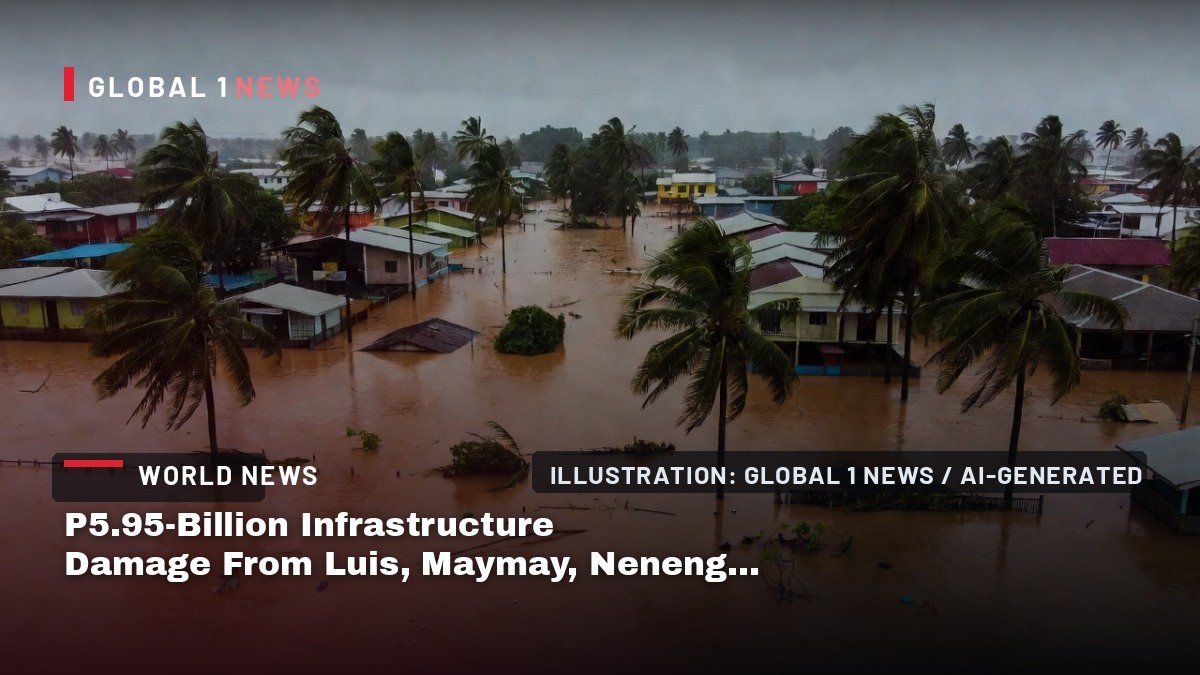
The combined wrath of Tropical Cyclones Luis, Maymay, and Neneng, intensified by the southwest monsoon or habagat, has left a deep scar on the nation's public works, with infrastructure damage now surging to P5.95 billion, according to the National Disaster Risk Reduction and Management Council (NDRRMC). This staggering figure, reported as of 6 a.m. Thursday, August 27, paints a grim picture of the toll these successive weather systems have taken on roads, bridges, schools, and other vital public facilities across Luzon and parts of the Visayas. When combined with the estimated P1.91 billion in agricultural losses, the total damage from this disaster is nearing the P8-billion mark, a heavy blow to a nation still navigating economic recovery.
For ordinary Filipinos, these numbers translate into more than just statistics. They represent the farmer in Nueva Ecija who lost his rice crop weeks before harvest, the student in Baguio whose school was buried under a landslide, and the family in Rizal whose home is now just a pile of debris. The NDRRMC reports that over 7.7 million individuals, or 2.2 million families, have been affected across 10 regions, a scale of displacement that tests the resilience of communities and the capacity of local governments to respond. As the nation grapples with this disaster, the spirit of bayanihan is once again being called upon, not just in the immediate relief efforts, but in the long, arduous road to rebuilding lives and livelihoods.
Infrastructure and Agricultural Damage: A P7.86-Billion Blow
The P5.95 billion in infrastructure damage is a significant escalation from earlier reports, reflecting the extensive destruction of public assets. This figure encompasses damage to national and local roads, bridges, flood control structures, and public buildings, including schools and health centers. The Cordillera Administrative Region (CAR), with its mountainous terrain, is likely to have suffered heavily, as landslides there have not only claimed lives but also severed critical transportation links, isolating communities and hampering relief efforts. The damage to infrastructure in this region is not just a matter of repair costs; it is a matter of access to basic services for thousands of residents.
Compounding the infrastructure losses is the P1.91 billion in agricultural damage reported by the NDRRMC. This is a devastating figure for a sector that employs a significant portion of the Filipino workforce. The Department of Agriculture has separately reported that agricultural losses have climbed even higher, reaching P2.32 billion in a later advisory. This discrepancy highlights the dynamic nature of damage assessment as reports from the ground continue to come in. For farmers, particularly those in Regions I, II, and III, which are major rice-producing areas, the loss of their crops means a loss of income, food security, and the capital needed for the next planting season. The impact will be felt at the dinner table, with potential price increases for basic commodities in the coming months.
Human Toll: 31 Lives Lost, 19 Injured, 3 Missing
The most tragic aspect of this disaster is the human cost. The NDRRMC has confirmed 31 deaths across several regions, a figure that has climbed from at least 23 reported around August 16. The Cordillera Administrative Region accounts for nearly half of these fatalities, with 15 deaths reported. In Baguio City alone, 10 people lost their lives, while three were reported in Atok and two in La Trinidad, all due to landslides. These numbers underscore the extreme danger posed by heavy rains on mountain slopes, where soil saturation can trigger sudden and deadly collapses.
Outside of CAR, the death toll includes eight people in Calabarzon, with four in Rizal and four in Batangas. Three more deaths were recorded in Metro Manila, with two in Caloocan and one in Quezon City. An additional five deaths were reported in La Union, Oriental Mindoro, Occidental Mindoro, and Negros Occidental. Beyond the fatalities, 19 people have been injured, and search and rescue operations are ongoing for three missing individuals in Manila, Quezon City, and Batangas City. For the families of the missing, the wait is agonizing, and for the communities that have lost neighbors and friends, the grief is profound. These are not just numbers; they are fathers, mothers, children, and kapitbahay who have been taken by the storm.
Housing Damage: Over 2,800 Homes Destroyed or Damaged
The storm's fury has also rendered thousands of families homeless. The NDRRMC reports that more than 2,800 houses were damaged across the affected regions. Of these, around 2,500 were partially damaged, leaving families to deal with leaky roofs, broken windows, and compromised walls. More tragically, 340 houses were totally destroyed, leaving their occupants with nothing but the clothes on their backs. For these families, the concept of "home" has been violently erased, and the task of rebuilding from scratch is a daunting prospect, especially for those with limited resources.
The destruction of homes has a cascading effect on communities. It disrupts the social fabric, as families are forced to seek shelter elsewhere, often with relatives or in crowded evacuation centers. Children lose the stability of their home environment, and their education is disrupted. The loss of a home also means the loss of personal belongings, documents, and memories that cannot be replaced. In the Philippines, where homeownership is a significant achievement for many families, the destruction of a house is a setback that can take years, if not decades, to overcome. The government's assistance in rebuilding these homes will be crucial, but the emotional and psychological toll on the affected families will take much longer to heal.
Evacuation Centers and Displaced Families
In the immediate aftermath of the storms, the priority has been the safety and well-being of the displaced. As of the NDRRMC's latest report, at least 325 evacuation centers remain operational, providing temporary shelter to roughly 28,000 displaced individuals, or 8,200 families. These centers, often schools or barangay halls, have become temporary homes for those who have lost their houses or whose homes are no longer safe to inhabit. While they provide a roof over people's heads, life in an evacuation center is far from comfortable, with limited privacy, shared facilities, and the constant uncertainty of when they can return home.
The number of people in evacuation centers represents only a fraction of the 7.7 million individuals affected, as many have chosen to stay with relatives or friends. The strain on these centers and on the local government units (LGUs) managing them is immense. They must provide food, water, medicine, and sanitation services to thousands of people, often with limited budgets and resources. The Department of Social Welfare and Development (DSWD) and other agencies are working to provide assistance, but the sheer scale of the displacement is a logistical challenge. The spirit of bayanihan is evident in the volunteers who cook meals, the private donors who send relief goods, and the community members who open their homes to strangers.
State of Calamity: 104 Localities Seek Faster Relief
To facilitate relief operations and the repair of damaged infrastructure, a total of 104 localities have been placed under a state of calamity. This declaration is a critical administrative step that allows local governments to access their calamity funds more quickly and to implement emergency measures without the usual bureaucratic delays. It also enables them to control the prices of basic goods and services, preventing profiteering during a time of crisis. For the residents of these areas, the declaration is a recognition of the severity of their situation and a promise of government assistance.
The declaration of a state of calamity is not a mere formality; it is a lifeline. It allows LGUs to use their Quick Response Fund (QRF) for immediate relief and rehabilitation efforts. It also streamlines the process for providing financial assistance to affected families. However, the funds available at the local level are often insufficient to cover the massive costs of rebuilding. This is where the national government, through agencies like the NDRRMC and the Department of Budget and Management (DBM), must step in to provide supplemental funding. The road to recovery will be long, and the financial resources required will be substantial, but the declaration of a state of calamity is the first crucial step in the journey.
Government Response and the Road to Recovery
The national government, through the NDRRMC and various line agencies, has been coordinating the response to this disaster. Search and rescue operations are ongoing for the three missing individuals, and relief goods are being distributed to evacuation centers. The Department of Public Works and Highways (DPWH) is tasked with clearing roads and repairing critical infrastructure, while the Department of Agriculture is assessing the full extent of the damage to crops and fisheries. These efforts are essential, but they are just the beginning of a long recovery process.
For the Filipino people, the focus now shifts to rebuilding and resilience. The storms have once again highlighted the country's vulnerability to natural disasters, particularly during the southwest monsoon season, which typically runs from June through September or October. As the nation mourns the 31 lives lost and works to support the millions affected, there is a collective call for better disaster preparedness, more resilient infrastructure, and more effective climate change adaptation measures. The bayanihan spirit that has been so evident in the relief efforts must now be channeled into the long-term task of building back better. The road ahead is challenging, but the resilience of the Filipino people, honed by countless storms before, offers a glimmer of hope for the communities now picking up the pieces.
This article was produced with AI-assisted research and editorial support. Sources: Philstar.com, Philippine News Agency.
By Bella Reyes, Staff WriterWhat's Your Reaction?
 Like
0
Like
0
 Dislike
0
Dislike
0
 Love
0
Love
0
 Funny
0
Funny
0
 Wow
0
Wow
0
 Sad
0
Sad
0
 Angry
0
Angry
0

Philippines/Southeast Asia Correspondent at Global1.News. Manila-based journalist covering Philippine politics, environment, maritime security, and social issues. Passionate about marine conservation and the communities protecting the Philippines' natural heritage.











Comments (0)