
P41-million withdrawal from Mans Carpio’s accounts in 73 minutes ‘unusual' — witness
During the impeachment trial of Vice President Sara Duterte, a forensic accountant highlighted a cash withdrawal that has raised eyebrows across the nation.
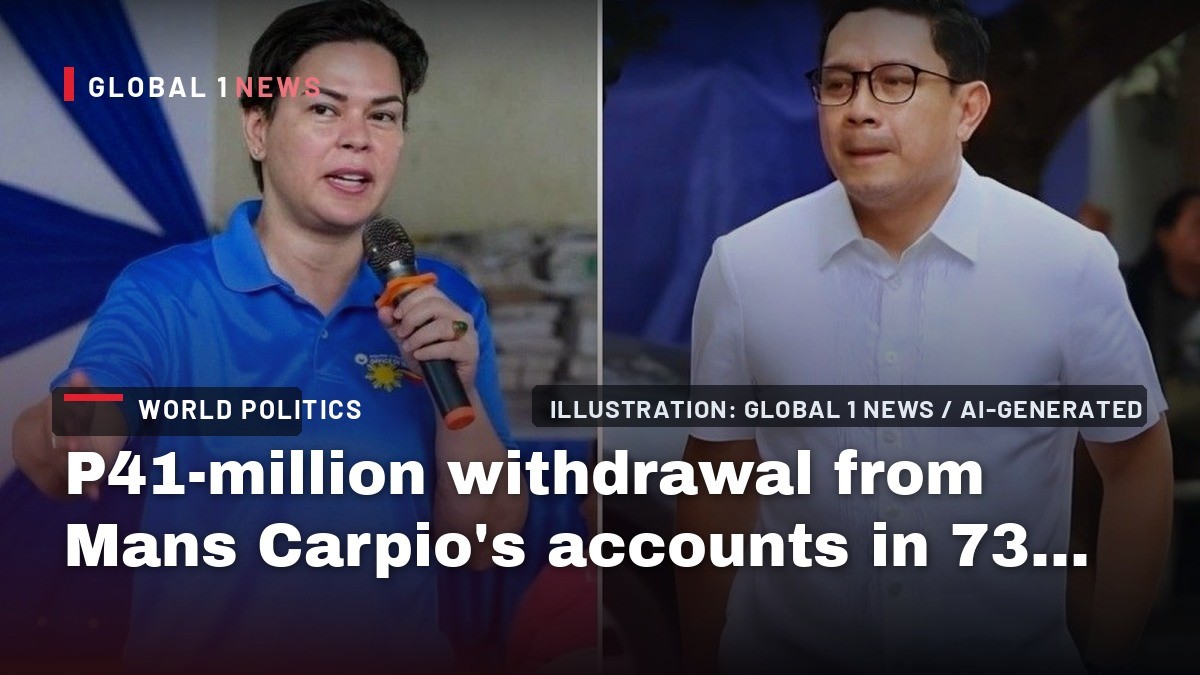
During the impeachment trial of Vice President Sara Duterte, a forensic accountant highlighted a cash withdrawal that has raised eyebrows across the nation. On August 6, 2024, a total of P41 million was taken out in cash from the bank accounts of the vice president’s husband, Mans Carpio, within a span of just over an hour. The speed and sheer amount of the transaction, according to forensic accountant Alexander Cabrera, are “unusual” for any ordinary Filipino, let alone a public figure’s family member.
Forensic findings: timing and lack of paper trail
Alexander Cabrera, who testified before the Senate on October 12, 2026, explained that the withdrawals were executed in rapid succession, with the final pull occurring right after a lunch break. He noted that counting P41 million in cash would itself be time‑consuming, yet the transactions continued almost immediately after the short intermission, suggesting a sense of urgency.
Cabrera also underscored the absence of supporting documents. “When transactions lack a trail, lack records and have no documents to support them, but the transactions still took place, the absence of documentation is also evidence,” he said. This gap in paperwork, he argued, could be a red flag in any forensic investigation, especially when large sums move in cash rather than through traceable bank transfers or manager’s checks.
Why cash matters: the practical challenges
For an “ordinaryong tao,” as Cabrera put it, moving P41 million in cash would require a sizable bag and a coordinated effort to transport and count the money. The forensic accountant highlighted that the logistics of such a withdrawal are atypical, raising questions about why the funds were not moved through more conventional banking channels that leave a clear audit trail.
The decision to withdraw the money in cash, rather than using a bank-to-bank transfer or a manager’s check, stood out to the expert. He asked why a large sum would be taken out in physical currency when other, more traceable, methods were available, especially given the heightened scrutiny that public officials and their families face.
Political context: recent controversies surrounding Carpio
The timing of the withdrawal is significant. Just weeks before the cash pull, former Education Secretary Sara Duterte resigned from her post as chairperson of the Department of Education on July 19, 2024. Shortly thereafter, on July 30, 2024, drug charges were filed against Mans Carpio in connection with the “magnetic lifter” case, a scandal that has already drawn public attention.
Senator Kiko Pangilinan pointed out this sequence, asking what might have happened around August 6 that prompted such a hurried cash extraction. He noted that the charges were filed six days before the withdrawal, suggesting a possible link between the legal pressure on Carpio and the decision to pull the cash quickly.
Carpio’s response: personal funds, no public money
In the midst of the impeachment hearing, Carpio has maintained that the cash was used for personal expenses, specifically credit‑card purchases that he says were paid with his own money. He has also denied any involvement of Vice President Duterte in the withdrawals and insists that no public funds were used.
These denials come as the impeachment complaint accuses Vice President Duterte of amassing wealth that far exceeds her lawful income, failing to fully disclose assets in her Statements of Assets, Liabilities and Net Worth (SALNs), and maintaining prohibited business interests while in office. The cash withdrawal is being examined as part of the broader allegation that the vice president’s family may be benefitting from undisclosed wealth.
Senate scrutiny: expert testimony and legislative questions
Senator Risa Hontiveros, who raised the issue during the trial, cited Table 24 on page 18 of Cabrera’s forensic report, which documents the total cash withdrawals on August 6. By bringing the forensic accountant’s findings to the Senate floor, Hontiveros sought to highlight potential irregularities in how the Carpio family handled large sums of money.
The Senate’s line of questioning focused on the mechanics of the withdrawal—why cash, why so quickly, and why without paperwork. The forensic accountant’s observations about the “lack of trail” and the hurried nature of the transactions added weight to the legislative probe, prompting further calls for transparency from the vice president’s camp.
Implications for public trust and accountability
For ordinary Filipinos watching the impeachment trial, the episode underscores a broader concern: how public officials and their families manage money that could be linked to public office. The image of a bag full of cash being hauled after a lunch break resonates with the everyday experience of barangay residents who know that large cash movements are rare and often signal something out of the ordinary.
If the cash was indeed personal, the question remains why it was not moved through more conventional, traceable means. The lack of documentation, as highlighted by the forensic accountant, may erode public confidence in the transparency of elected officials, especially when the nation is still grappling with issues of corruption and misuse of public funds.
Looking ahead: next steps in the impeachment process
The Senate will continue to examine the forensic evidence as part of the broader impeachment case against Vice President Sara Duterte. While the cash withdrawal alone may not determine the outcome, it adds a layer of complexity to the accusations of unexplained wealth and undisclosed business interests.
As the trial proceeds, the public will be watching closely how the Senate balances expert testimony, legislative inquiries, and the defense’s claims of personal use. For many Filipinos, the hope is that a thorough and transparent process will either vindicate the vice president or hold her accountable, reinforcing the democratic principle that no one is above the law.
This article was produced with AI-assisted research and editorial support. Reporting is based on the source material cited below. Sources: Philstar.com; Global1.News (13 October 2026).
By Bella Reyes, Staff Writer
What's Your Reaction?
 Like
0
Like
0
 Dislike
0
Dislike
0
 Love
0
Love
0
 Funny
0
Funny
0
 Wow
0
Wow
0
 Sad
0
Sad
0
 Angry
0
Angry
0

Philippines/Southeast Asia Correspondent at Global1.News. Manila-based journalist covering Philippine politics, environment, maritime security, and social issues. Passionate about marine conservation and the communities protecting the Philippines' natural heritage.















Comments (0)