
North Korea's Yongbyon Expansion Exposes the Limits of Nuclear Diplomacy
The IAEA says North Korea has built a new two-storey uranium enrichment building at its Yongbyon complex, capable of housing 28 centrifuge cascades, with operations also beginning at Kangson. The finding exposes the limits of sanctions and nuclear diplomacy.
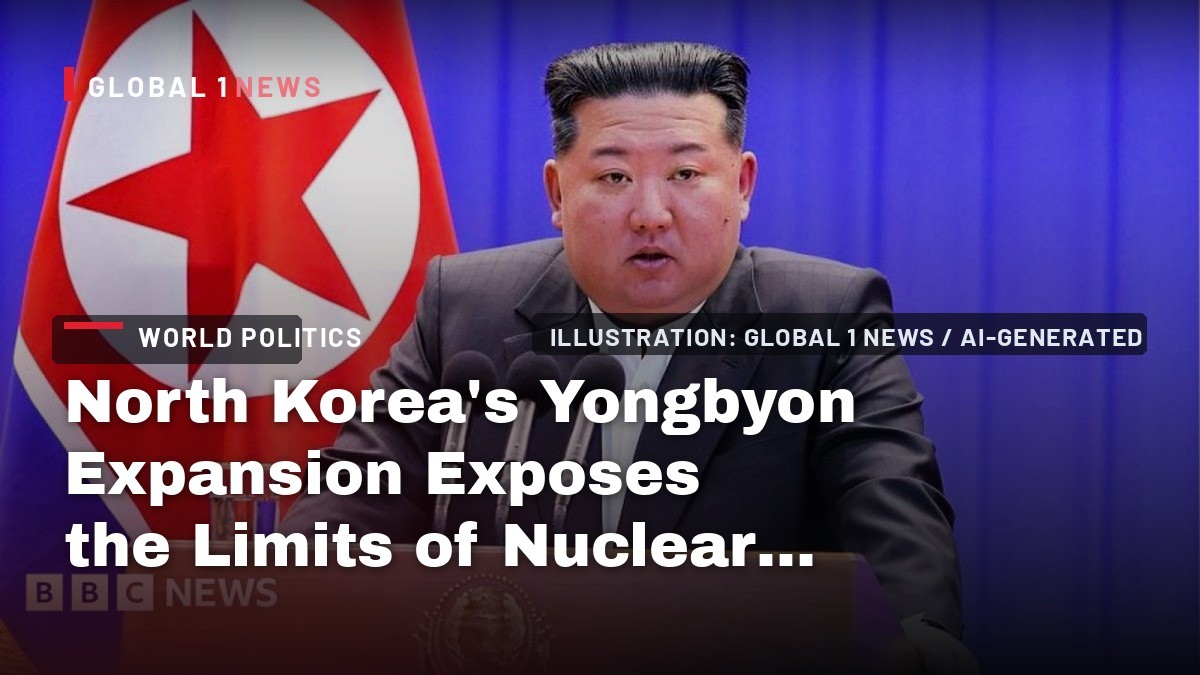
The International Atomic Energy Agency's disclosure that North Korea has constructed a new two-storey uranium enrichment building at its Yongbyon nuclear complex is more than a technical footnote to the long-running Korean nuclear saga. It is a signal that Pyongyang's weapons programme has moved into a phase of deliberate, incremental consolidation — one that neither sanctions nor diplomacy has been able to arrest. For the Asia-Pacific, the implications ripple outward from the Korean Peninsula to Beijing, Tokyo, Seoul, Washington and the wider Indo-Pacific alliance architecture.
According to the IAEA, the new building at Yongbyon is reportedly capable of housing up to 28 centrifuge cascades used to enrich uranium. The agency's director general, Rafael Grossi, described the continuation and further development of the DPRK's nuclear programme as "clear violations of relevant UN Security Council resolutions" and "deeply regrettable." The IAEA has no inspectors inside North Korea — it was expelled in 2009 — and relies entirely on satellite imagery for its assessments. That monitoring gap is itself a central part of the story.
The Yongbyon Expansion and What the IAEA Can See
The IAEA first referred to the existence of the new building in June, though Grossi had mentioned the possibility earlier in the year. In June, the agency reported that North Korean leader Kim Jong Un had visited a "newly inaugurated nuclear materials production factory" on 3 June, which it identified as the Yongbyon enrichment facility. Kim praised the country's "greatly expanded production capacity," adding that this would "offer the possibility of carrying out larger plans."
The agency also said there were indications that operations had started at another enrichment facility in Kangson, near Pyongyang, in January this year. An annex had first been constructed in Kangson in 2024. In April, the IAEA said North Korea appeared to be stepping up its ability to make nuclear bombs, monitoring the apparent expansion of Yongbyon. Taken together, these findings point to a steady, sanctions-defying expansion of the North's nuclear infrastructure.
Historical Context: From the Agreed Framework to the Six-Party Talks
To understand why this matters, it is necessary to recall the arc of past attempts to cap North Korea's nuclear programme. The 1994 Agreed Framework froze Yongbyon's plutonium reactor under IAEA monitoring in exchange for heavy fuel oil and light-water reactors. That arrangement collapsed in 2002 amid mutual recriminations. The Six-Party Talks — involving the two Koreas, China, Japan, Russia and the United States — produced the September 2005 joint statement on denuclearisation, but implementation stalled and the talks effectively ended in 2009, the same year Pyongyang expelled IAEA inspectors.
Since then, the international community has relied on UN Security Council resolutions to impose sanctions, but enforcement has been uneven. North Korea conducted six nuclear weapons tests, the last in September 2017. In 2022, Pyongyang declared itself a nuclear power and vowed never to relinquish its weapons. A 2022 report by a non-proliferation think-tank estimated that Kim spends $640m annually on his secretive arsenal — a staggering sum for one of the world's poorest countries.
China's Leverage and Strategic Calculus
Beijing remains the only actor with meaningful supply-side influence over Pyongyang. As North Korea's principal economic patron and diplomatic shield at the UN Security Council, China has long resisted calls for tighter enforcement that could destabilise the Kim regime. Yet the expansion at Yongbyon and Kangson complicates Beijing's own strategic calculus.
China's primary interest is preventing a nuclear-armed, unstable neighbour from triggering a regional arms race that would draw US forces deeper into Northeast Asia. The deployment of the Terminal High Altitude Area Defense (THAAD) system in South Korea in 2017 — which Beijing vehemently opposed — is a case in point. Each North Korean provocation strengthens the case in Seoul and Tokyo for enhanced missile defence, intelligence-sharing and, in Japan's case, a counterstrike capability debate that has gained traction in recent years.
Beijing also has to weigh its growing alignment with Moscow. The Russia-DPRK axis has deepened since 2022, with reports of arms transfers and summitry. For China, this is a double-edged sword: it dilutes US pressure on Pyongyang but also reduces Beijing's singular leverage. If Russia becomes an alternative patron, China's ability to broker restraint diminishes.
Seoul's Dilemma: Dialogue Versus Deterrence
South Korean President Lee Jae Myung proposed talks with North Korea in August on officially ending the war between the two countries, adding that this could serve as a forum for discussing "effective ways to halt the advancement of the North's nuclear capabilities." North Korea has yet to respond. Lee previously said Pyongyang was producing 15 to 20 more warheads annually, telling the BBC last year he would back a deal between US President Donald Trump and Kim to freeze production.
Seoul's position is delicate. It must maintain a credible deterrent with Washington while keeping the door open to dialogue. The Yongbyon expansion undermines the political case for engagement and strengthens hawks who argue that only pressure and containment can work. It also raises questions about the durability of the US extended deterrence commitment, particularly if Washington's attention is drawn elsewhere.
Tokyo's Counterstrike Debate and the Alliance Architecture
Japan has watched these developments with growing alarm. The expansion of North Korea's enrichment capacity directly affects Japan's threat perception, reinforcing the argument for acquiring counterstrike capabilities — the ability to hit enemy launch sites — which Tokyo has been debating since 2022. Prime Minister Sanae Takaichi's government has continued that debate, and each North Korean advance adds urgency.
For Washington, the challenge is to reassure both Seoul and Tokyo while avoiding a spiral that could lead to a regional nuclear cascade. The US alliance architecture in Northeast Asia — the US-Japan Security Treaty, the US-ROK Mutual Defense Treaty — is being tested by a North Korean programme that is becoming more survivable and more concealed. As Edward Howell, a lecturer at the University of Oxford, told the BBC: "What makes North Korea's nuclear programme so concerning is that many of its facilities are unknown, concealed, and thus difficult to target. Beyond Yongbyon, we know that other facilities exist: Kangson, for instance. The embeddedness of North Korea's nuclear doctrine within its foreign and domestic policy means that we should expect there to be more concealed production sites."
Second-Order Effects for ASEAN and the Global South
The implications extend beyond Northeast Asia. ASEAN states, particularly those in the South China Sea littoral, worry that a nuclear-armed North Korea could normalise proliferation in the region. The Treaty on the Southeast Asia Nuclear Weapon-Free Zone (SEANWFZ) is already under strain. If North Korea's programme is seen as successful, it could embolden other actors to pursue latent nuclear capabilities.
For the Global South, the failure to halt Pyongyang's programme undermines the credibility of the Nuclear Non-Proliferation Treaty (NPT) regime. The IAEA's inability to inspect inside North Korea — a gap that has persisted since 2009 — is a stark reminder that the international community's monitoring tools are only as good as the access it is granted. The agency's reliance on satellite imagery is a second-best solution that leaves critical questions unanswered.
Strategic Implications
The Yongbyon expansion is not a sudden development; it is the culmination of years of incremental advances. The IAEA's findings confirm that North Korea is not merely maintaining its arsenal but expanding it. The new two-storey building, capable of housing up to 28 centrifuge cascades, and the operations at Kangson, represent a qualitative and quantitative leap.
For China, the strategic calculus is increasingly uncomfortable. Beijing's leverage over Pyongyang is real but limited. It can slow, but not stop, North Korea's nuclear march. The deepening Russia-DPRK relationship further erodes China's monopoly on influence. Meanwhile, each North Korean advance strengthens the US alliance system in Northeast Asia — the very architecture Beijing seeks to weaken.
For Seoul and Tokyo, the choice is between dialogue and deterrence, but the two are not mutually exclusive. President Lee's proposal for talks remains unanswered, but the window for engagement is narrowing. For Washington, the challenge is to manage a three-way alliance dynamic while preventing a nuclear cascade. For ASEAN and the Global South, the lesson is that the NPT regime's enforcement mechanisms are only as strong as the great powers' willingness to use them.
The IAEA's report is a warning. Without a diplomatic breakthrough, North Korea's nuclear programme will continue to grow, and the risks of miscalculation will rise. The international community has no inspectors on the ground, no reliable intelligence on concealed sites, and no consensus on how to respond. That is a recipe for strategic drift — and in Northeast Asia, drift can be dangerous.
By Prof. Marcus Chen, Staff Writer
This article was produced with AI-assisted research and editorial support. Sources: BBC News (BBC World), International Atomic Energy Agency (IAEA).
What's Your Reaction?
 Like
0
Like
0
 Dislike
0
Dislike
0
 Love
0
Love
0
 Funny
0
Funny
0
 Wow
0
Wow
0
 Sad
0
Sad
0
 Angry
0
Angry
0

World Politics Analyst at Global1.News. Based in Beijing, covering US-China relations, global trade, and geopolitical strategy. Brings deep analytical perspective to the power dynamics shaping international affairs.















Comments (0)