
North Korea Fires Ballistic Missiles, Deepening Silence Fuels Analyst Speculation
North Korea fired what appeared to be a midrange ballistic missile toward the ocean east of the Korean Peninsula on August 12, its second launch in less than a week, according to South Korea’s Joint Chiefs of Staff (JCS). The back-to-back tests, which come amid an unusual silence from Pyongyang regarding the launches, have prompted intense speculation among regional analysts about the nature and intent of the weapons being tested.
An Unusual Silence From Pyongyang
Perhaps the most striking aspect of the August 12 launch is what has not been said. North Korea has not confirmed the launches at all, much less which specific missile was involved. This stands in stark contrast to previous test cycles, where state media typically released photographs and detailed descriptions of new weapon systems within hours or days of a launch.
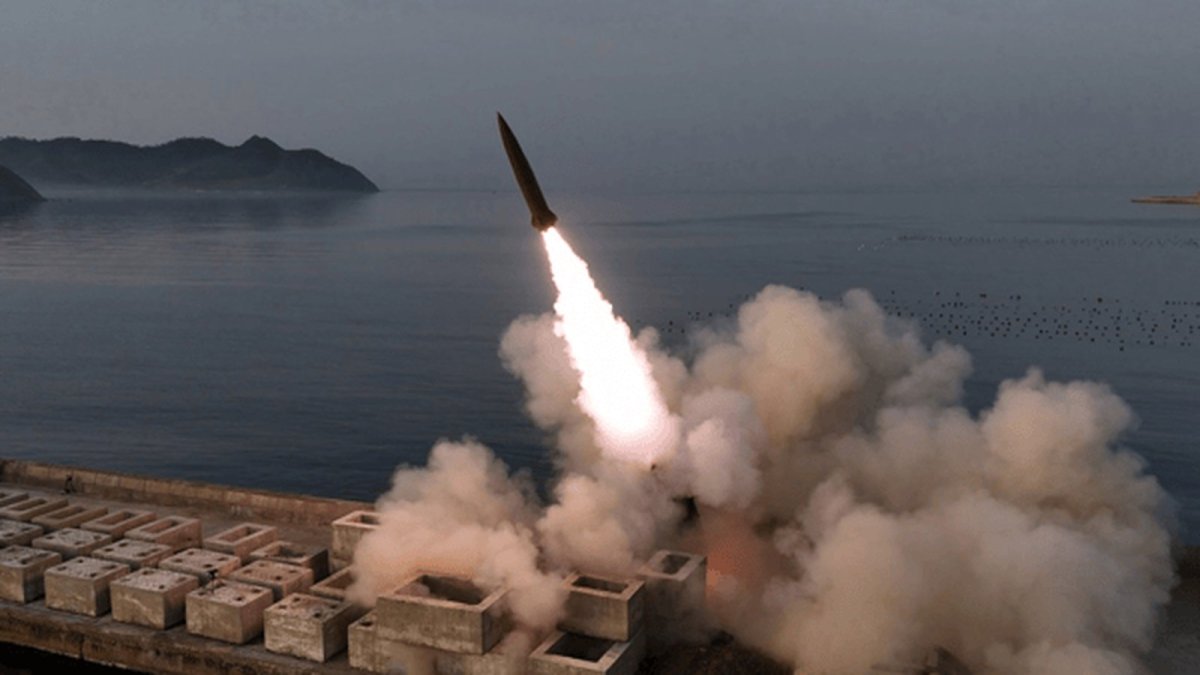
The absence of imagery is particularly notable given that the April 19, 2026, test of the Hwasongpho-11 Ra missiles was accompanied by extensive state media coverage. That file photo, showing the launch of one of the five missiles tested, has been widely circulated. The lack of similar material for the August launches suggests either that Pyongyang is exercising unusual operational security or that the tests did not go as planned.
South Korean officials have added to the uncertainty. The JCS did not disclose the missile’s type or flight angle, a departure from its usual practice of offering at least a preliminary classification within hours of a launch. The JCS’s unusual reticence about its range and angle points to something beyond a routine short-range test.
Breaking a 48-Day Lull
The August 12 test followed a shorter-range ballistic missile that North Korea fired from the same Wonsan area on August 6. That earlier test was Pyongyang’s first ballistic weapons test in 48 days, breaking a lull that had persisted since its missile launch on June 25.
The timing of the resumption is significant. The back-to-back launches came two days after South Korea and the United States announced their plans for joint drills. The annual Ulchi Freedom Shield exercise is set to begin on August 17. The allies describe the drills as defensive, but North Korea has for years denounced them as invasion rehearsals and has frequently responded with weapons tests timed around the training period.
This pattern is well-established in the region. The Wonsan launch site, on the east coast, has become one of the locations North Korea uses most often. Firing toward the eastern ocean lets the military test range and altitude without sending debris over South Korean, Japanese, or Chinese territory. That geographic reality has made the area a default choice for routine tests.
Technical Questions and Hypersonic Possibilities
According to local media reports, the missile tested on August 6 showed flight characteristics that differed from a conventional ballistic trajectory. That raised the possibility North Korea tested the gliding profile of a short-range hypersonic system before firing a related missile to near-maximum range six days later.
The KN-23, part of North Korea’s short-range arsenal, is a solid-fuel missile modeled on the Iskander system built in Russia, with a maximum range of roughly 700 to 800 kilometers, close to the distance reported for the August 12 launch. However, South Korean officials said they needed more time to identify the type of missile fired on August 12.
The possibility of a hypersonic glide vehicle test is significant. Such systems are designed to maneuver during flight, making them harder to intercept than traditional ballistic missiles. If North Korea is indeed testing such a system, it would represent a meaningful advancement in its strike capabilities and complicate the defensive calculations of South Korea, Japan, and the United States.
Alliance Coordination and Emergency Meetings
South Korea’s presidential national security office convened emergency meetings after both launches, calling them provocations that violate United Nations Security Council resolutions and urging Pyongyang to halt such tests immediately. Officials said the military would maintain readiness to respond to any further provocation in coordination with the United States.
The Japanese government also protested both launches. Defense Minister Koizumi Shinjiro told reporters the missile landed outside Japan’s exclusive economic zone. He added that Tokyo had lodged a protest with Pyongyang through diplomatic channels in Beijing. Koizumi described the repeated launches as “a threat to the peace and security of Japan, the region, and the international community.”
The foreign ministries of South Korea, the United States, and Japan also held a trilateral telephone call after the August 12 launch, where they “reaffirmed that ballistic missile launches by North Korea violate the relevant U.N. Security Council Resolutions and called on North Korea to cease such provocations that threaten the peace and security of the region and the international community.” The U.S. Pacific Command said after both launches that it was consulting closely with allies and partners. That assessment found no immediate threat to U.S. personnel, territory, or allies, and it reaffirmed Washington’s defense commitment to the region.
Strategic Context and Production Expansion
North Korea has tested ballistic missiles regularly since the collapse of nuclear talks between Kim Jong Un and U.S. President Donald Trump in 2019, expanding an arsenal barred under multiple U.N. Security Council resolutions. The August 12 launch thus extended a pattern that has become the new normal in Northeast Asia.
Kim ordered a 2.5-fold increase in ballistic and cruise missile production during a visit to a missile industrial facility in early June, and state media have since highlighted new systems such as the Hwasal-2 cruise missile and a submarine-launched variant called the Pulhwasal-3-31. Kim was also shown new missile systems on June 25, including a modular launcher developed as an analogue of the U.S. HIMARS rocket system.
This production expansion suggests that North Korea is not merely conducting symbolic tests but is actively building a larger and more diverse arsenal. The emphasis on solid-fuel missiles, which are harder to detect and destroy before launch, and on cruise missiles, which fly at low altitudes, indicates a focus on survivability and penetration capability.
Implications for the Regional Security Environment
The current situation presents several analytical challenges. First, the unusual silence from Pyongyang makes it difficult to assess whether these tests were routine or represented a new capability. Second, the timing around the Ulchi Freedom Shield exercise suggests that North Korea is using its weapons tests as a signaling mechanism, a pattern that has persisted for years.
For inter-Korean relations, the launches underscore the absence of meaningful dialogue. The emergency meetings convened by South Korea’s presidential national security office reflect a posture of vigilance rather than engagement. The trilateral coordination among Seoul, Tokyo, and Washington has become more institutionalized in recent years, and the swift joint response to these launches indicates that the alliance structure remains robust.
The broader Northeast Asian security environment is characterized by a complex interplay of military posturing, alliance coordination, and diplomatic stalemate. North Korea’s continued missile development, coupled with its expanding production capacity, suggests that the status quo will persist for the foreseeable future. The Ulchi Freedom Shield exercise, set to begin on August 17, will likely be met with further provocations, continuing a cycle that has defined inter-Korean and regional security dynamics for decades.
As analysts await further details on the missile type and trajectory, the key question remains whether these tests represent incremental improvements to known systems or the introduction of genuinely new capabilities. The JCS’s unusual reticence suggests that the latter possibility cannot be dismissed. For now, the region watches and waits, with the understanding that North Korea’s silence speaks as loudly as its launches.
This article was produced with AI-assisted research and editorial support. Source: The Diplomat.
By Prof. David Park, Staff WriterWhat's Your Reaction?
 Like
0
Like
0
 Dislike
0
Dislike
0
 Love
0
Love
0
 Funny
0
Funny
0
 Wow
0
Wow
0
 Sad
0
Sad
0
 Angry
0
Angry
0

East Asia/Technology Correspondent at Global1.News. Seoul-based voice covering Korean politics, technology, business, and culture. Analyzes how technology and geopolitics intersect across East Asia.














Comments (0)