
Korea Drought Crisis: Military, Fire Trucks Mobilized in Southeast
South Korea has issued only its second-ever national fire mobilization order for a drought crisis, deploying hundreds of firefighting water tankers and military vehicles to combat severe water shortages across the southeastern region centered on South Gyeongsang Province.
South Korea has issued only its second-ever national fire mobilization order for a drought crisis, deploying hundreds of firefighting water tankers and military vehicles to combat severe water shortages across the southeastern region centered on South Gyeongsang Province. The unprecedented response underscores the severity of a dry spell that has pushed agricultural reservoir levels to roughly one-third of capacity and prompted emergency water rationing for households in 27 locations across the province.
Full Article: South Korea's Historic Drought Mobilization: Fire Trucks and Military Deployed as Southeast Faces Water Crisis
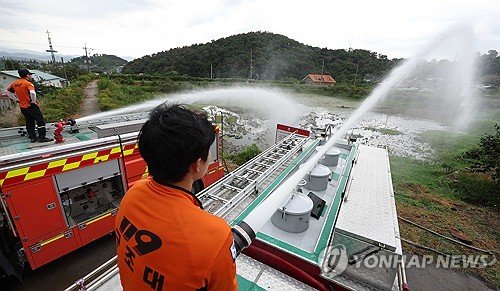
Seoul, South Korea – August 14, 2026 — The National Fire Agency issued a national fire mobilization order on Tuesday, August 11, 2026, dispatching 200 fire department water tankers and 400 firefighters from fire headquarters across 16 cities and provinces to South Gyeongsang Province. The deployment, which began Wednesday, August 12, was initially scheduled to conclude Thursday but has been extended as conditions continue to deteriorate. On Friday, August 14, fire authorities deployed more than 150 water tankers — a total of 159 vehicles, including 100 from outside the province, according to the South Gyeongsang provincial firefighting headquarters — with an additional 14 military vehicles joining the water-supply effort for farms and households.
A Historic Second: The National Fire Mobilization Order
The significance of this mobilization cannot be overstated. This marks only the second time in South Korean history that a national fire mobilization order has been issued because of drought. The first occurred during the devastating drought in Gangneung, Gangwon Province, in August 2025. The rarity of this measure reflects the extraordinary nature of the current crisis, which has affected all 18 municipalities in South Gyeongsang Province, all of which officially entered drought stages on Thursday, August 13.
Firefighters from Gyeonggi and Gangwon provinces traveled approximately 280 kilometers (174 miles) to reach Miryang, one of the hardest-hit areas. The journey carries symbolic weight: Gangwon Province suffered a severe drought last year and received assistance from fire stations nationwide. As one firefighter from the Icheon Fire Station in Gyeonggi noted, "We left at 5 a.m. to get here, and the drought seems even more serious than what I saw on the news." Another firefighter from Gangwon remarked, "This time we have come to South Gyeongsang to return the favor" — a sentiment that reflects the spirit of mutual aid embedded in Korea's disaster response framework.
Reservoir Levels Plummet: Data Paint a Dire Picture
The statistical picture is stark. South Gyeongsang's average water reservoir storage rate stood at 32.2 percent on Friday, August 14, dramatically below the long-term average of 70.6 percent. Water levels at agricultural reservoirs in the province have fallen to about 33 percent of capacity, or roughly 47 percent of the usual level for this time of year. Cumulative rainfall over the past six months totaled 586.7 millimeters (23.1 inches), only about 60 percent of the normal amount.
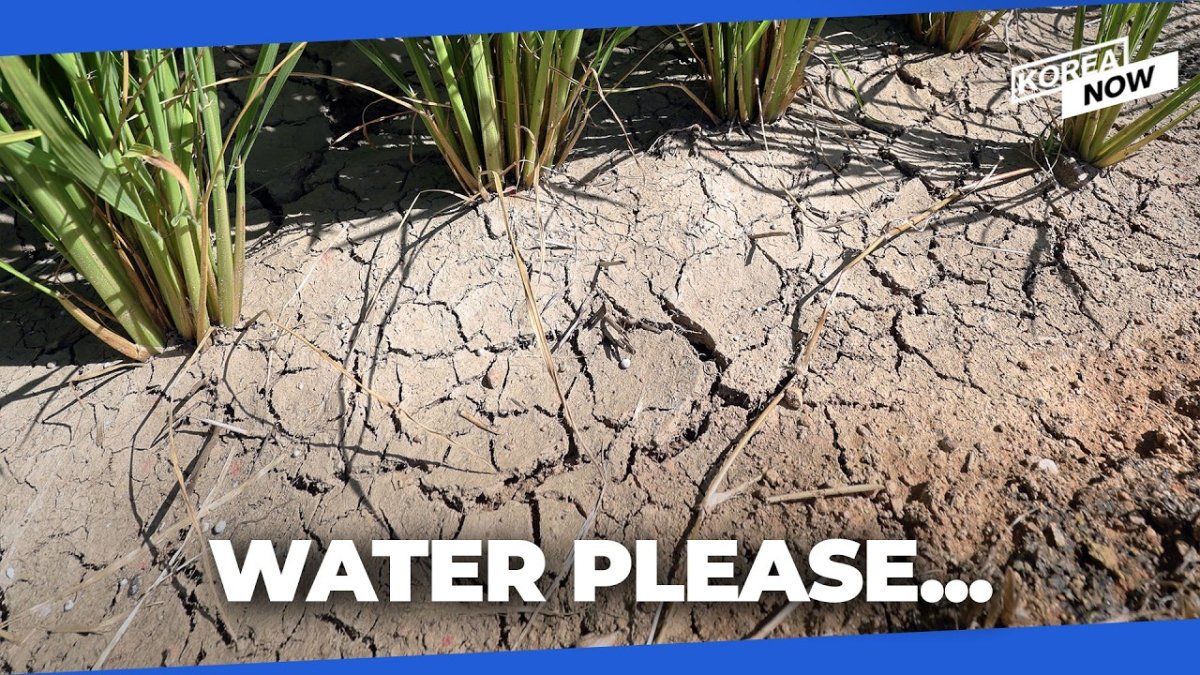
Farmers describe the drought as "not seen in 40 years," according to the Korea JoongAng Daily. In Miryang, Changwon, and nearby areas, farmers are digging dry streambeds and reviving old wells as reservoir levels plunge. The dried-up bed of a reservoir in Miryang was photographed on August 3, 2026, showing deep cracks in parched soil — cracks wide enough for a finger to sink into. The crisis extends beyond South Gyeongsang: Gwangju's main reservoir has also dropped below half full amid stagnant heat and absent rain.
Farmers on the Frontline: Rice Paddies and Parched Fields
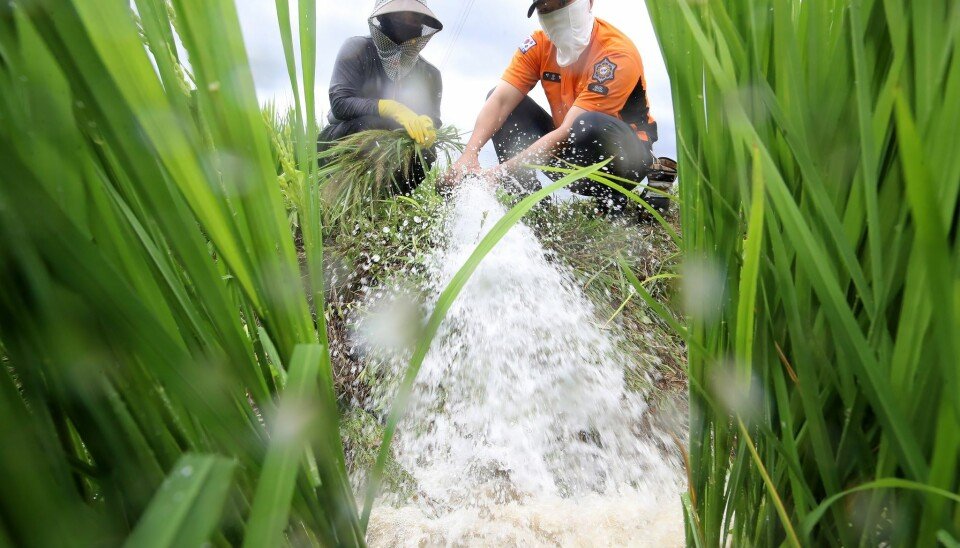
The agricultural impact is severe and spreading. Farmland where crop growth had been impaired totaled 2,121 hectares (5,241 acres) as of Wednesday, August 12, according to the provincial government. Firefighters have been spraying rice paddies using fire hoses 65 millimeters wide — equipment normally reserved for major structural fires — with pressure carefully lowered to protect delicate rice plants.
Lee Gi-jun, head of Daejeon Village in Miryang, described the grim reality: the Deokgok Reservoir now releases water only twice a week. "The paddies need water every other day... There is nothing we can do if it does not rain," he said. Some rice leaves have dried up and curled, while others have turned reddish "as if they were scorched" — though Lee noted the plants may recover if watered in time.
Park Chang-ha, head of Anchon Village in Miryang, painted an even bleaker picture: "There are three valleys nearby, but they are now so dry that there is not a single drop of water." His village has been under night water rationing — from 9 p.m. to 6 a.m. — since late last month, a measure that has become necessary as small-scale water supply facilities, including groundwater wells and private water sources, run dry.
Household Water Restrictions and Government Response
Beyond agriculture, the crisis has reached households. Water restrictions are currently in place in 27 locations, including islands in Tongyeong and villages in Miryang, Geoje, Yangsan, and Hadong — all areas relying on small-scale water supply facilities such as groundwater and private wells. The provincial government is supplying drinking water and household water using bottled water and water supply vessels, with plans to expand deliveries and develop additional wells if the drought persists.
The government response has been multi-layered and escalating. South Gyeongsang Province raised its disaster and safety response to "Emergency Level 2" on August 1 and entered an emergency work system together with its 18 cities and counties. The Ministry of the Interior and Safety announced it would establish a dedicated task force and work with private logistics companies to transport water trucks, pumps, and other essential equipment. President Lee has ordered the full mobilization of resources to minimize damage from the extreme heat, according to Yonhap News Agency reporting.
Under the national mobilization order, fire authorities supplied 12,445 tons of water to the province over the first two days of the operation. As of 4 p.m. Wednesday, fire authorities had supplied 2,503.5 metric tons of agricultural water across 351 operations; fire trucks also sprayed 42 metric tons of water on roads and livestock facilities to lower temperatures — a dual-purpose response addressing both drought and the concurrent heatwave.
Compounding Crisis: Drought Meets Record Heatwave
The drought does not exist in isolation. It coincides with a record summer heatwave across South Korea — the country experienced its hottest day in modern history this summer, and a separate heatwave has been linked to at least 16 deaths, according to TRT World reporting. The Guardian reported on August 13 that South Korean farmers are suffering record heat, with potatoes "boiling" in the ground, while Hong Kong reported its highest-ever temperature and Japan designated "cruelly hot" days.
This convergence of extreme heat and drought creates a vicious cycle: high temperatures accelerate evaporation from already-depleted reservoirs, while the lack of water reduces the land's capacity to moderate temperatures through evapotranspiration. The result is a feedback loop that intensifies both conditions simultaneously.
Regional and Strategic Implications for Northeast Asia
This drought crisis carries implications that extend far beyond South Gyeongsang's borders. South Korea's food security is directly implicated — the country has long treated rice self-sufficiency as a strategic policy priority, and domestic rice production remains both a cultural touchstone and a carefully protected agricultural asset. A sustained drought in the southeastern region, which includes some of the country's most productive agricultural land, could increase pressure on Korea's managed rice import arrangements with partners such as China and the United States, with attendant implications for regional trade dynamics.
The crisis also tests South Korea's disaster governance framework. The national fire mobilization order — now issued twice in consecutive years for drought — signals a structural shift in how Korea's emergency management system conceptualizes climate-related disasters. Historically, Korea's disaster response infrastructure was designed primarily for floods, typhoons, and industrial accidents. The repeated need for drought mobilizations suggests that water scarcity must now be treated as a first-order national security concern, on par with the conventional disasters that have historically shaped Korea's emergency management doctrine.
Furthermore, the drought raises questions about long-term water infrastructure investment. South Korea's agricultural water systems were largely built during the Park Chung-hee era industrialization push of the 1970s, designed for a climate regime that is rapidly changing. The current crisis — with reservoir levels at 47 percent of usual capacity — suggests that aging infrastructure may be inadequate for the more volatile precipitation patterns associated with climate change. The Korea Times reported on August 13 that a nationwide rain forecast for the long weekend could bring relief to drought-hit southern regions, but such intermittent relief does not address the structural vulnerability.
Looking Ahead: Relief in Sight, But Structural Questions Remain
Weather forecasts offer some hope: a nationwide rain forecast for the long weekend could bring relief to drought-hit southern regions. However, meteorologists caution that a single rainfall event — even a substantial one — will not fully replenish reservoirs that have fallen to one-third of capacity. The province will need sustained precipitation over weeks, not days, to return to normal levels.
For now, the mobilization continues. Firefighters from across the country remain stationed in South Gyeongsang, spraying rice paddies, delivering water to parched villages, and hoping for rain. The immediate crisis may pass with the arrival of seasonal rains, but the deeper questions — about infrastructure resilience, climate adaptation, and the adequacy of Korea's disaster response framework for a warming world — will remain long after the water tankers return to their home stations.
By Prof. David Park, Staff Writer
This article was produced with AI-assisted research and fact-checking based on the KOREA NOW video report and official news sources cited above.
What's Your Reaction?
 Like
0
Like
0
 Dislike
0
Dislike
0
 Love
0
Love
0
 Funny
0
Funny
0
 Wow
0
Wow
0
 Sad
0
Sad
0
 Angry
0
Angry
0

East Asia/Technology Correspondent at Global1.News. Seoul-based voice covering Korean politics, technology, business, and culture. Analyzes how technology and geopolitics intersect across East Asia.












Comments (0)