
Nepal-Tibet Flash Floods: Death Toll Climbs Past 600 as Thousands Remain Missing
Kathmandu, Nepal — Aug 29, 2026. The numbers are still moving, and that is the most terrifying part of this catastrophe.
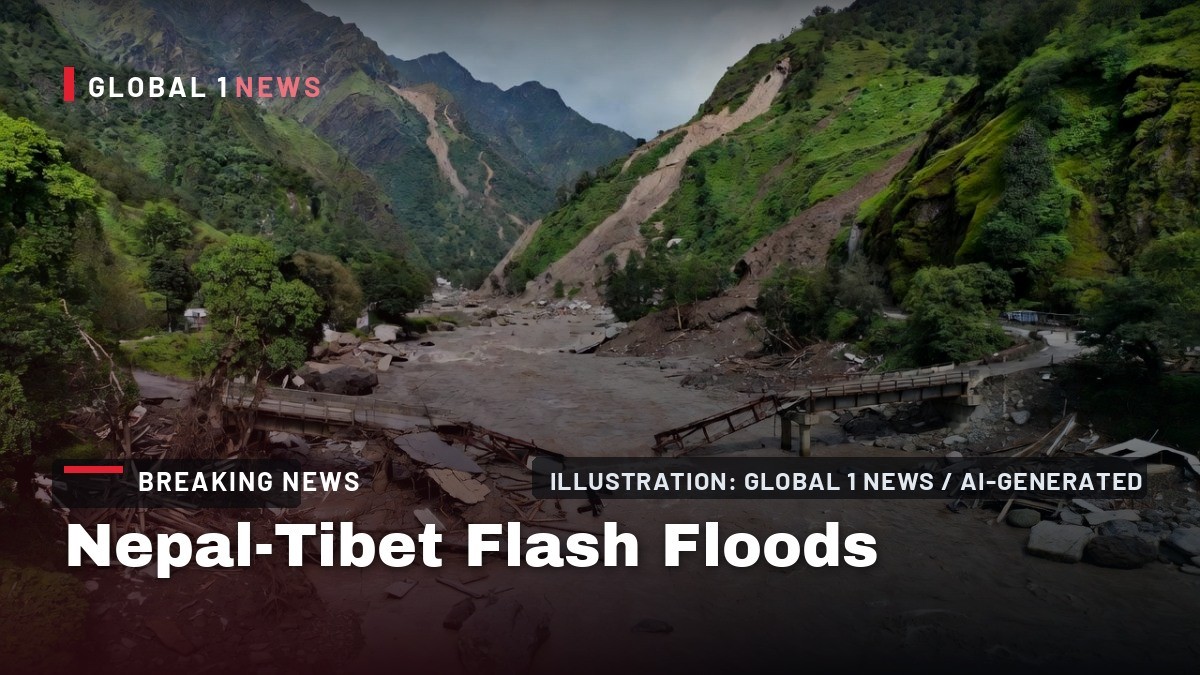
Kathmandu, Nepal — Aug 29, 2026. The numbers are still moving, and that is the most terrifying part of this catastrophe. What began as a wall of water and debris surging from a glacier-triggered landslide near the Nepal-China border on Wednesday morning has become one of the deadliest flash flood events in the Himalayas in decades, with Nepali authorities now confirming at least 626 dead and more than 2,400 people still unaccounted for. The flood did not just strike one village or one valley — it tore through a 72-kilometer corridor of the Trishuli River system, hammering settlements across at least six districts and leaving rescue crews scrambling to reach survivors trapped in tunnels, under rubble, and in communities cut off by destroyed roads and bridges.
How the Disaster Unfolded
The catastrophe began on the morning of Wednesday, August 26, when a massive slope failure involving a glacier in Langtang National Park combined with a landslide below it. According to the U.S. Geological Survey (USGS), the force of the landslide produced a seismic signal registering magnitude 5.2 — initially reported as a magnitude 4.4 earthquake. But this was no earthquake. It was the sound of an enormous chunk of glacier falling thousands of feet at the same time as a landslide, creating a torrent of water, mud, and debris that surged down the Bhote Koshi River from the Tibet side into Nepal's Rasuwa district.
The flood entered Nepal via Lhende, a tributary of the Bhotekoshi, and quickly became what witnesses described as a tsunami-like wall of water. It traveled roughly 72 kilometers along the Trishuli River corridor, striking dozens of settlements in Rasuwa and Nuwakot districts before cascading downstream through Dhading, Gorkha, Chitwan, and Nawalparasi East. The sheer speed and force of the event caught communities completely off guard. One witness described the flood hitting villages "like liquid cement" — a phrase that captures both the density of the debris flow and the impossibility of outrunning it.
A Rising Death Toll and Thousands Missing
The official casualty figures have been climbing steadily, and they are far from final. By the evening of Friday, August 28, Nepal's National Disaster Risk Reduction and Management Authority (NDRRMA) reported 579 confirmed dead and 1,924 missing. By Saturday, August 29 — today — the Kathmandu Post reported the toll had risen to 626 dead with 2,426 people still unaccounted for, according to NDRRMA. Combined Nepal-China missing figures have surpassed 2,400, according to Malay Mail reporting syndicated from Reuters.
What makes these numbers particularly grim is where the bodies are being found. Chitwan district has accounted for 233 bodies, and Nawalparasi East has accounted for 154 — both far downstream from where the flood originated. In Rasuwa itself, where the flood first struck, only 12 bodies have been recovered. That disparity tells a stark story: the flood picked up victims, debris, and destruction as it traveled, and the bodies were carried dozens of kilometers downstream before being deposited. Rescue teams are bracing for the possibility that many of the missing will never be found.
The missing include a significant number of foreign nationals. Government records from August 27 suggested 910 people missing, including 517 foreigners. The Nepal Tourism Board said 384 travelers were unaccounted for, including 291 foreign nationals, though those were described as preliminary figures. At least 12 Britons were among the missing, according to the Daily Mail. Al Jazeera reported at least 389 dead in Nepal and 3 in China's Tibet with more than 1,500 missing as of August 27. The Diplomat, citing early figures, reported the flood centered on Nepal's Rasuwa District and China's Gyirong County killed at least 160 people with 900 still missing. The numbers have only grown since.
Rescuers Race to Free Trapped Hydropower Workers
Among the most urgent rescue operations is unfolding at the Trishuli 3A hydropower project, where more than 100 workers were trapped in a tunnel when the flood hit. The Nepal Army has led the rescue effort, with around 350 workers and locals evacuated so far, according to the Straits Times. The Star reported that rescuers were racing to save people trapped in the hydropower tunnel, a race against time as concerns grow about the structural integrity of the tunnel and the possibility of further flooding.
The hydropower sector has been hit especially hard. About 900 people were reported missing from hydropower projects alone, according to the New York Times. The Trishuli-1 hydropower project, which sits about 70 kilometers north of Kathmandu on the Upper Trishuli River, has also been affected, as have the Syabrubesi hydropower projects, which were damaged in the flood. The disaster has exposed the vulnerability of Nepal's aggressive hydropower expansion in steep, glacier-fed valleys — infrastructure that brings economic development but also places hundreds of workers in the direct path of glacial flood risk.
Villages Hit 'Like Liquid Cement'
The human toll is most visceral in the small settlements that lined the river corridor. Timure and Syabrubesi, two towns in Rasuwa district that served as markets and staging points for cross-border trade, were damaged or swept away entirely. Witnesses described the flood arriving not as rising water but as a solid wall of mud, rock, and debris moving at terrifying speed. The phrase "like liquid cement" has been repeated by survivors and officials alike, capturing the way the flood did not just drown — it entombed.
Roads and bridges across the region were destroyed, severing communities from help and complicating rescue efforts. The Nepal Army said 14 helicopters and disaster response teams have been deployed for rescue and relief, but in a region where roads are the lifeline, the loss of connectivity has been devastating. Nepal's Ministry of Foreign Affairs issued a statement describing severe flash floods that caused huge loss of lives, widespread displacement, and extensive damage to houses, roads, bridges, hydropower facilities, and other critical infrastructure. The ministry's language was measured, but the scale of the destruction it describes is anything but.
Across the Border: Gyirong's Ordeal
The disaster did not respect the border. On the China side, the flood hit Gyirong County in Tibet, a key border trade hub. A team of 21 rescuers became the first to reach the badly hit town of Gyirong in the late afternoon of Friday, August 28, according to euronews. The delay in reaching Gyirong underscores how completely the flood destroyed access routes. China temporarily halted its Tibet rescue operation amid fears of renewed flooding, a decision that reflects the ongoing instability of the region.
China has reported at least 3 dead in Tibet, according to Al Jazeera, though that figure is likely to rise as rescuers reach more isolated areas. The combined Nepal-China missing figure surpassing 2,400 people makes clear that this is a cross-border disaster requiring a coordinated cross-border response. The fact that the first rescue team only reached Gyirong on Friday — two days after the flood — is a sobering reminder of how difficult this terrain is even under normal conditions, let alone after a catastrophic flood has destroyed the infrastructure that connects these communities to the outside world.
Fresh Threats: Barrier Lakes and Monsoon Rain
Even as rescue operations continue, Nepal faces a fresh threat. A newly formed barrier lake near the Tibet border is raising alarm, according to Outlook India. Collapsed earth has formed unstable dams and "barrier lakes" in China's hard-hit Gyirong County, according to CNN. These natural dams are extremely dangerous — if they breach, they could release another wall of water downstream, potentially re-flooding areas that have already been devastated and threatening rescue workers and survivors alike.
Compounding the danger, three days of rain are forecast for the region. Rain on already saturated ground, on unstable slopes, and on barrier lakes that are barely holding back millions of cubic meters of water is a recipe for further disaster. The monsoon season in the Himalayas is always a time of heightened risk, but this year's combination of glacial instability, heavy rainfall, and the debris left behind by the flood has created a volatile situation that could persist for weeks.
Scientists had maintained a flash flood early warning system for years, and the South China Morning Post credited it with consistently preventing casualties in the past. But this time, the system proved incapable of detecting the disaster in time. The event was triggered by a glacier falling thousands of feet simultaneously with a landslide — a compound event that is inherently difficult to predict. The failure of the early warning system is a critical lesson, but it is cold comfort to the families of the missing.
International Response and the Road Ahead
Nepal's government has sought foreign aid, and the international community is beginning to respond. India's opposition leader Kharge has asked the Indian government to send aid to Nepal. Nepal has also requested that India and China provide Bailey bridges to restore connectivity, according to the Hindustan Times. Bailey bridges — portable, prefabricated truss bridges — are exactly what is needed in a disaster like this, where permanent bridges have been destroyed and communities are cut off from food, water, and medical care.
The road ahead is long and difficult. The immediate priority is rescue: finding the trapped workers in the hydropower tunnel, reaching isolated villages, and recovering bodies. But the longer-term challenges are staggering. Rebuilding roads and bridges in steep mountain terrain takes months, not weeks. Rebuilding hydropower projects that were damaged or destroyed will take even longer. And the psychological toll on survivors who watched a wall of "liquid cement" consume their homes, their neighbors, and their livelihoods will last a lifetime.
This disaster is also a warning. The Himalayas are warming, glaciers are retreating, and the risk of glacial lake outburst floods and glacier-triggered landslides is increasing. Nepal's hydropower boom has brought thousands of workers into high-risk valleys. The early warning system that worked for years failed this time, and the question now is whether it can be improved before the next disaster strikes. The monsoon is not over. The barrier lakes are unstable. The ground is still moving. The next few weeks will be critical — not just for recovery, but for preventing a second catastrophe on top of the first.
For now, the numbers are all we have: 626 dead, 2,426 missing, and counting. Behind each number is a person, a family, a community. The flood took them in minutes. Finding them, burying them, and rebuilding what was lost will take far longer.
This article was produced with AI-assisted research and editorial support. Sources: Kathmandu Post, New York Times, CNN, Al Jazeera, USGS, ReliefWeb, The Diplomat, euronews, Hindustan Times, Outlook India, Nepal Ministry of Foreign Affairs.
By Jessica Ali, Staff Writer
What's Your Reaction?
 Like
0
Like
0
 Dislike
0
Dislike
0
 Love
0
Love
0
 Funny
0
Funny
0
 Wow
0
Wow
0
 Sad
0
Sad
0
 Angry
0
Angry
0

Editor-in-Chief at Global1.News. Atlanta-based journalist who cuts through the BS and tells it like it is. Lead anchor, host, and the voice you hear when the spin stops and the truth starts.














Comments (0)