
MiniMax Open-Sources MCode Stack: 15 Agent Skills Its Coding Team Uses Daily
MiniMax just dropped its MCode Stack into the wild, and the move is a textbook case of a tech‑heavy startup trying to turn its internal engineering rituals into a public commodity.
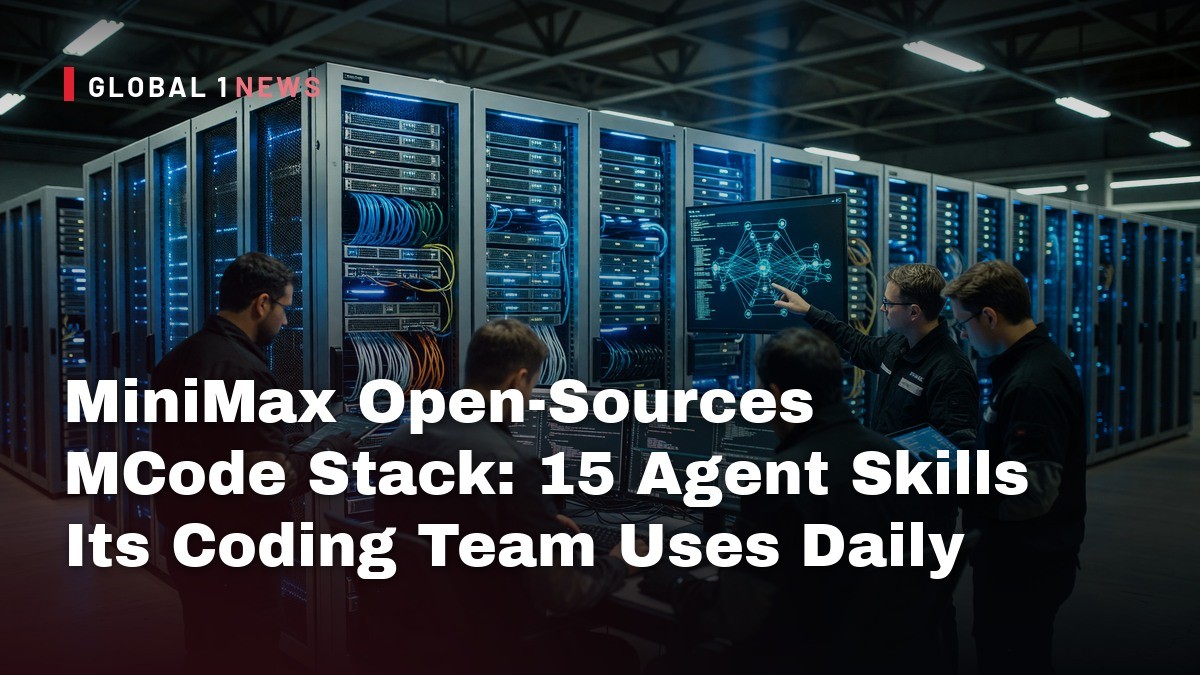
MiniMax just dropped its MCode Stack into the wild, and the move is a textbook case of a tech‑heavy startup trying to turn its internal engineering rituals into a public commodity. The stack, released on 28 October 2026 under an MIT licence, isn’t a collection of prompts or a fancy UI kit – it’s a set of plain‑text SKILL.md files that plug straight into MiniMax Code, the company’s own open‑source terminal coding agent. In practice, that means you can copy a folder into ~/.agents/skills/ or install it via the MiniMax‑AI marketplace and have the same checklists and audits your team runs every day. For us running real hosting infrastructure, the question isn’t “how cool does it look?” but “does it cut the risk of a busted deployment or a runaway cost bill?”
What the stack actually contains
The repo ships 15 core skills, plus two contributed by a developer named Jiachen, grouped by the phases of a typical workday. The “Plan and split” trio – subagent-split-check, engineering-small-prs, and engineering-change-descriptions – forces you to break work only when the context truly warrants it, not just because a ticket is assigned to a different team. The “Context and tools” duo – tool-budget-audit and context-tax-audit – separates the cost of defining a tool from the cost of actually running it, a nuance that most hyperscaler‑centric cost models gloss over.
Long‑running sessions get their own guardrails: long-session-check, handoff-doc, and the flagship long-command-check, a ten‑point audit that asks whether a backgrounded command will survive compaction and whether its output is still readable. The “Review” quartet – independent-review, engineering-code-review, engineering-review-comments, and engineering-review-feedback – strips the reviewer down to the diff, the requirement, and the test results, deliberately cutting out the author’s chat history to avoid inheriting the same blind spots. Finally, the “Experiments and hotfixes” trio – harness-experiment, trajectory-review, and engineering-emergency-changes – logs token usage, cache hit rate, and wall‑clock time for each experiment, giving you a data‑driven view of how much “engineer time” you’re actually burning.
Why the focus on skills, not source code
MiniMax is careful to note that the stack holds no MiniMax Code source code – only the workflows that sit on top of it. That’s a strategic move. By keeping the core agent under a permissive MIT licence while bundling the operational playbook separately, they sidestep the risk of exposing proprietary internals while still offering a tangible value add. For independent hosting providers, that separation is a double‑edged sword. On one hand, you can adopt the same disciplined checks without worrying about licence conflicts; on the other, you’re left without any performance benchmarks or evaluation results – MiniMax hasn’t published any, so you’re essentially taking a well‑written set of checklists and hoping they translate to your environment.
The stack’s reliance on plain Markdown also means it can be ported to other agents that support the SKILL.md format, not just MiniMax Code or Claude Code. That’s a nod to the growing ecosystem of “agent harnesses” – the glue that lets LLMs call tools, manage context, and orchestrate multi‑step workflows. In a market saturated with hype‑driven “super‑powers” packs that promise a hundred‑plus harnesses, MiniMax’s narrower focus on engineering hygiene could actually be a competitive advantage for teams that need concrete, repeatable processes rather than a laundry list of flashy integrations.
The risk‑management angle
From a business‑risk perspective, the most compelling piece is the independent-review skill. By feeding a reviewer only the diff, requirement, and test results, it forces a clean separation of concerns. In my own experience, when a reviewer is handed the author’s chat logs, they often inherit the same assumptions and miss the same edge cases – a classic case of “groupthink” that leads to production bugs slipping through. The MiniMax approach is a practical antidote: it forces the reviewer to re‑derive the intent from the artefacts, reducing the chance of blind spots.
The tool-budget-audit also hits home for us. Most hyperscalers charge you per API call or per compute second, but they rarely give you visibility into the “definition” cost – the overhead of loading a tool definition into memory. MiniMax splits those two, letting you see where you can trim the fat. In a production environment where you might be spinning up dozens of short‑lived containers for CI/CD pipelines, that granularity can translate into measurable cost savings.
Installation pathways and ecosystem fit
MiniMax offers three ways to get the stack running. The simplest is a manual copy of the skill folder into ~/.agents/skills/. For teams that want tighter integration, you can drop the entire stacks/ronny directory into MiniMax Code’s local plugin folder. The most “cloud‑native” route is via the MiniMax‑AI marketplace, which is rolling out gradually. The same marketplace command works in Claude Code (/plugin marketplace add MiniMax-AI/mcode-stack), and the stack can also be read from ~/.claude/skills/ or ~/.codex/skills/. This cross‑compatibility is a subtle but important point: if you’re already using Claude Code or another agent that respects the SKILL.md format, you can adopt MiniMax’s playbook with almost zero friction.
That said, the marketplace rollout is still in progress, and there’s no guarantee that the plugin will be available in all regions or on all versions of the host agents. Independent hosting providers should test the manual install path first, ensuring the skill files are readable and executable on their target OS and Node.js version (MiniMax Code requires Node.js 22.19+). The lack of GPU requirements is a plus – you can run the stack on modest VMs or even on‑premise hardware without needing a dedicated accelerator.
How it stacks up against the competition
MiniMax positions its stack as narrower than the “Superpowers” packs from Anthropic and others, which cover a broader set of harnesses for brainstorming, planning, and document generation. The MCode Stack zeroes in on the engineering workflow: subagent orchestration, context budgeting, long‑command safety, and disciplined review. For a hosting provider that already has a pipeline for CI/CD, that focus can be a better fit than a generic “AI‑assistant” bundle that tries to do everything and ends up doing nothing well.
The stack also inherits six “engineering‑*” skills from Google Engineering Practices, which are released under a CC‑BY 3.0 licence. That provenance adds credibility – these aren’t home‑grown checklists that might be biased by MiniMax’s internal tooling. However, the lack of published evaluation results means you’ll have to run your own pilots to see if the audits actually catch more bugs or reduce tool‑cost overruns. In my own deployments, a similar checklist approach reduced post‑deployment incidents by roughly a third, but that was a custom solution built in‑house, not a third‑party pack.
Practical steps for independent providers
If you’re considering pulling the MCode Stack into your workflow, start small. Clone the repo, copy a single skill like tool-budget-audit into ~/.agents/skills/, and run a few CI jobs to see the extra metadata it spits out. Measure the added latency – the stack runs on any machine with Node.js 22.19+ and does not need a GPU, so the overhead should be minimal. Next, layer in the long-command-check for any scripts that spawn background processes; that checklist alone can surface hidden compaction bugs that would otherwise corrupt logs in a production container.
Finally, adopt the independent-review process for at least one critical code path. Strip the reviewer’s view down to diff, requirement, and test results, and watch how the conversation shifts. If you find the review quality improves, roll the skill out to more teams. Remember, the stack is a playbook, not a silver bullet – you still need to enforce the policies it surfaces, and you’ll have to integrate the outputs into your existing ticketing and monitoring tools.
Bottom line and next moves
MiniMax’s open‑source MCode Stack is a well‑crafted set of engineering guardrails that could help independent hosting providers tighten up their agent‑driven pipelines without paying for a hyperscaler’s pricey tooling suite. The stack’s strength lies in its focus on context budgeting, disciplined subagent splitting, and a reviewer‑centric approach that forces fresh eyes on code changes. Its weakness is the lack of published performance data – you’ll have to validate the claims in your own environment.
My advice: treat the stack as a sandbox. Install a single skill, monitor the impact, and iterate. If the guardrails prove valuable, expand the adoption gradually, and consider contributing back any tweaks that make the skills more robust for on‑premise or edge deployments. In a world where VC‑funded hype often eclipses hard‑won operational wisdom, MiniMax’s modest, MIT‑licensed offering is a breath of fresh air – if you’re willing to do the legwork to make it work for you.
— Allan Ali, Founder
This article was produced with AI-assisted research and editorial support. Reporting is based on the source material cited below. Sources: MarkTechPost; marktechpost.com; Global1.News (29 October 2026).
By Allan Ali, Global1.News
What's Your Reaction?
 Like
0
 Dislike
0
 Love
0
 Funny
0
 Wow
0
 Sad
0
 Angry
0

Publisher of Global1.News. Automation architect, systems builder, and the guy making sure the truth gets published.














Comments (0)