
President Mahama's State Visit Opens Fresh Chapter in Africa-Caribbean Relations
The four-day official visit by Ghanaian President John Dramani Mahama to Jamaica marks a turning point in how Africa and the Caribbean can work together on shared goals of economic progress, health support and justice for historical wrongs. With direct flights on the horizon, nurses heading to Jamaican hospitals and renewed focus on reparations, the trip brings practical benefits that reach far beyond Kingston.
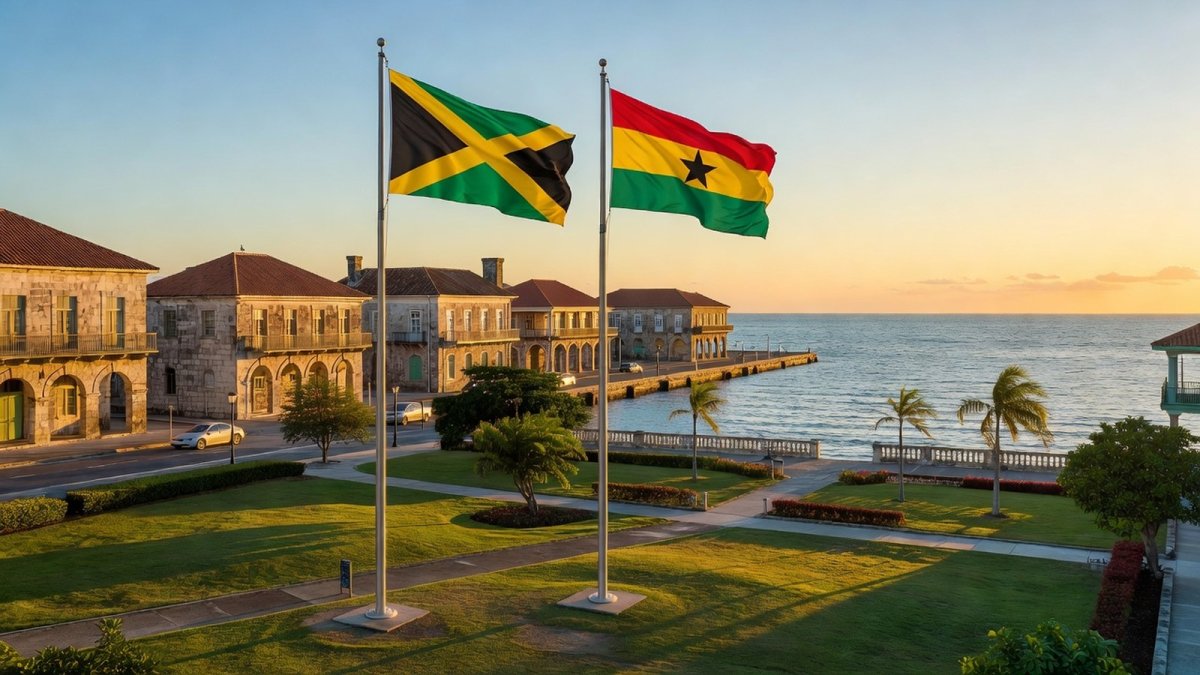
Kingston, Jamaica — Ghanaian President John Dramani Mahama arrived at Norman Manley International Airport on Sunday evening 2 August 2026 for a four-day state visit as special guest of the Jamaican Government during Emancipation and Independence commemorations. He was received by Ambassador Sandra Grant Griffiths, Senator the Honourable Kamina Johnson Smith, Ghana's Minister for Foreign Affairs Samuel Okudzeto Ablakwa and Ghana's High Commissioner H.E. Kofi Attor. The visit runs until Wednesday 5 August 2026.
Arrival and Ceremonial Welcome
The official programme began on Monday 3 August with a welcome ceremony at King's House, livestreamed by the Jamaica Information Service. President Mahama called on Governor-General His Excellency the Most Honourable Sir Patrick Allen and Lady Allen before holding bilateral talks with Prime Minister Dr the Most Honourable Andrew Holness. A joint press conference followed at Jamaica House, after which the President joined a high-level reparations dialogue at the University of the West Indies Mona Campus alongside Sir Hilary Beckles. Later he toured Independence Village at the National Arena, hosted by Minister of Culture, Gender, Entertainment and Sport Hon. Olivia Grange.
The timing of the arrival during Jamaica's Emancipation and Independence commemorations underscores a deliberate shift from past political solidarity toward shared economic goals. Mahama's words that earlier unity centred on liberation while today's must target the economic emancipation of our people resonate deeply across the Caribbean, where communities still navigate the legacies of displacement. In Trinidad and Tobago, such visits echo our own Emancipation observances, reminding families with African roots that these gatherings strengthen collective resolve rather than merely marking anniversaries.
From a regional standpoint, the ceremonial elements at King's House and the University of the West Indies show how formal welcomes can translate into lasting institutional links. Trinidad's own African heritage institutions often draw on similar moments to build people-to-people exchanges, encouraging practical community initiatives such as joint cultural programmes that help younger generations see Africa not as distant history but as an active partner in daily progress.
Landmark Agreements on Flights, Health and Defence
Leaders announced several concrete outcomes. A Bilateral Air Services Agreement is before Ghana's parliament and will be fast-tracked to allow direct flights between Accra and Montego Bay, with national carriers or third-party airlines operating the route. On health cooperation, Jamaica signed an agreement to recruit health professionals from Ghana, with the first nurses expected soon to support the local system while staff from both countries exchange places for specialised training. A new Defence Cooperation Agreement covers joint military training and disaster response, building on Ghana's earlier military support after Hurricane Melissa, which caused roughly US$12 billion in damage across Jamaica. Teacher exchange programmes in mathematics, physics and science were also discussed.
Direct air links between Accra and Montego Bay promise more than convenience; they open routes for families separated by generations to reconnect without the barriers of multiple stops and high costs. In Trinidad and Tobago, where diaspora remittances form a vital part of household economies, easier travel could similarly boost cultural and economic flows, allowing artisans and service providers to explore new opportunities across the Atlantic. The health worker exchanges add another layer, enabling specialised training that addresses staffing shortages while building mutual expertise suited to tropical disease patterns common in both regions.
The defence cooperation points to a practical model for small island states facing increasing climate threats. Trinidad and Tobago shares these vulnerabilities, and joint training in disaster response could strengthen regional preparedness through shared knowledge of resilient infrastructure. Teacher exchanges in core subjects further suggest long-term human capital development, where Caribbean classrooms gain from African perspectives on science and mathematics, enriching local education systems in ways that benefit entire communities.
Trade Ambitions and the AfCFTA Opportunity
President Mahama pledged to advance duty-free movement of goods between the African continent and CARICOM. When he assumes the African Union chairmanship next year, forging stronger trade links will sit high on his agenda. He highlighted the African Continental Free Trade Area, noting that manufacturers in one country can export to the other 54 nations, reaching a market of 1.4 billion people with a combined GDP of almost US$3 trillion. Ghanaian investors are being encouraged to explore opportunities in Jamaican real estate, construction and manufacturing, while Jamaican businesses will receive briefings on prospects in Ghana.
The African Continental Free Trade Area offers Caribbean producers a gateway to scale beyond local markets, allowing goods manufactured in Jamaica or Trinidad to reach a vast continental network without repeated tariff hurdles. For Trinidad and Tobago's manufacturers in agro-processing and creative sectors, this framework could diversify export destinations at a time when traditional partners face economic pressures. Ghanaian interest in Jamaican real estate and construction mirrors potential reciprocal flows, where Caribbean expertise in tourism and logistics finds receptive ground in growing African economies.
Prime Minister Holness pointed to recent results from a virtual investment and new market ministerial business mission held last month, with progress in logistics, tourism, hospitality, agro-processing, information communication technology, financial technology and the creative industries. Such signals indicate these links are already moving from discussion to action. In the wider Caribbean, the ambitions align with CARICOM's broader push for intra-regional and south-south trade, reducing reliance on distant northern markets. Communities in Port of Spain stand to gain from streamlined customs processes that lower costs for small businesses, turning abstract trade pacts into tangible improvements in local livelihoods and job creation.
Advancing the Reparations Cause
President Mahama came to push the global reparations agenda forward. Ghana's resolution at the UN General Assembly, backed by 123 countries, described the transatlantic slave trade and racialised chattel enslavement of Africans as the gravest crime against humanity. Ghana and CARICOM will continue joint work through special legal and expert groups based in Accra. The President stated clearly that Ghana fully supports Jamaica's petition to the British Royal Family because different paths lead to the same objective of justice.
The establishment of joint legal and expert groups in Accra provides a structured platform for sustained advocacy, moving beyond statements to coordinated legal strategies. Trinidad and Tobago's own reparations discussions benefit from this unified front, as regional voices gain strength when backed by African states with direct historical connections to the trade routes. Mahama's clear endorsement of Jamaica's petition to the British Royal Family illustrates how varied approaches can converge on justice without competition, encouraging Caribbean nations to pursue multiple avenues simultaneously whether through international forums or bilateral channels. For communities across the region, the focus on historical wrongs ties directly to present-day development needs, linking reparations to investments in education and health that address ongoing inequalities rooted in the past.
Deep Historical and Cultural Ties
Diplomatic relations between Jamaica and Ghana span more than five decades, rooted in the arrival of enslaved Africans from the Gold Coast, present-day Ghana. President Mahama paid floral tribute at the shrine of National Hero the Right Excellent Marcus Mosiah Garvey at National Heroes Park and addressed a special Joint Sitting of the Houses of Parliament. He visited the Ghanaian Village Houses at Seville Heritage Park in St Ann, two traditional African structures symbolising enduring bonds. The President also planned to visit the Bob Marley Museum, honouring the artist's message of mental freedom.
Marcus Garvey's influence on Ghana's founding father Kwame Nkrumah and the adoption of the Black Star symbol demonstrate how Caribbean ideas helped shape modern African nationhood, creating a two-way current of inspiration that continues today. The resumption of the Jamaica-Ghana Permanent Joint Commission for Cooperation after more than two decades, marked in May by the handover of cultural artefacts and a copy of Jamaica's Emancipation record to the museum at Cape Coast Castle, revives institutional memory that had faded. In Trinidad, similar heritage sites and Emancipation events draw on these connections to celebrate shared ancestry while fostering contemporary exchanges in music, literature and visual arts.
Visits to sites such as the Ghanaian Village Houses and the Bob Marley Museum reinforce the living nature of these bonds. They remind Caribbean audiences that cultural figures like Garvey and Marley carried messages of mental and economic freedom that still guide regional identity. Practical outcomes include renewed interest in preserving and sharing artefacts, which can support educational programmes in Trinidadian schools and community centres, deepening public understanding of how African roots inform present-day Caribbean life.
Implications for Trinidad and Tobago and the Wider Caribbean
For Trinidad and Tobago, closer Africa-Caribbean cooperation opens practical avenues in energy sector partnerships, expanded trade routes and stronger diaspora connections. The push for direct air links and duty-free arrangements under AfCFTA could ease movement of goods and people, supporting local manufacturers and service providers seeking new markets. Climate resilience measures outlined in the defence agreement align with shared concerns about extreme weather facing small island developing states, offering frameworks for collaborative planning that protect vulnerable coastal communities.
Closer energy ties could see Trinidad and Tobago share expertise in natural gas development with Ghanaian counterparts, creating mutual benefits in technology transfer and investment. Cultural exchanges centred on Garvey's legacy and events such as Carnival and Emancipation celebrations provide accessible ways to build everyday connections. As CARICOM nations prepare for Ghana's 70th Independence Anniversary next year, the visit signals a shift from symbolic solidarity toward concrete economic and social collaboration that benefits communities from Port of Spain to Accra. For families in Trinidad and Tobago, these developments translate into stronger diaspora networks, new market access and a renewed sense of shared purpose across the Atlantic.
By Sharon Sahatoo, Staff WriterThis article was produced with AI-assisted research and editorial support. Reporting is based on sources cited in the article.
What's Your Reaction?
 Like
0
Like
0
 Dislike
0
Dislike
0
 Love
0
Love
0
 Funny
0
Funny
0
 Wow
0
Wow
0
 Sad
0
Sad
0
 Angry
0
Angry
0

Caribbean Correspondent at Global1.News. Based in Port of Spain, Trinidad, covering Caribbean politics, economy, energy, climate, and culture. Amplifying the voices and stories of the Caribbean region.












Comments (0)