
London police defends mask policy ahead of anti-Israel march, rejects claims of 'two-tier policing'
London’s Metropolitan Police have announced that officers will evaluate each masked demonstrator individually during the anti‑Israel march scheduled for 10 October, organized by the Palestine Coalition.
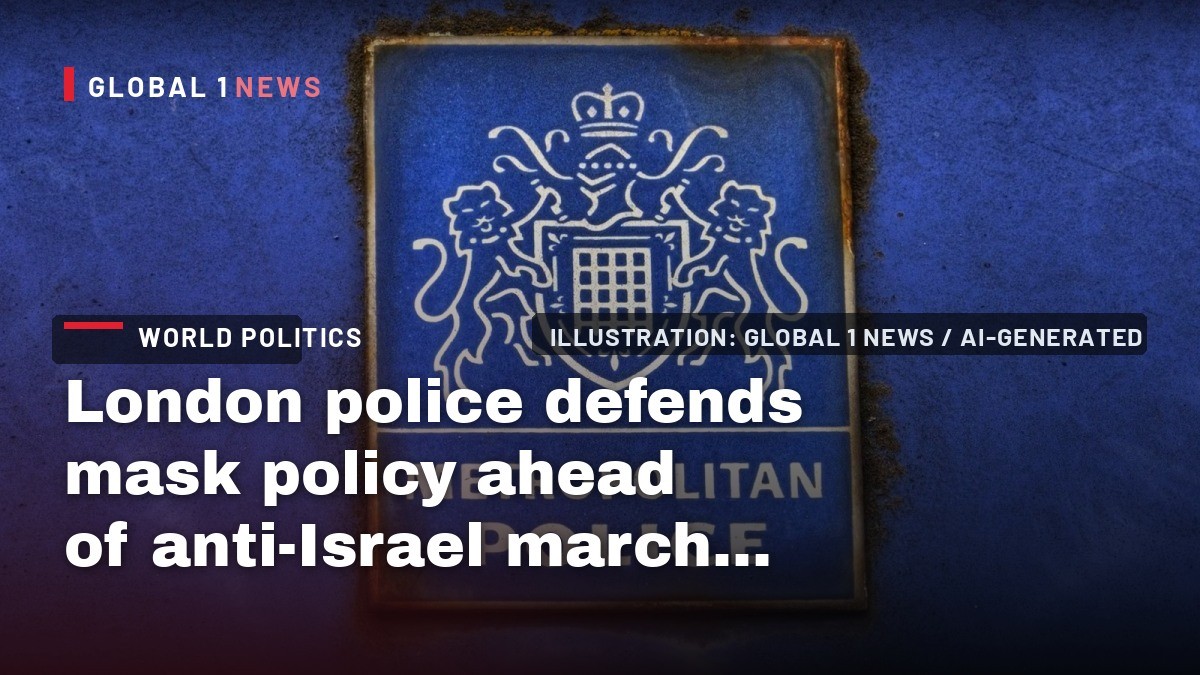
London’s Metropolitan Police have announced that officers will evaluate each masked demonstrator individually during the anti‑Israel march scheduled for 10 October, organized by the Palestine Coalition. The police statement, given to JNS, makes clear that participants who refuse to uncover their faces may face arrest under existing powers, a stance that has reignited a debate over alleged “two‑tier policing” in Britain.
Police rationale and legal framework
Deputy Assistant Commissioner Carl Gavin explained that the Met will invoke laws permitting it to demand the removal of face coverings when a protester’s intent appears to be concealment of identity or intimidation. He cited Section 60AA of the Public Order Act, which grants officers the authority to arrest anyone who refuses to remove a mask after being asked. Gavin stressed that this power is exercised only when the officer judges the mask to be used for unlawful purposes, not as a blanket ban on face coverings.
The spokesperson for the Metropolitan Police added that officers are “experienced in policing marches and the differing groups who attend and will use their judgment on why a person is wearing a mask and what action is required.” This language underscores a case‑by‑case approach, positioning the policy as a matter of professional discretion rather than a pre‑emptive restriction on protest attire.
Scale of the upcoming demonstration
According to the police spokesman, the march could attract “up to 10,000 people.” While the figure is an estimate, it signals the Met’s expectation of a sizable gathering, especially given the timing of the event near the third anniversary of the 2023 terror attack on Israel. Gavin warned that the proximity to that anniversary “has the potential to have a greater impact on communities than the previous national matches,” suggesting heightened sensitivities and a possible escalation in tensions.
The anticipated size of the crowd also informs the police’s logistical planning. The Met’s experience with prior demonstrations, including 35 large protests organized by groups within the Palestine Coalition since October 2023, provides a backdrop for assessing risks and allocating resources. Gavin noted that the “majority who attend do so peacefully and lawfully,” but acknowledged that a “small minority” has been arrested for racially or religiously aggravated public‑order offenses.
Historical context of protests and arrests
Since October 2023, the Palestine Coalition and affiliated groups have staged 35 large protests, according to Gavin. While most participants have complied with the law, the Met reports that a minority have been detained for offenses ranging from stirring racial hatred to supporting designated terrorist organizations. These arrests illustrate the fine line authorities walk between safeguarding public order and preserving the right to protest.
The claim filed by Mark Birbeck, founder of Our Fight UK, adds another layer to the narrative. Birbeck alleges that he was arrested in 2024 on suspicion of violating the Terrorism Act while debating anti‑Israel protesters. The Campaign Against Antisemitism, which is representing and funding his High Court claim, describes the incident as a “galling example of two‑tier policing,” arguing that Palestinian activists face “impunity” while supporters of British Jews are subjected to terrorism‑related charges.
Responses from civil society
The Campaign Against Antisemitism’s statement highlights a perception of unequal treatment. It contends that “while Palestine activists repeatedly break our laws with impunity, a member of the public is seemingly unable to peacefully express support for British Jews without being arrested on suspicion of terrorism.” This framing positions the Birbeck case as emblematic of broader grievances about perceived bias in law‑enforcement practices.
In parallel, the group Stop the Hate plans to rally outside New Scotland Yard on the same day. The Met clarified that Stop the Hate’s advertised time‑frame was shorter, but that the conditions set for the rally actually allow participants to remain until 2:30 p.m., “longer, in fact, than the advertised event.” This detail reflects the police’s effort to manage multiple demonstrations simultaneously while maintaining order in the vicinity of the police headquarters.
Legal implications of Section 60AA
Section 60AA, referenced by Gavin, empowers officers to require removal of face coverings when they suspect the mask is being used to conceal identity for the purpose of intimidation or committing an offense. The law does not categorically prohibit masks; rather, it gives discretion to assess intent. The Met’s emphasis on “professional judgment” seeks to reassure the public that the power will be applied proportionately.
Legal scholars note that the provision has been invoked in previous high‑profile protests, often sparking debate over civil liberties. The balance between security concerns and the right to anonymity in public demonstrations remains a contested space, especially in a climate where facial recognition technology is increasingly prevalent.
Potential impact on community relations
The upcoming march occurs at a sensitive juncture for Jewish and broader minority communities in the UK. The memory of the 2023 terror attack on Israel still resonates, and any perceived escalation in police action could exacerbate tensions. Gavin’s acknowledgment that the event “has the potential to have a greater impact on communities than the previous national matches” signals an awareness of the broader social reverberations.
Community leaders have called for calm and dialogue. While the source material does not include statements from Jewish or Arab community representatives, the pattern of police‑community interaction in previous protests suggests that clear communication about policing policies can mitigate misunderstandings. The Met’s decision to articulate the legal basis for mask removal aims to provide transparency, yet the perception of “two‑tier policing” persists among advocacy groups.
Looking ahead: what to expect on 10 October
On the day of the march, officers will be tasked with monitoring a crowd that could number up to 10,000, assessing individual cases of mask‑wearing, and responding to any incidents that cross the threshold into criminal conduct. The presence of Stop the Hate outside New Scotland Yard adds another focal point for police resources.
Observers will be watching closely to see how the Met balances its stated commitment to proportionality with the practical challenges of a large, potentially volatile demonstration. The outcome may influence future policing strategies for protests linked to the Israel‑Palestine conflict, as well as the legal discourse surrounding Section 60AA and the broader question of how democracies manage dissent while protecting public safety.
This article was produced with AI-assisted research and editorial support. Reporting is based on the source material cited below. Sources: JNS (Jewish News Syndicate); jns.org; Global1.News (10 October 2026).
By Hannah Berg, Staff Writer
What's Your Reaction?
 Like
0
Like
0
 Dislike
0
Dislike
0
 Love
0
Love
0
 Funny
0
Funny
0
 Wow
0
Wow
0
 Sad
0
Sad
0
 Angry
0
Angry
0
Israel Correspondent at Global1.News. Based in Tel Aviv, covering Israeli politics, security, technology, and society. Provides balanced, deeply-sourced reporting on one of the most closely-watched regions in the world.












Comments (0)