
Leipzig Airport Drone Bomb Highlights Europe's Hybrid Warfare Vulnerability
The discovery of an explosives-laden drone on the tarmac of Leipzig/Halle Airport has triggered one of the most serious security alerts at a European logistics hub since the war in Ukraine began.
The discovery of an explosives-laden drone on the tarmac of Leipzig/Halle Airport has triggered one of the most serious security alerts at a European logistics hub since the war in Ukraine began. German Interior Minister Alexander Dobrindt has warned of a "new level of danger" from an attack that "may involve foreign powers", as investigators examine whether the device was positioned to strike aircraft moving military supplies to Kyiv.
Drone Bomb at Leipzig Airport Raises Hybrid Warfare Alarm Across Europe
Leipzig, Germany — Article continues below.
Discovery of the Drone
Late Tuesday night on August 4 2026, an airport employee located a small drone fitted with an explosive device at Leipzig/Halle Airport in Schkeuditz, Germany. The device was positioned in the cargo section close to the southern runway. Investigators noted that the drone appeared to be "floating" between several Ukrainian Antonov cargo planes parked on the tarmac.
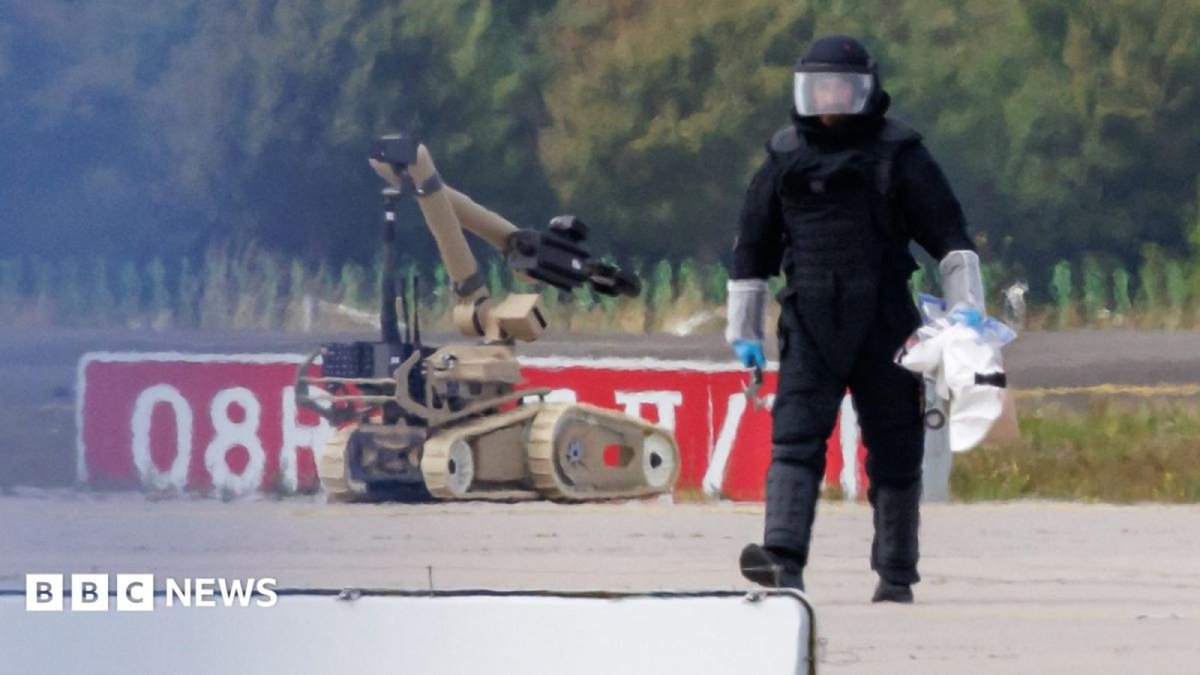
Police deployed a bomb disposal robot to defuse and destroy the device, and one runway was locked down as numerous flights were diverted. Authorities treated the find as a serious security breach requiring immediate containment measures. One of the Antonov aircraft nearby bears the slogan "Be Brave Like Kherson", a reference to the southern Ukrainian city on the front line of Russia's invasion.
The DHL Plane Collision Investigation
Around the same time, a DHL cargo plane collided with an "unidentified object" while aborting its landing and pulling up into the sky. The aircraft proved unable to land in Leipzig and instead made an unscheduled landing in Hanover. Authorities continue to investigate whether this event involved a second drone, and teams are still working to establish who launched the devices and why.
Interior Minister's Assessment
German Interior Minister Alexander Dobrindt warned of a "new level of danger" from an attack that "may involve foreign powers". His statement highlighted the potential for external actors to target critical infrastructure supporting European logistics operations. While there is no proof at this stage linking the drone directly to Russia, and Moscow denies any role, German and European authorities point to a documented record of Russian-linked sabotage across the continent.
Links to Ammunition Transport
German media reports from WDR, NDR and Sueddeutsche Zeitung, citing investigators, indicate the drone was found near a plane reportedly carrying ammunition destined for Ukraine. If confirmed, the targeting of logistics on European soil marks a notable expansion of the conflict's geographic scope, shifting risk from Ukrainian territory to alliance rear areas. The choice of location would underscore an intent to interdict supplies at their point of departure rather than during transit through contested airspace.
Attribution in hybrid warfare remains complicated by the absence of conclusive proof linking the device to any state actor, despite the established pattern of Russian-linked sabotage. Moscow's denials align with prior responses to similar incidents, leaving investigators to rely on circumstantial indicators such as technical similarities to earlier plots. With multiple European sites experiencing drone activity in recent weeks, authorities must assess whether individual finds represent opportunistic efforts or coordinated probes designed to map vulnerabilities across the logistics network.
The 2024 Precedent Plot
Investigators are examining striking parallels with a July 2024 plot in which a parcel containing a sophisticated incendiary device caught fire at Leipzig airport's DHL hub shortly before being loaded onto a plane. A similar package travelled to the UK and caught fire at a warehouse in Birmingham, while two additional packages were found in Poland. A group of men are currently on trial in Lithuania and Poland, with prosecutors believing they formed part of a network of proxies recruited by Russian military intelligence.
Court proceedings have exposed recruitment mechanisms that relied on cryptocurrency transfers and instructions relayed through intermediaries, illustrating a distributed network structure that kept handlers insulated from direct exposure. One defendant, a Ukrainian citizen named Vladyslav D., described making multiple long car trips in July 2024 following directives from a contact identified only as "Warrior" — collecting cans of corn "lightly covered with soil", picking up headphones from the edge of a Lithuanian forest, digging beneath plastic flowers in a cemetery to uncover drone components, and leaving items by a roadside in central Poland. He was paid more than $2,000 (1,487 pounds) in cryptocurrency for his efforts.
Investigations revealed that materials originated in part from Kaliningrad, with caches recovered from burial sites in Lithuania containing drone parts and pre-packed explosive containers. The scale of the operation, encompassing nearly two dozen individuals facing terror-related charges, points to a coordinated proxy system capable of sustaining activity across several countries while maintaining operational security. Last September, Lithuanian prosecutors said investigators had also seized RDX explosives meant for "other terrorist attacks" — an amount equivalent to 6kg of TNT — with some devices "manufactured to intensify the blast".
Methods Used in Prior Operations
Several men were paid to transport explosives around Europe concealed in cans of sweetcorn and chopped tomatoes, with detonators hidden inside headphone sets. Suspects also handled drone parts, and the case speaks of attachments suitable for holding a bomb, with some materials brought into the EU from the Russian exclave of Kaliningrad. Some German sources report that the explosive used in the current Leipzig incident was Semtex, which contains RDX — the same substance found in the food cans recovered from the Lithuanian cemetery.
Professor Jackie Akhavan of Cranfield University noted that the drone casing, if metal, might have put a hole in a plane, but a blast wave would probably just have dented it unless fragmentation was added inside. Continuity between the 2024 plot and the 2026 drone discovery emerges through shared technical elements, including the use of RDX-based explosives and drone-related hardware. Both cases involve concealment methods suited to cargo environments and target infrastructure supporting Ukrainian logistics — an enduring operational template that adapts delivery mechanisms while retaining core objectives of disruption and intimidation.
Suspected Motives and Patterns
Andrei Soldatov, an expert on Russia's intelligence agencies, said it "makes sense" to suspect Moscow given the clear pattern of sabotage and hostile activity ranging from arson attacks on facilities supporting Ukraine to drones over sensitive sites in Europe. He described the action as a message: "You get something like that into one of the biggest European airports and you send the message that, 'Guys, we can do that. Remember'."
Russia's pattern of hybrid operations across Europe has consistently targeted logistics nodes that sustain Ukrainian defensive capabilities. The placement of an explosive device at Leipzig/Halle, a primary cargo hub for Antonov Airlines, demonstrates reach into a site that processes both commercial freight and NATO-aligned military movements, amplifying the psychological impact without requiring direct attribution.
Ukraine's sustained long-range drone strikes against Russian infrastructure have intensified pressure on Moscow, prompting an apparent acceleration of sabotage efforts to restore a sense of equilibrium in the conflict. By positioning a device near aircraft reportedly linked to ammunition transport, an operation would signal an intent to disrupt supply lines at their European origin rather than solely on the battlefield, forcing European authorities to divert resources toward domestic security and potentially slowing the pace of assistance to Kyiv.
Geopolitical Ramifications
John Lough of the New Eurasian Strategies (NEST) Centre observed that the incident represents Russian interference aimed at undermining support for Ukraine by highlighting the dangers of escalation and "scaring the German authorities". A Nato official told the BBC: "We are aware of the incident, which the German authorities continue to investigate."
Leipzig/Halle functions simultaneously as a commercial cargo center and a node for NATO military movements, making any security breach there a direct challenge to alliance sustainment efforts. The presence of Antonov Airlines aircraft underscores the airport's role in facilitating state-level cargo operations that intersect with Western supply commitments. Antonov maintains its European base at the facility while providing aircraft for selected NATO tasks, a role that places Ukrainian state assets at the center of transcontinental military transport. A spokeswoman in Kyiv said: "We are not making any such assumptions... We don't know what this drone was or why it was there."
Domestically, the event contributes to heightened scrutiny of infrastructure protection within Germany, potentially influencing budgetary priorities and political debates over defense spending. Across the continent, similar drone sightings at ports, energy sites and other airports compound concerns about systemic exposure. In the wider context of great-power competition, such actions reinforce narratives of multipolar friction by demonstrating how targeted interference can complicate collective responses without crossing thresholds that invite conventional retaliation.
Future Outlook for Hybrid Attacks
Analysts anticipate an intensification of hybrid measures as Russia seeks to offset battlefield pressures through expanded sabotage. John Lough has characterized the current period as one in which such attacks are likely to rise "quite sharply over the coming months", reflecting a strategic calculation that exploits European caution regarding escalation. "I think it's a dangerous moment," he said.
Recent drone observations at additional German airports and sensitive installations indicate a widening pattern of reconnaissance and potential preparation. These sightings coincide with Ukraine's ongoing strikes on Russian targets, suggesting a reciprocal dynamic in which each side employs unmanned systems to impose costs beyond traditional front lines. The cumulative effect strains European security resources and necessitates a reevaluation of detection and response protocols at civilian facilities.
European security architecture faces increasing demands for coordinated resilience measures across logistics networks. The integration of military supply functions into commercial hubs creates persistent vulnerabilities that hybrid actors can exploit with limited resources. Strengthening attribution capabilities and hardening perimeter defenses will be essential if authorities are to maintain the flow of assistance while deterring further low-signature operations.
By Prof. Marcus Chen, Staff Writer
This article was produced with AI-assisted research and editorial support. Reporting is based on sources cited in the article.
What's Your Reaction?
 Like
0
Like
0
 Dislike
0
Dislike
0
 Love
0
Love
0
 Funny
0
Funny
0
 Wow
0
Wow
0
 Sad
0
Sad
0
 Angry
0
Angry
0

World Politics Analyst at Global1.News. Based in Beijing, covering US-China relations, global trade, and geopolitical strategy. Brings deep analytical perspective to the power dynamics shaping international affairs.














Comments (0)