
Israeli High Court orders return of Jalud residents after settler violence
JALUD, occupied West Bank — Israel's High Court of Justice has ordered the state to allow Palestinian residents of Jalud, a village in the northern occupied West Bank near Nablus, to return to homes from which they were driven out by Jewish settlers, after the court heard evidence that included video footage of Israeli soldiers playing football inside a seized Palestinian home.
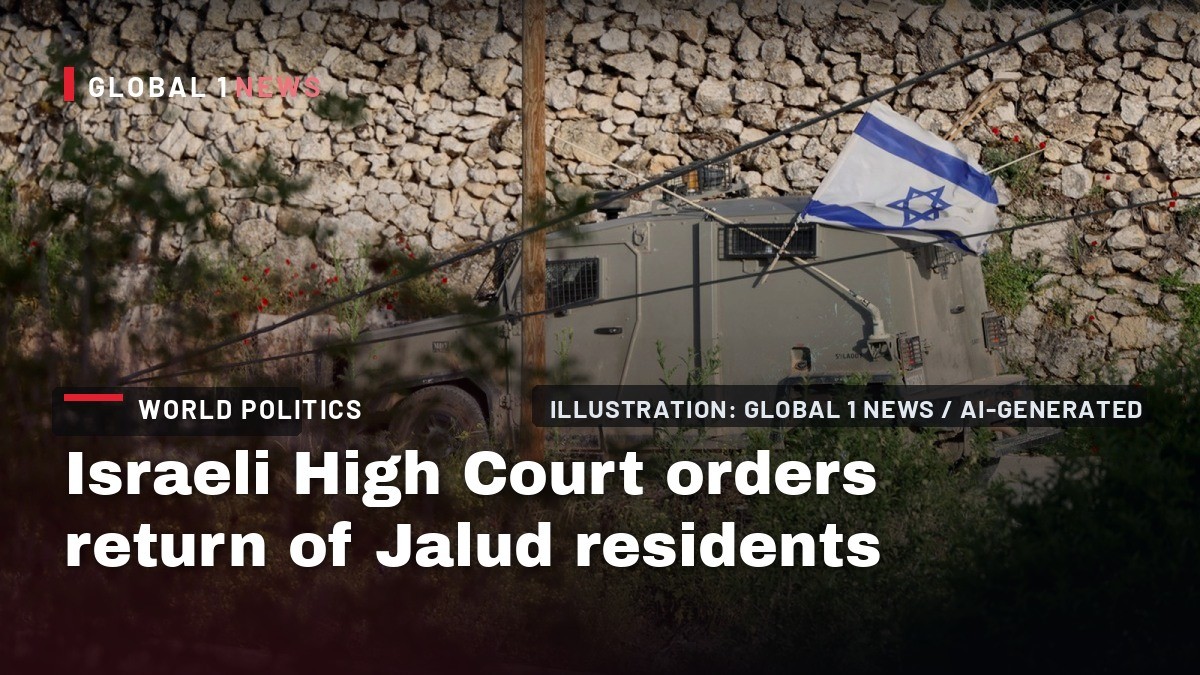
Israeli High Court orders return of Jalud residents after settler violence
JALUD, occupied West Bank — Israel's High Court of Justice has ordered the state to allow Palestinian residents of Jalud, a village in the northern occupied West Bank near Nablus, to return to homes from which they were driven out by Jewish settlers, after the court heard evidence that included video footage of Israeli soldiers playing football inside a seized Palestinian home.
Court ruling follows months of displacement
The ruling, delivered by Supreme Court President Isaac Amit sitting with Justices Alex Stein and Yechiel Kasher, marks a rare judicial intervention in a pattern of settler violence that has forced hundreds of Palestinian families from their homes across the West Bank. The court ordered the state to coordinate the residents' return within 14 days, secure their safe passage, and restore utilities that had been cut off during the campaign against the village.
The state has until 22 September to submit a progress report and until 8 October to detail what enforcement measures it intends to take against those responsible for the violence. The court's decision comes after three petitioners from Jalud challenged the authorities' failure to protect them from what the justices described as a campaign of terror intended to drive them out of their homes.
Video evidence shows soldiers inside seized home
Central to the court's deliberations was video evidence showing Israeli soldiers playing football inside a Palestinian home that had been seized during the campaign against Jalud's residents. The footage, cited in the court's ruling, underscored the military's alleged complicity in the displacement rather than its prevention.
The court wrote that "the emerging picture is extremely bleak. There are plenty of questions, but fewer satisfactory answers." The justices criticised the authorities for failing to seize the vehicles of suspects whose number plates had already been recorded and asked why no investigations had been opened against individuals who had been identified.
The video evidence aligns with documented cases in which the Israeli army has been accused of facilitating settler attacks rather than preventing them. In Qusra, also in the northern West Bank, soldiers occupied the home of a besieged family as a "military post" while settlers laid siege to neighbouring houses, according to reporting from the West Bank.
Campaign against Jalud began in April
According to the ruling, the campaign against Jalud's residents began in April, when settlers pitched a tent on privately owned Palestinian land in Area B, which is under Israeli civil and Palestinian security control. Over the following months, residents were subjected to a sustained campaign intended to drive them from their homes.
Settlers carried out incursions, set up roadblocks, threw stones, destroyed property, severed a water line, uprooted trees and burned a vehicle. Two of the three petitioners were forced to abandon their homes by 22 June. Instead of arresting settlers, the Israeli army is said to have encouraged the terrorising of Palestinian residents, according to the court's findings.
Jalud sits in a region of the northern West Bank that has seen repeated confrontations between Palestinian farming communities and settlers from nearby outposts. The village's agricultural lands, like those of many communities in the area, have been progressively encroached upon over years of settlement expansion, making the recent campaign particularly devastating for families who depend on their land for livelihood.
Record settler violence documented by UN
The ruling comes against a backdrop of what the UN Office for the Coordination of Humanitarian Affairs (OCHA) has called the worst period of settler violence in two decades of monitoring. OCHA recorded more than 1,330 settler attacks on Palestinians in the West Bank between January and late July this year, an average of six a day.
A UN-mandated commission of inquiry has found that Israeli authorities "have repeatedly failed to prevent foreseeable settler attacks and, in some cases, have directly enabled them through army protection and the provision of weapons and funding." The Israeli human rights organisation B'Tselem said: "The government funds and arms the settlers while the Israeli military stands by and, in many cases, actively participates in the attacks."
The scale of violence documented by OCHA reflects a broader deterioration in the occupied West Bank, where Palestinian communities face increasing pressure from settlement expansion, military closures and settler violence. For residents of villages like Jalud, the daily reality involves navigating roadblocks, confronting armed settlers and watching their olive groves and homes come under attack with little recourse to protection.
Precedent of failed court orders raises concerns
Court orders of this kind have failed to hold in the past, raising questions about whether the Jalud ruling will translate into lasting change for the village's displaced families. In August 2024, the same court ordered the return of Palestinian residents of Khirbet Zanuta, a hamlet in the South Hebron Hills, who had been driven out the previous year by settlers linked to the Meitarim Farm outpost.
Within three weeks, renewed attacks and more than 100 documented incidents of harassment forced the families out again, prompting the rights group Haqel to file a contempt of court motion that remains before the justices. The Khirbet Zanuta case illustrates the gap between judicial rulings and enforcement on the ground, where settlers and military authorities have repeatedly failed to comply with court orders.
Rights groups say such rulings, however welcome, do little to alter the pattern of ethnic cleansing. The persistence of violence despite court intervention points to systemic failures in the Israeli legal and enforcement systems when it comes to protecting Palestinian residents of the occupied West Bank from settler attacks.
Wider displacement across West Bank communities
OCHA has documented more than 5,900 Palestinians displaced from 117 West Bank communities as a result of settler attacks and related access restrictions between January 2023 and April 2026, a pattern Amnesty International has described as part of Israel's policy of ethnic cleansing in Area C, under full Israeli civil and military control.

The displacement of communities like Jalud and Khirbet Zanuta forms part of a broader strategy that human rights organisations say aims to depopulate Palestinian areas and clear land for settlement expansion. Families forced from their homes often find themselves in overcrowded urban centres or dependent on relatives, losing not only their houses but their agricultural land, livestock and livelihoods.
For the residents of Jalud, the court's order offers a measure of hope, but the experience of other communities suggests that return is only the first step in a longer struggle. The state's obligation to secure safe passage and restore utilities will require sustained enforcement, something that has been notably absent in previous cases.
Questions remain over enforcement and accountability
The court's criticism of the authorities for failing to seize vehicles and open investigations against identified individuals highlights a broader pattern of impunity for settler violence. Despite documented incidents, arrests of settlers are rare, and prosecutions even rarer, while Palestinian victims of violence often face barriers to accessing legal remedies.
The state's progress report, due by 22 September, and its enforcement plan, due by 8 October, will be closely watched by rights groups and the displaced families of Jalud. Whether the military will take meaningful action against settlers who have terrorised the village, or whether the pattern of facilitation documented in the court's ruling will continue, remains to be seen.
The video evidence of soldiers playing football in a seized Palestinian home has become a symbol of the military's approach to settler violence — one in which the army appears to treat Palestinian homes as recreational spaces rather than protected property. For the families of Jalud, the return ordered by the court is a necessary step, but the deeper questions of accountability and protection remain unresolved.
As the 14-day deadline approaches, residents of Jalud will be preparing to return to homes that have been occupied and damaged, to water lines that were severed and trees that were uprooted. The court has ordered the state to restore utilities and secure their safe passage, but the experience of Khirbet Zanuta serves as a warning that judicial orders alone may not be sufficient to protect them from further attacks.
The international community, which has repeatedly called for an end to settler violence and for accountability for those responsible, will be watching whether Israel implements the court's ruling or allows it to become another example of a paper victory for Palestinian rights. For now, the families of Jalud wait, hoping that this time the order will hold.
By Fatima Al-Rashid, Staff Writer
This article was produced with AI-assisted research and editorial support. Sources: Middle East Monitor (middleeastmonitor.com).
What's Your Reaction?
 Like
0
Like
0
 Dislike
0
Dislike
0
 Love
0
Love
0
 Funny
0
Funny
0
 Wow
0
Wow
0
 Sad
0
Sad
0
 Angry
0
Angry
0

Gulf/MENA Correspondent at Global1.News. Based in Doha, covering Gulf politics, energy markets, diplomacy, and development across the Middle East and North Africa. Tracks the economic transformation of the Gulf states.















Comments (0)