
Israeli army blows up Palestinian man's home weeks after his killing
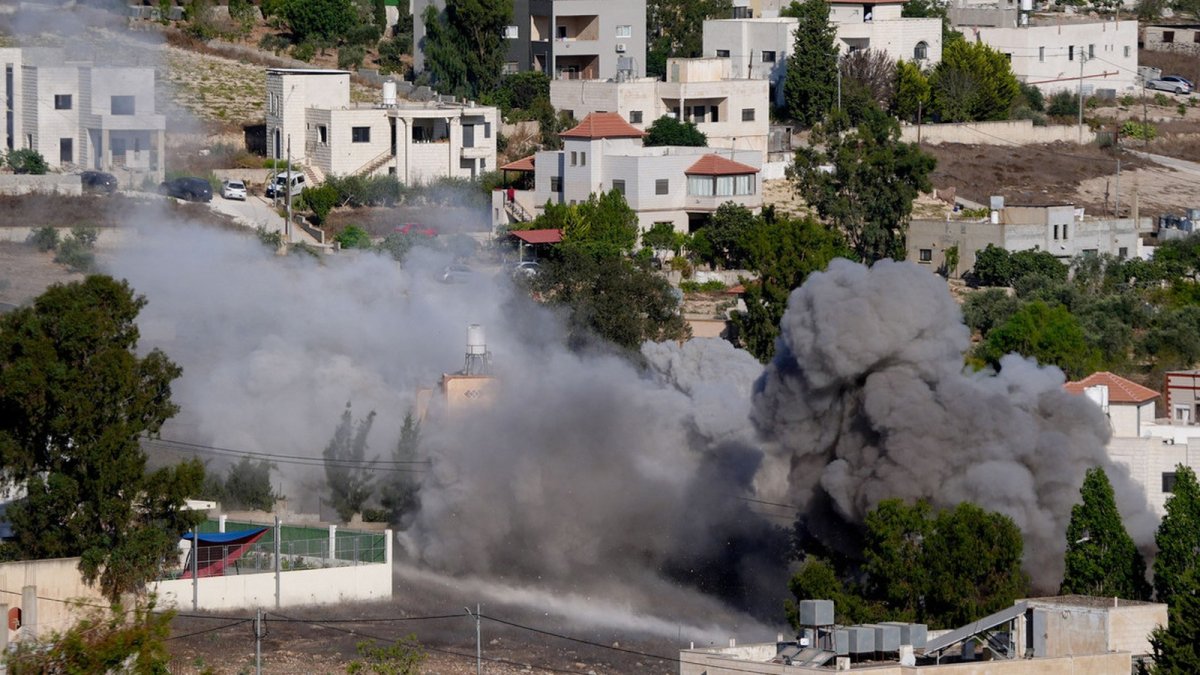
Israeli Forces Demolish Home of Slain Palestinian Man in Nablus Village TAL, Occupied West Bank — Less than three weeks after Farouk Ramadan was killed while confronting an attack on his village, Israeli forces returned to Tal, southwest of Nablus, and blew up the third floor of his family's residential building.
Israeli Forces Demolish Home of Slain Palestinian Man in Nablus Village
TAL, Occupied West Bank — Less than three weeks after Farouk Ramadan was killed while confronting an attack on his village, Israeli forces returned to Tal, southwest of Nablus, and blew up the third floor of his family's residential building. The demolition, carried out on the morning of August 11, came after Israeli troops raided the area and forced residents of several nearby homes to evacuate, according to local sources.
Ramadan was among four Palestinians killed and four others injured during a late July assault on Tal by Israeli forces and settlers, according to local sources. Witnesses and community members report that Ramadan, who was unarmed, seized a weapon from one of the settlers during the confrontation and opened fire, killing two of the attackers before he was killed. The Israeli military has described the July 24 incident as a shooting attack, but Palestinian residents maintain that Ramadan acted in self-defense as the village came under assault.
The demolition of Ramadan's home is part of a broader pattern of punitive demolitions that human rights organizations have long condemned as collective punishment under international law. The practice, which Israeli authorities say is meant to deter attacks, has been criticized by the United Nations and human rights groups as a violation of the Fourth Geneva Convention, which prohibits the destruction of property in occupied territory except where absolutely necessary for military operations.
Anza Village Faces Mass Demolition of Shops and Homes
In a separate operation on the same day, Israeli forces moved into the village of Anza, south of Jenin in the northern West Bank, with demolition vehicles and began tearing down approximately 20 shops located on the main road linking the village to Jenin. Tayseer Sadaqa, an activist who documents Israeli violations in Anza, said the army raided the village and began the demolitions under the pretext of construction without permits.
"The demolitions are being carried out under the pretext of building without a permit," Sadaqa told reporters. The shops, many of which served as the primary source of income for local families, were reduced to rubble within hours. Residents watched as bulldozers dismantled storefronts that had operated for years, some for decades, along one of the village's busiest commercial corridors.
The Anza demolitions are particularly significant because they target commercial infrastructure, not just residential structures. Local economists and community leaders note that the destruction of shops along the main road will have immediate and long-term economic consequences for the village, cutting off livelihoods and reducing access to essential goods and services for surrounding communities.
Wider Wave of Demolitions Across the West Bank
The operations in Tal and Anza were not isolated incidents. Early Tuesday morning, Israeli forces demolished two Palestinian homes in the village of Shuqba, west of Ramallah, according to the International Middle East Media Center. The demolished structures included a two-story house under construction belonging to Ahmad Shallash and a single-story residence owned by Mousa Sweilem. Witnesses reported that soldiers fired tear gas at residents and journalists during the operation, causing several cases of suffocation.
The Shuqba demolitions were carried out without prior notice, according to residents, leaving families with no time to salvage belongings or make alternative arrangements. Such surprise demolitions have become increasingly common, according to Palestinian monitoring groups, who document the daily reality of displacement across the occupied territory.
These operations come amid what Palestinian sources describe as an escalation in the destruction of Palestinian homes and other structures across the occupied West Bank, alongside illegal settlement expansion and the establishment of new outposts. Since the start of Israel's war on Gaza in October 2023, Israeli forces and settlers have escalated attacks in the West Bank, killing more than 1,183 Palestinians, injuring around 13,000 and arresting nearly 25,000, according to Palestinian figures.
UN Data Shows Dramatic Rise in Demolition Rates
The United Nations Office for the Coordination of Humanitarian Affairs has documented a sharp increase in demolitions across the West Bank. In a report published August 7, OCHA noted that demolitions displaced 22 people and affected over 100 others in a single week. More striking, the report found that since 2024, the monthly average of structures demolished in Area C and East Jerusalem has been at least twice the average recorded over the preceding 15 years.
Earlier data from OCHA, published May 1, showed that more than 620 Palestinians had been displaced by demolitions due to lack of building permits in 2026 alone, an average of 160 people displaced per month. These figures reflect a systematic approach to demolition that goes beyond punitive measures, targeting the very infrastructure of Palestinian daily life.
The permit system itself has been widely criticized as discriminatory. Palestinians face enormous bureaucratic hurdles in obtaining building permits in Area C, which constitutes about 60 percent of the West Bank and remains under full Israeli control. Permit approval rates for Palestinians are extremely low, while Israeli settlements in the same areas continue to expand rapidly. This disparity has led human rights organizations to conclude that the permit system is designed to limit Palestinian development and facilitate settlement expansion.
Community Impact and the Human Cost
For the families affected, the demolitions represent not just the loss of physical structures but the destruction of homes, memories, and futures. In Tal, the Ramadan family has lost the third floor of their home, a space that held the daily life of a family now mourning a son. In Anza, shop owners have lost their means of survival. In Shuqba, two families are now without shelter.
The psychological toll is equally severe. Children who witness their homes being destroyed, parents who cannot protect their families from displacement, and communities that live under the constant threat of demolition all experience trauma that extends far beyond the physical destruction. Rights groups and local organizations working in the West Bank have repeatedly documented the psychological effects of home demolitions on families, though comprehensive mental health data from the affected areas was not immediately available.
The economic impact ripples outward from each demolition. When a shop is destroyed, the owner loses income, employees lose wages, and the community loses access to goods and services. When a home is demolished, the family must find alternative housing, often at significant cost, and may be forced to move away from their support networks and livelihoods. Over time, these individual losses accumulate into collective economic decline.
Annexation Fears and the Two-State Future
Palestinian officials and analysts warn that the escalation in demolitions is part of broader Israeli efforts to impose facts on the ground, paving the way for annexation of the occupied West Bank and undermining the possibility of establishing a Palestinian state along the 1967 borders under relevant UN resolutions. The systematic destruction of Palestinian homes, shops, and infrastructure, combined with continued settlement expansion, is reshaping the territorial reality of the West Bank in ways that make a contiguous, viable Palestinian state increasingly difficult to achieve.
The demolitions also come at a time of heightened regional tension, with the war in Gaza continuing and no political horizon for a resolution to the Israeli-Palestinian conflict. International responses have been largely limited to statements of concern, with no meaningful action to hold Israel accountable for what human rights organizations describe as violations of international law.
For Palestinians in the West Bank, the message is clear: their presence, their homes, and their livelihoods are under systematic threat. The demolitions in Tal, Anza, and Shuqba are not isolated incidents but part of a coordinated pattern that has accelerated dramatically since October 2023. As Sadaqa told Anadolu, "The demolitions are being carried out under the pretext of building without a permit" — a characterization echoed by Palestinian monitoring groups who say the cumulative effect is to make daily life in the occupied territory increasingly untenable.
The international community's response will be critical in determining whether this pattern continues. UN resolutions, including Security Council Resolution 2334, have affirmed that Israeli settlements in the occupied Palestinian territory are a flagrant violation of international law and called for an end to all settlement activities. Yet enforcement mechanisms remain absent, and the demolitions continue.
For now, the families in Tal, Anza, and Shuqba are left to pick up the pieces, to rebuild what they can, and to wait for a political process that has shown little sign of addressing their reality. The demolition of Farouk Ramadan's home, coming so soon after his killing, serves as a stark reminder of the price Palestinians continue to pay in a conflict that shows no signs of resolution.
This article was produced with AI-assisted research and editorial support. Sources: Middle East Monitor, Anadolu Agency, UN OCHA, Arab News, Times of Israel, Palestine Information Center, IMEMC.
By Fatima Al-Rashid, Staff Writer
What's Your Reaction?
 Like
0
Like
0
 Dislike
0
Dislike
0
 Love
0
Love
0
 Funny
0
Funny
0
 Wow
0
Wow
0
 Sad
0
Sad
0
 Angry
0
Angry
0

Gulf/MENA Correspondent at Global1.News. Based in Doha, covering Gulf politics, energy markets, diplomacy, and development across the Middle East and North Africa. Tracks the economic transformation of the Gulf states.












Comments (0)