
Infrastructure Gaps Test Pakistan’s Flagship CPEC Industrial Zone, Field Survey Finds
Since its 2020 notification, the Allama Iqbal Industrial City (AIIC) in Faisalabad has been heralded as the flagship Special Economic Zone (SEZ) of Pakistan’s China‑Pakistan Economic Corridor (CPEC).
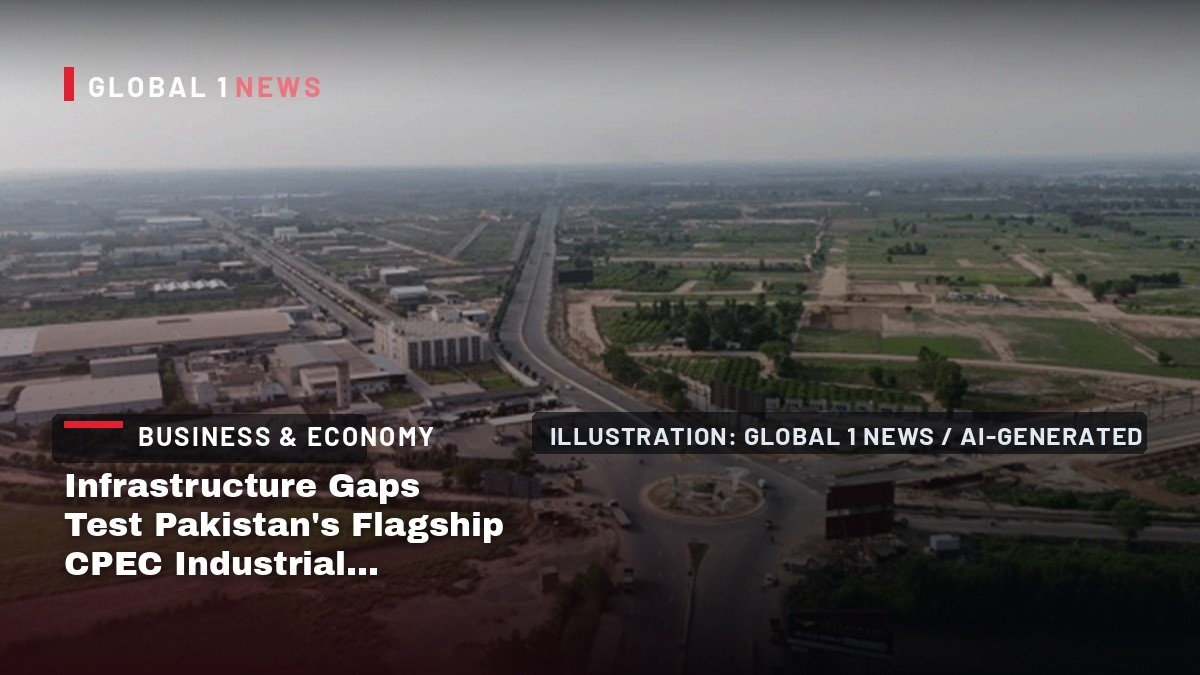
Since its 2020 notification, the Allama Iqbal Industrial City (AIIC) in Faisalabad has been heralded as the flagship Special Economic Zone (SEZ) of Pakistan’s China‑Pakistan Economic Corridor (CPEC). By September 2026 the zone has attracted more than 327 billion rupees in committed investment and allotted 223 of the 424 planned plots. Yet a recent field survey conducted by the zone’s own authority, the Faisalabad Industrial Estate Development & Management Company (FIEDMC), together with four operating firms, reveals a stark mismatch between capital inflows and the provision of basic utilities, logistics and transport services that are essential for an export‑oriented industrial hub.
Investment Inflows and Plot Allocation: A Quantitative Overview
The AIIC’s financial profile, as disclosed by the Board of Investment, shows a cumulative commitment exceeding 327 billion rupees (approximately US$1.2 billion). Of the 424 plots earmarked for development, 223 have already been allotted, reflecting a rapid uptake by both domestic and foreign investors. Since its inception the zone has drawn 117 investors, including firms from China, Germany, Switzerland, Canada and the Netherlands, and has recorded 147 billion rupees in foreign capital alongside 180.53 billion rupees in domestic investment. These figures underscore the AIIC’s role as a magnet for capital within the broader CPEC framework.
Nevertheless, the sheer volume of pledged funds and allotted land does not automatically translate into operational capacity. The survey’s diagnostic nature—focused on on‑site observations rather than statistical sampling—highlights that the physical and institutional infrastructure required to harness these investments remains underdeveloped.
Utility Deficits: Water, Power and Wastewater Treatment
One of the most pressing gaps identified by both FIEDMC officials and tenant firms concerns water supply. The zone lacks a centralized piped potable network; consequently, each enterprise must drill and manage its own wells. This self‑boring arrangement not only raises the risk of groundwater depletion but also imposes additional capital costs on firms that could otherwise be directed toward production.
Energy reliability, while not described as scarce, is deemed “costly” by tenants such as Ocean Ceramics, which employs 230 workers. The firm’s leadership indicated that reductions in gas and electricity expenses would significantly boost performance, suggesting that current tariffs or supply intermittency erode competitiveness.
Perhaps most critical is the absence of a funded Combined Effluent Treatment Plant (CETP). The zone’s assessment notes that no CETP has been financed, leaving each company to manage industrial wastewater independently. Both the zone’s senior engineering manager and the China‑Pakistan steel joint venture rated the shared effluent‑treatment facilities as merely “average,” underscoring the environmental and operational risks associated with ad‑hoc waste management.
Logistics and Customs Facilitation: The Missing Trade Backbone
Customs facilitation emerged as the single most acute barrier to export activity. Surveyed officials ranked “CETP and utility reliability” as urgent, yet they also highlighted the need to render the “One‑Window Operation” service fully functional and time‑bound. This platform, intended to streamline regulatory approvals, remains only partially operational, compounding delays for firms seeking to move goods across borders.
Compounding the customs bottleneck is the complete lack of on‑site warehousing, logistics or customs facilities. All three categories were explicitly marked “not included” in the zone’s infrastructure assessment, forcing firms to rely on external logistics providers and adding layers of cost and time to export processes.
Ocean Ceramics, despite reporting annual revenues in the 1‑5 billion‑rupee range, currently exports none of its output. The firm attributes this to the combined effect of inadequate customs support, high energy costs and insufficient transport links, illustrating how infrastructural deficits directly translate into lost export potential.
Transport and Connectivity: Constraints on Labor and Digital Operations
Worker mobility and digital connectivity constitute another critical shortfall. Both zone officials and tenant firms cited the absence of dedicated public transport for commuting employees. The lack of reliable transport not only hampers labor availability but also raises safety and security concerns for a workforce that must travel to a peripheral industrial site.
Digital infrastructure is likewise underdeveloped. Ocean Ceramics reported weak mobile signal and slow internet coverage across the AIIC, impairing customs filing, coordination with overseas buyers and the adoption of digital production tools. In an era where supply‑chain visibility increasingly relies on real‑time data exchange, such connectivity gaps threaten to marginalize the zone’s firms in global value chains.
Industrial Linkages and Cluster Development: A Fragmented Ecosystem
The AIIC was envisioned as an integrated industrial cluster where firms could benefit from proximity, shared services and supply‑chain synergies. However, the survey of four tenant firms reveals a largely fragmented ecosystem. Three of the four companies—including the China‑Pakistan steel joint venture—operate as stand‑alone units, reporting no sourcing or supply relationships with neighboring tenants.
Only Matco Foods, a food‑processing exporter employing 250 workers, identified an intra‑zone linkage, sourcing construction steel from a neighboring tenant. This limited inter‑firm collaboration suggests that the zone’s design has yet to foster the horizontal spillovers characteristic of successful SEZs, where clustering can reduce transaction costs and stimulate innovation.
Governance and Data Transparency: Gaps in Monitoring Export Performance
FIEDMC’s own records on firm‑level export performance—such as the number of exporting firms, export values and destination markets—were left entirely blank in the survey. This omission points to a broader issue of data transparency and monitoring within the zone’s governance framework. Without systematic tracking, policymakers and investors lack the evidence base needed to assess the AIIC’s contribution to Pakistan’s export targets under the CPEC agenda.
The absence of reliable export data also hampers the ability of think tanks such as the Korea Development Institute (KDI) or the Institute for International Economic Policy (KIEP) to conduct comparative analyses of SEZ performance across the region. Robust data collection would enable more nuanced policy recommendations and facilitate cross‑border learning, especially given the AIIC’s role as a flagship CPEC project.
Forward Outlook: Aligning Investment with Operational Capacity
The AIIC’s trajectory illustrates a classic development paradox: capital inflows outpacing the provision of core infrastructure. While the zone’s investment pipeline has attracted significant domestic and foreign interest, the lack of reliable water, energy, wastewater treatment, transport, customs and digital services threatens to convert financial commitments into dormant assets rather than productive factories.
Addressing these deficits will require coordinated action among multiple ministries—particularly the Ministry of Planning, Development and Special Initiatives (MoPDSI), the Ministry of Industries and Production (MoIP), and the Ministry of Commerce (MoC)—as well as collaboration with think tanks such as the Asan Institute for Policy Studies, which can provide strategic guidance on SEZ governance. Prioritizing the funding of a CETP, operationalizing the One‑Window facilitation system, and establishing dedicated public transport routes are immediate steps that align with the priorities voiced by FIEDMC senior officials.
In the longer term, fostering intra‑zone industrial linkages and improving data transparency will be essential for transforming the AIIC into a genuine export engine. If these measures are implemented, the zone could serve as a model for other CPEC projects and for South Asian SEZs seeking to translate investment promises into tangible economic outcomes. Conversely, failure to close the infrastructure gap risks entrenching a pattern of under‑utilized capital that undermines both Pakistan’s development objectives and the broader strategic goals of the China‑Pakistan partnership.
This article was produced with AI-assisted research and editorial support. Reporting is based on the source material cited below. Sources: The Diplomat; thediplomat.com; Global1.News (20 September 2026).
By Prof. David Park, Staff Writer
What's Your Reaction?
 Like
0
Like
0
 Dislike
0
Dislike
0
 Love
0
Love
0
 Funny
0
Funny
0
 Wow
0
Wow
0
 Sad
0
Sad
0
 Angry
0
Angry
0

East Asia/Technology Correspondent at Global1.News. Seoul-based voice covering Korean politics, technology, business, and culture. Analyzes how technology and geopolitics intersect across East Asia.















Comments (0)