
Habagat Flooding Crisis: 8 Dead, 382,000 Displaced as Luzon Dams Spill
Habagat rains enhanced by Tropical Cyclones Luis and Maymay have killed at least 8 people and displaced more than 382,000 across Luzon, with the Marikina River at second alarm and Luzon dams nearing spilling levels as PAGASA forecasts more rain through August 11.
In a recent ANC 24/7 DZMM special coverage, the gravity of the southwest monsoon, enhanced by Tropical Cyclones Luis and Maymay, unfolded in real-time as "Alerto sa Habagat" tracked relentless rains battering Luzon. The broadcast captured the escalating crisis, from the swelling Marikina River to the overflowing dams in Benguet, painting a stark picture of a nation once again grappling with the force of nature. This weekend's deluge has transformed streets into rivers, displaced hundreds of thousands, and reignited a critical national conversation about infrastructure, preparedness, and accountability.
Habagat Fury: 8 Dead, 382,000 Displaced as Luzon Dams Spill and Marikina River Hits Second Alarm
Manila, Philippines — The enhanced southwest monsoon, or habagat, unleashed its full power over the weekend, leaving a trail of destruction across Luzon that has claimed at least eight lives and forced more than 382,000 people from their homes. The National Disaster Risk Reduction and Management Council (NDRRMC) reported the official death toll as of 6 p.m. Sunday, with casualties spanning six provinces, while local officials and police reported additional fatalities in separate incidents. The widespread flooding and landslides have tested the nation's disaster response systems, exposing vulnerabilities in flood control infrastructure that have long been a point of contention.
The Story: A Weekend of Unrelenting Rain
The southwest monsoon, supercharged by the tail-end of Tropical Cyclones Luis and Maymay, dumped record amounts of rain across the main island of Luzon beginning late last week. The Philippine Atmospheric, Geophysical and Astronomical Services Administration (PAGASA) placed the Pampanga, Agno, Abra, and NCR-Pasig-Marikina-Laguna de Bay river basins under a flood watch, warning of persistent rainfall through August 11. The deluge overwhelmed drainage systems and caused major rivers, including the Marikina, to swell dangerously, triggering massive evacuations in Metro Manila and nearby provinces.
By Sunday, the NDRRMC confirmed that flooding had engulfed 182 areas across northern Luzon, the CALABARZON region, and MIMAROPA, according to Office of Civil Defense (OCD) Deputy Administrator Bernardo Rafaelito Alejandro IV. The scale of the disaster prompted a coordinated response from national agencies, including the NDRRMC, PAGASA, Metropolitan Manila Development Authority (MMDA), Department of Public Works and Highways (DPWH), and the Philippine Coast Guard, all working to assist affected communities.

The Human Toll: Deaths, Injuries, and the Missing
The human cost of the habagat's fury is heartbreaking. The NDRRMC's official count as of Sunday evening lists eight dead: two in Rizal from a rockslide, two in Batangas from drowning and electrocution, two in Benguet from a landslide, and two in La Union from a landslide, electrocution, and drowning. Unofficial reports at press time Sunday night added to the grim tally, including a motorcycle rider in Antipolo City hit by a falling tree and a boy who drowned in a river in Candon City, Ilocos Sur.
Beyond the dead, the NDRRMC reported one person missing in Batangas and seven injured in Benguet. The Philippine Coast Guard also conducted a dramatic rescue in Mabini, Batangas, evacuating a mother who had recently given birth, her newborn, and a family member from their flooded home. These individual stories underscore the immediate, life-threatening dangers that the monsoon rains pose to families in vulnerable, low-lying areas.
Dams Under Pressure: Angat, La Mesa, Ambuklao, and Binga
The intense rainfall has pushed Luzon's major dams to their limits, forcing operators to release water and increasing flood risks downstream. Angat Dam in Norzagaray, Bulacan, which supplies water to Metro Manila, rose a staggering 6.40 meters in just six days, reaching 161.81 meters on Sunday, with a 2.92-meter jump between Saturday and Sunday alone. This rapid rise prompted concerns about the dam's capacity and the need for controlled releases.
In Benguet, the situation was even more critical. Ambuklao Dam in Bokod opened all eight of its gates to a combined 14 meters, while Binga Dam opened six gates at 15 meters, with its water level at 574.34 meters. Meanwhile, La Mesa Dam in Quezon City stood at 79.72-79.75 meters on Sunday, a mere 0.40-0.43 meter below its 80.15-meter spilling level, prompting warnings for low-lying areas in northern Metro Manila to prepare for potential flooding.
Marikina's Second Alarm: A City on Edge
Nowhere was the crisis more visible than in Marikina City, where the Marikina River reached the second alarm at 10:56 a.m. Sunday at 16.0 meters, and continued to rise to 17.5 meters by 4 p.m. Under the second alarm, preemptive evacuation of riverside communities was triggered, with over 400 individuals seeking shelter at the Concepcion Integrated School evacuation center. The city's disaster protocols were put to the test as residents fled their homes with whatever they could carry.
Adding to the city's woes, Marikina 1st District Rep. Marcelino "Marcy" Teodoro revealed that the Tumana Pumping Station failed to operate, preventing floodwaters from discharging into the Pasig River. He immediately alerted the DPWH and the contractor responsible for the station. Marikina 2nd District Rep. Miro Quimbo went further, calling for the suspension of the contractor and operator of the Iwahig and Tumana pumping stations after an on-site inspection found significant issues, highlighting a critical failure in the city's flood mitigation infrastructure.
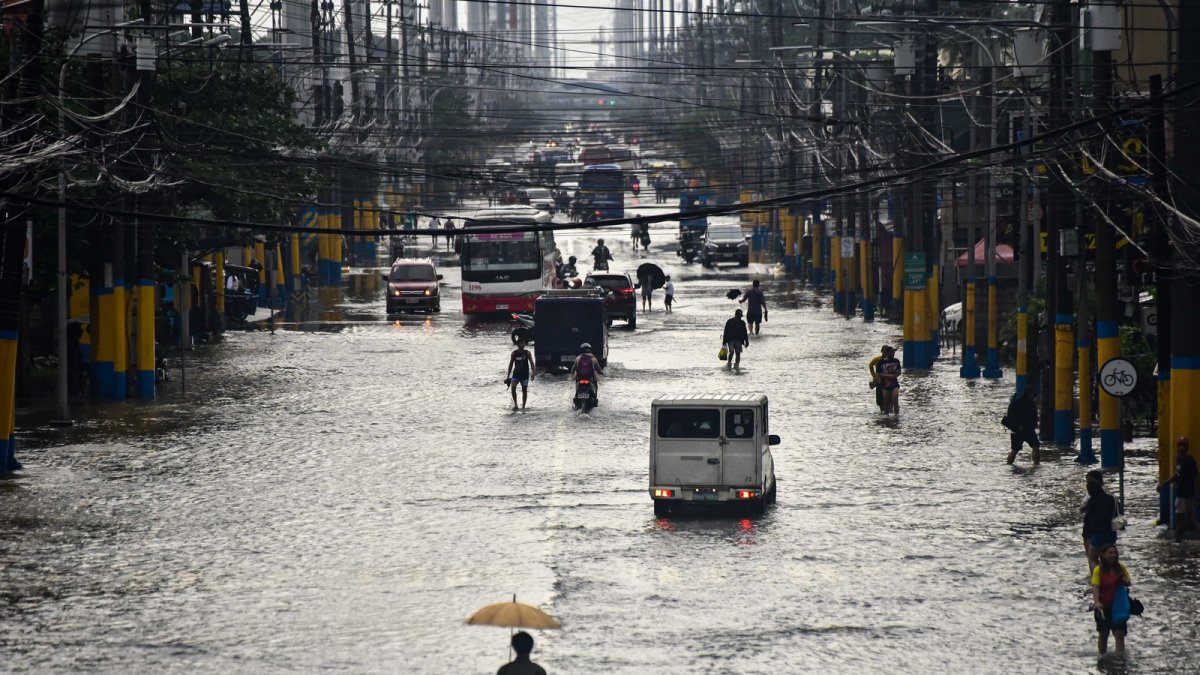
Flooding Across Luzon: A Regional Crisis
The flooding was not confined to Marikina. MMDA chairperson Romando Artes reported that Metro Manila received about 302 millimeters of rain since August 5, including approximately 226 millimeters upstream of the National Capital Region. This volume overwhelmed even dredged creeks, which were deepened by 2-3 meters but still could not handle the sheer amount of water. "It is really the volume of rain and years of neglect of our waterways," Artes said, noting that informal structures have narrowed waterways and reduced their capacity.
The flooding rendered roads impassable to light vehicles in Quezon City, Las Piñas, Parañaque, Pasay, Mandaluyong, Malabon, and Manila. In a dramatic incident, the perimeter wall of Forbes Park along EDSA-Ayala northbound collapsed, blocking two lanes. DPWH Secretary Vince Dizon said the structure and its construction materials would be investigated. The Quezon City government evacuated 351 families, or 884 people, while landslides were reported in Regions I, CAR, and CALABARZON, including the complete washout of Beckel Road in La Trinidad, Benguet.
Philippine Context: The Floodgate Scandal and Trillion-Peso Questions
This disaster unfolds against the backdrop of a massive flood-control corruption scandal that has shaken public trust. Expelled Congressman Zaldy Co has accused President Ferdinand Marcos Jr. and House Speaker Martin Romualdez of pocketing kickbacks from flood-control projects, allegations both have denied. The Ombudsman is pursuing complaints against Romualdez and Co, while Sen. Panfilo Lacson delivered a privilege speech titled "Flooded Gates of Corruption," revealing that P1.9 trillion was appropriated for flood control from 2011 to 2025, with P1 trillion allocated from 2023 to 2025 alone.
"When we are speaking in trillions of pesos, we can expect our streets and low-lying communities to be flood-free when the rains pour," Lacson said, capturing the public's frustration. The failure of the Tumana Pumping Station and the collapse of the Forbes Park wall are now seen not as isolated incidents, but as symptoms of a systemic failure to deliver on promises of infrastructure resilience. The P105.5 million in infrastructure damage and P3.53 million in agricultural losses reported by the NDRRMC are a stark reminder of the cost of inaction.
Impact on Filipinos: Displacement and Damage
The human impact is staggering. The NDRRMC reported that more than 124,000 families have been affected, with over 382,000 people displaced. Of these, 86 evacuation centers are sheltering about 2,200 families, or 7,300 people, while another 1,132 families, or about 3,700 people, are staying with relatives or friends outside of formal centers. The disaster has also damaged 170 houses, with 13 completely destroyed, leaving families with nothing but the clothes on their backs.
In La Trinidad, Benguet, the complete washout of Beckel Road, a P63-million renovation project that began on June 4 and was suspended on June 28 due to structural issues, has cut off a vital artery for the community. La Trinidad Mayor Roderick Awingan and Benguet District Engineer Teofilo Ramirez Jr. are now facing questions about the project's integrity. For the farmers, vendors, and families who depend on this road, the damage is not just an inconvenience; it is a threat to their livelihoods and their connection to markets and services.
What to Watch For: Forecasts, Dam Releases, and Accountability
PAGASA forecasts that the enhanced habagat will continue to bring rains over parts of Luzon and Visayas, with persistent rainfall expected through August 11. An additional 100-200 mm of rain is expected in Ilocos Sur, La Union, Zambales, Bataan, Metro Manila, Rizal, Cavite, Batangas, and Occidental Mindoro. More than 9,000 barangays nationwide are at risk of rain-induced landslides and flooding from August 8 to 11, meaning the crisis is far from over.
As the waters slowly recede, the focus will shift to accountability. The calls from Marikina lawmakers to suspend the contractors of the failed pumping stations, the DPWH's investigation into the Forbes Park wall collapse, and the ongoing Ombudsman probe into the flood-control funds will be critical tests of the government's commitment to transparency and justice. For the millions of Filipinos who have once again been displaced by the rains, the question is not just when the next storm will come, but whether the billions of pesos promised for flood control will ever translate into real protection for their communities.
By Bella Reyes, Staff Writer
This article was produced with AI-assisted research and editorial support. Reporting is based on sources cited in the article.
What's Your Reaction?
 Like
0
Like
0
 Dislike
0
Dislike
0
 Love
0
Love
0
 Funny
0
Funny
0
 Wow
0
Wow
0
 Sad
0
Sad
0
 Angry
0
Angry
0

Philippines/Southeast Asia Correspondent at Global1.News. Manila-based journalist covering Philippine politics, environment, maritime security, and social issues. Passionate about marine conservation and the communities protecting the Philippines' natural heritage.















Comments (0)