
22 Oxygen Stations Out of Service in Gaza Amid Israeli Blockade: Health Ministry
Gaza's Health Ministry warns that 22 of the enclave's 34 oxygen stations are out of service under the Israeli blockade and a severe spare-parts shortage, with only four filling devices still operational. MSF calls the restrictions a policy of attrition by design, as hospitals lose generators, clean water, and lifesaving oxygen.
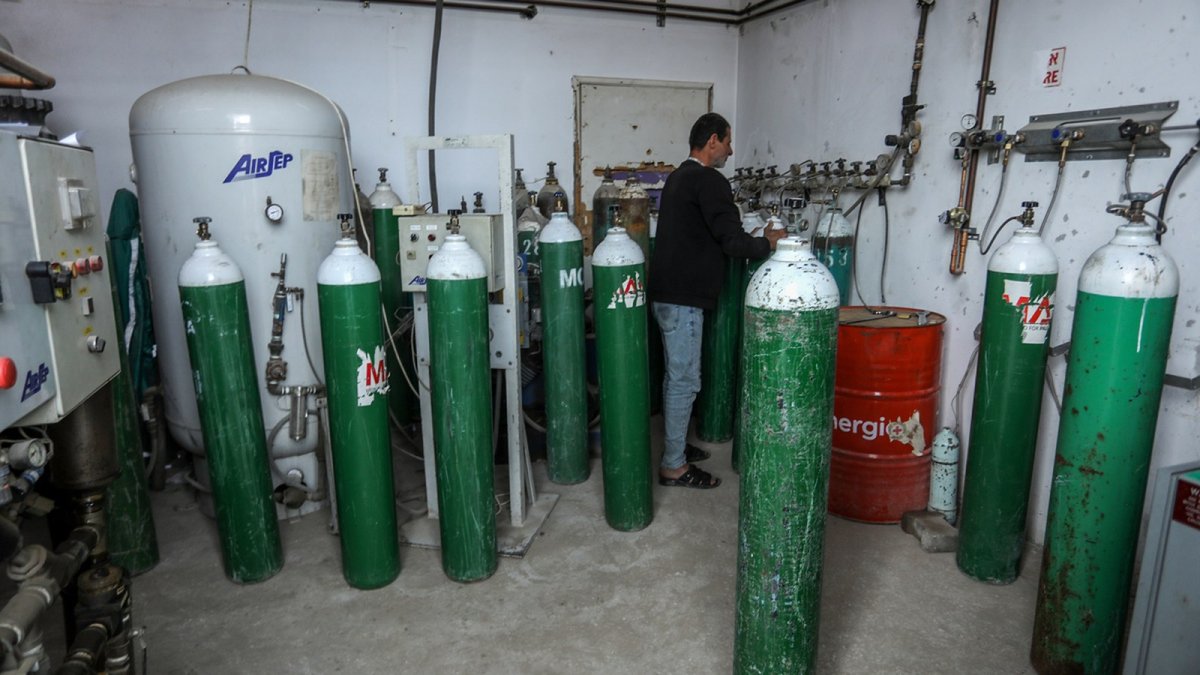
GAZA CITY — The oxygen supply that sustains Gaza's most vulnerable patients is on the verge of collapse. The Gaza Health Ministry warned Saturday that at least 22 of the enclave's 34 oxygen stations have been forced out of service under the weight of the Israeli blockade and a critical shortage of spare parts, leaving only four of the 30 devices used to fill oxygen cylinders operational. The 12 stations still functioning are running under what the ministry described as "extremely complex technical and mechanical conditions," with operational capacity "completely depleted" and breakdowns becoming increasingly frequent.
The warning comes as medical staff across the Strip confront a reality in which the most basic tools of survival — oxygen, electricity, clean water — are being systematically stripped away. The ministry stressed that "the availability of oxygen is not a medical luxury; it is a lifeline for many vital and life-saving departments," and warned that the remaining stations face "complete paralysis," threatening oxygen supplies to hospitals and to patients receiving treatment at home. It called for the "immediate and direct opening of channels" to bring in spare parts and new oxygen stations.
A Health System Pushed to the Breaking Point
The oxygen crisis is not an isolated failure but the latest symptom of a health system that has been pushed to the edge of extinction. Engineering teams cannot carry out emergency maintenance on the remaining filling devices, which the ministry said "could stop at any moment." Each hour that passes without intervention brings Gaza's hospitals closer to a scenario in which operating theaters go dark, incubators fall silent, and patients on oxygen therapy are left to gasp for air.
The situation is compounded by the broader collapse of essential infrastructure. Doctors Without Borders (MSF), in a statement issued between August 12 and 14, warned that Israeli authorities continue to restrict the entry of engine oil and spare parts essential to keeping hospital generators, ambulances, water pumps, and water trucks running. With most electricity cut and much of the electrical infrastructure destroyed, hospitals rely almost entirely on generators — machines that require constant fuel and maintenance to function.
In some MSF-supported facilities, the organization barely has enough engine oil to last a month. Prices have increased twentyfold over the last six months, and by the end of July, engine oil cost more than $4,900 per gallon — a figure that places it far beyond the reach of most medical facilities and humanitarian organizations operating in the Strip.
When a Generator Fails, Patients Suffer
The consequences of these shortages are not abstract. On August 5, a generator at the MSF field hospital in Deir al-Balah broke down. Teams were forced to ration electricity, limiting the operating theater to the most critical cases. X-ray services stopped entirely. Burn patients, already enduring immense pain, suffered without air conditioning in the sweltering summer heat.
Ola Bardawil, MSF deputy project coordinator, described the human toll in stark terms: "Newborn babies in incubators, people who rely on oxygen generators, or those in need of lifesaving surgery will suffer." Her words echo the warnings of the Health Ministry, which has repeatedly said that the collapse of oxygen supply would be catastrophic for a population already enduring the longest and most brutal conflict in recent memory.
The breakdown at Deir al-Balah is a microcosm of a wider pattern. Across Gaza, hospitals are operating with equipment that is aging, damaged, or entirely dependent on supplies that Israel restricts at the border. The Kerem Shalom crossing remains the only operational entry point for goods into Gaza, according to the UN Office for the Coordination of Humanitarian Affairs (OCHA) in its report released Friday, August 14. Restrictions continue on several essential supplies and types of equipment, including the very items needed to keep the health system alive.
A Policy of Attrition by Design
For humanitarian organizations on the ground, the pattern is unmistakable. Filipe Ribeiro, MSF head of mission in Palestine, did not mince words: "What we are witnessing in Gaza is not a series of isolated shortages, it is a policy of attrition by design. For more than two years, we have observed Israel's policies restricting the entry of supplies. These policies do not merely delay aid; they dismantle the very systems people rely on to survive."
Ribeiro's assessment points to a deliberate strategy that extends far beyond the immediate exigencies of war. "Today it is engine oil and spare parts; tomorrow it will be something else. The items change, but the logic remains the same: reducing people to conditions in which life becomes untenable and dignity is systematically stripped away through the denial of the most ordinary, most essential goods. This is not bureaucracy. It is a deliberate effort to make existence itself impossible."
The restrictions are not limited to high-tech medical equipment. Routine items — from ointments for skin diseases to rubber seals for medical sterilization equipment — are also blocked. These are not luxury goods; they are the mundane but essential components of a functioning health system. Their absence forces medical staff to improvise, to ration, and to make impossible choices about who receives care and who does not.
Water Insecurity Deepens the Crisis
The health crisis is inseparable from the broader humanitarian catastrophe unfolding across Gaza. A July survey by water and sanitation monitoring organizations found that 90 percent of households experienced moderate to high water insecurity. MSF's water desalination hub has seen its output cut from more than 158,500 gallons to 92,470 gallons per day — a reduction of more than 66,000 gallons. That means more than 40,000 fewer people can access clean drinking water each day.
The lack of clean water has direct health consequences, particularly for children, the elderly, and those with chronic conditions. Waterborne diseases, skin infections, and dehydration are constant threats in a territory where sanitation systems have been destroyed and where the fuel needed to pump and purify water is scarce. The restrictions on engine oil and spare parts for water trucks and pumps mean that even the limited water that can be produced may not reach the people who need it most.
The World Health Organization's latest data, published August 11 and covering the period through July 31, showed major gaps in the availability of health resources and services across Gaza's medical facilities. These gaps are not temporary disruptions; they are the result of a sustained and systematic denial of the means to provide basic care.
A Ceasefire That Has Not Brought Peace
A ceasefire has been in place in Gaza since October 10, 2025, following an Israeli war that caused widespread destruction to the enclave's health system and infrastructure. But the ceasefire has not brought an end to the suffering. In a separate statement on August 14, Dr. Khalil al-Daqran, spokesman for the Palestinian Health Ministry in Gaza, said the number of Palestinians killed in Gaza has exceeded 73,000, including more than 23,000 children, with more than 173,000 injured.
Since the ceasefire began, more than 1,260 people — most of them children, women, and the elderly — have been killed, and more than 4,000 injured. Dr. al-Daqran described the health system's condition as "tragic" and accused Israel of pursuing a policy of targeted killings, striking people with missiles and bombs while they are in vehicles, walking, or inside tents. The result, he said, has been "charred" bodies and severe chest and head injuries and limb amputations — injuries that require precisely the kind of intensive care that the collapsing oxygen supply can no longer support.
The combination of ongoing violence and the systematic denial of essential supplies has created a death spiral from which Gaza's health system cannot escape on its own. Hospitals cannot treat the wounded without oxygen, electricity, and clean water. They cannot maintain their equipment without spare parts, and they cannot reach patients without ambulances that run on fuel.
The International Community's Responsibility
The warnings from the Health Ministry, MSF, and OCHA are not new. Humanitarian organizations have been sounding the alarm for months, calling on Israel to open all crossings and allow the unimpeded entry of essential goods. The Health Ministry's plea for the "immediate and direct opening of channels" to bring in spare parts and new oxygen stations is a demand for the most basic of humanitarian access — the kind that international law requires and that human dignity demands.
Yet the response from the international community has been largely inadequate. The Kerem Shalom crossing remains the sole entry point for goods, and restrictions persist on the very items needed to sustain life. The UN and humanitarian agencies continue to call for compliance with international humanitarian law, but the gap between rhetoric and reality grows wider with each passing day.
For the people of Gaza, the question is not one of politics but of survival. The oxygen stations that are failing are not abstract infrastructure; they are the difference between life and death for patients in intensive care, for newborns struggling to breathe, for the elderly and the injured who depend on a steady supply of medical gas. When the last filling device stops, when the last generator falls silent, when the last drop of clean water is gone, the consequences will be measured in lives lost — lives that could have been saved with the most basic of supplies.
The Health Ministry's warning is a final call. "The availability of oxygen is not a medical luxury; it is a lifeline." If the international community does not act — and act now — that lifeline will be severed, and the people of Gaza will be left to face the consequences alone.
This article was produced with AI-assisted research and editorial support. Sources: Gaza Health Ministry, Anadolu Agency, Middle East Monitor, Doctors Without Borders (MSF), UN OCHA, World Health Organization.
By Fatima Al-Rashid, Staff Writer
What's Your Reaction?
 Like
0
Like
0
 Dislike
0
Dislike
0
 Love
0
Love
0
 Funny
0
Funny
0
 Wow
0
Wow
0
 Sad
0
Sad
0
 Angry
0
Angry
0

Gulf/MENA Correspondent at Global1.News. Based in Doha, covering Gulf politics, energy markets, diplomacy, and development across the Middle East and North Africa. Tracks the economic transformation of the Gulf states.












Comments (0)