
Taiwan Demands Answers as Indonesia Joins China in Naval Exercise East of the Island
Taipei has formally demanded clarification from Jakarta after Beijing publicly announced a joint naval exercise with an Indonesian frigate in waters east of Taiwan, the first time China has openly coordinated a foreign military drill in that maritime zone.
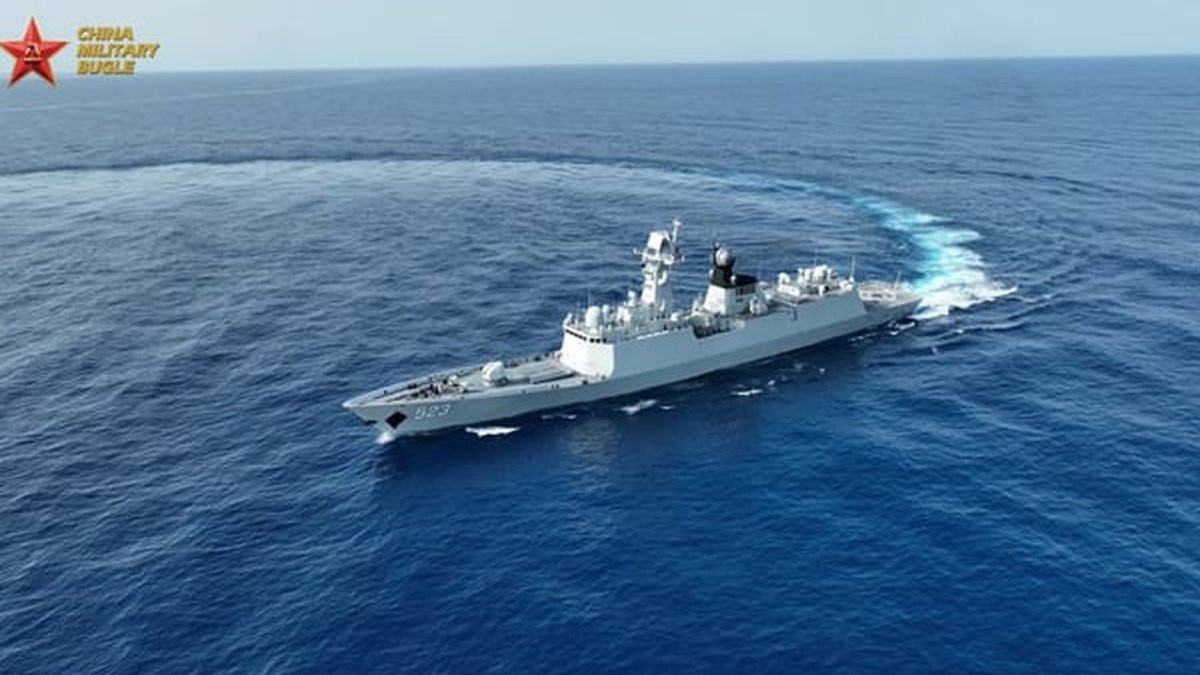
Taipei has formally demanded clarification from Jakarta after Beijing publicly announced a joint naval exercise with an Indonesian frigate in waters east of Taiwan, the first time China has openly coordinated a foreign military drill in that maritime zone. The exercise, conducted on August 12, 2026, involved the PLA Navy Type 054A guided-missile frigate Honghe and the Indonesian Navy’s Martadinata-class frigate KRI I Gusti Ngurah Rai, and triggered sharp condemnation from Taiwan’s Mainland Affairs Council, which characterized the event as a “military provocation” and a “severe infringement upon Taiwan’s sovereignty.”
In its August 11 announcement, China's Ministry of National Defense framed the operation as a routine “navigation exercise” focused on communication drills and at-sea replenishment, stating the goal was to “enhance the joint operational capabilities of the two navies, deepen practical cooperation, and jointly safeguard regional peace and stability.” Yet the location—waters east of Taiwan that serve as the island’s principal maritime depth beyond the heavily monitored Taiwan Strait—has elevated the drill from a technical matter to a strategic signal with implications for the entire first island chain, including the seas adjacent to the Korean Peninsula.
A First-of-Its-Kind Public Declaration
What distinguishes this exercise is not tactical complexity but unprecedented public framing: this is the first instance in which Beijing has openly announced bilateral training with a foreign navy in waters east of Taiwan, although the two navies have engaged in multilateral exercises such as Komodo and Peace Garuda. The choice of the Honghe, a frigate that entered service in 2022 under the Eastern Theater Command, underscores the deliberate nature of the signal. The Indonesian vessel, KRI I Gusti Ngurah Rai, is a SIGMA 10514-derived design, a modern blue-water platform.
The exercise was completed on August 12: the two warships formed a naval formation and conducted drills covering maritime communications, formation maneuvers, and resupplying operations. A crew member aboard the Honghe, Gao Yongjie, stated that “all communication short codes and flag signaling were in line with international standards, effectively testing our ship’s capability for maritime communication and information exchange with foreign naval vessels.” The statement was carefully worded to emphasize interoperability and international norms, yet the political context renders such reassurances largely moot for Taipei.
Taiwan’s Mainland Affairs Council warned that the exercise represented “exercises in name, expansion in fact.” Taiwan’s Ministry of Foreign Affairs has formally asked Indonesia to clarify the purpose and scope of the drill, a diplomatic request that places Jakarta in an awkward position given its more than 300,000 migrant workers in Taiwan and its formal recognition of the One China framework.
Jakarta’s Balancing Act Between Beijing and Washington
Indonesia’s response has been measured, with its navy describing the exercise as routine and “not related to war fighting.” This characterization aligns with Jakarta’s long-standing independent and active foreign policy. Yet the timing complicates that narrative: the announcement came the same week that US Under Secretary of War for Policy Elbridge Colby met Indonesian Defense Minister Sjafrie Sjamsoeddin during a Southeast Asia tour that also included the Philippines, Thailand, and Cambodia. A US defense official courting Jakarta while an Indonesian warship drills with the PLA Navy east of Taiwan illustrates the intensifying competition for influence in the Indo-Pacific.
Indonesia’s military engagement with China has deepened steadily: the two nations elevated their relationship to a Comprehensive Strategic Partnership, held their first foreign and defense ministers’ meeting in April 2025, and conducted the Peace Garuda 2024 humanitarian exercise. The PLA Navy’s training ship Qijiguang and dock landing ship Kunlunshan visited Surabaya in early August, conducting a joint exercise upon departure on August 6—the month's second navy-to-navy interaction. The Type 075 amphibious assault ship Hainan made a technical stop in Jakarta in December 2024, and the training ship KRI Bima Suci has visited Shanghai three times since 2019, most recently in May 2026.
The KRI I Gusti Ngurah Rai visited Japan earlier in the same deployment, conducting GARSAMEX communications and tactical-maneuvering drills in Sagami Bay. The same warship training with both Japan and China within a single deployment strikingly illustrates Indonesia’s strategic autonomy—a posture allowing Jakarta to extract benefits from multiple partners without formal alignment. For Seoul, this pattern offers a useful comparative lens, as South Korea similarly navigates between its US alliance and deep economic interdependence with China.
Beijing’s Maritime Assertiveness East of Taiwan
The exercise must be understood within a broader pattern of Chinese pressure east of Taiwan. Beijing stepped up its presence after Tokyo and Manila announced they would hold talks to resolve their maritime disputes in that region, dispatching coast guard and government vessels and, for the first time, questioning foreign commercial boats in apparent sovereignty demonstrations. China’s June 2026 coast guard patrols off Taiwan’s east coast angered Taipei and drew concern in Washington and other Western capitals.
Chinese military commentator Zhang Junshe framed the exercise as “highly significant,” arguing that inviting a foreign warship into waters under Chinese jurisdiction demonstrates Beijing’s sovereign rights over the exclusive economic zone, continental shelf, and territorial waters east of Taiwan. This assertion is foundational to Beijing’s position: it regards Taiwan as its own territory and therefore claims maritime rights extending eastward from the island, including Taiwan’s EEZ. Beijing explicitly objected to the Japan-Philippines talks on this ground, asserting that any regional maritime delimitation must account for Chinese sovereignty over Taiwan.
These waters are proximate to Japan's southwestern islands and the Philippines, making them a convergence point for multiple overlapping claims and security concerns. Previous “Justice Mission 2025” maneuvers covered the Taiwan Strait and waters north, southwest, southeast, and east of the island, but exclusively as Chinese operations. The addition of a foreign partner changes the character of the signal.
Implications for the Korean Peninsula and Trilateral Security
For South Korea, the significance extends beyond the cross-strait context. The waters east of Taiwan sit in the same maritime theater as the East China Sea approaches relevant to Seoul, which maintains its own unresolved delimitation with Beijing over overlapping EEZ claims around Ieodo, known internationally as Socotra Rock. The precedent of a foreign navy joining Chinese exercises in contested waters could broaden the geography of pressure around the first island chain, potentially normalizing multinational military activity where Seoul has its own unresolved disputes.
South Korea’s trilateral security cooperation with Washington and Tokyo, formalized at Camp David in August 2023, rests partly on shared concern about coercive maritime behavior. Beijing recruiting middle-power navies for exercises in sensitive zones would represent a new form of maritime statecraft—one that seeks to legitimize Chinese claims through international participation rather than unilateral assertion. Such multilateralism complicates the narrative of a unified democratic front against coercion.
Seoul has traditionally been more cautious than Japan in public statements on cross-strait matters, seeking to balance the US alliance with deep economic ties to China. The Indonesian example illustrates how middle powers manage strategic autonomy—maintaining robust military ties with both sides while avoiding formal commitments. For Korean policymakers, the episode raises a question: if Jakarta can train with both Japan and China in a single deployment without rupturing relations with either, what does that portend for the cohesion of the trilateral security architecture that Seoul has invested in since Camp David?
Strategic Significance and the Limits of Symbolism
Regional analysis from Defence Security Asia, published on August 12, 2026, argues that the drill’s importance derives less from tactical complexity than from the combination of location, foreign participation, and replenishment symbolism. At-sea replenishment is particularly notable, hinting at extended operational endurance—though no evidence establishes a permanent logistics arrangement, access agreement, basing footprint, or weapons transaction. The exercise appears a one-off engagement rather than the start of a sustained bilateral naval partnership.
This distinction matters for calibrating the response. The exercise is symbolically significant: it demonstrates Beijing's ability to attract foreign partners for activities in waters it claims as sovereign, lending an international veneer to its maritime assertions. However, it does not represent a structural shift in the regional balance of power. Indonesia’s independent foreign policy, its substantial ties with Taiwan, and its simultaneous engagement with the United States and Japan all suggest Jakarta is not choosing sides—it is hedging.
For Taipei, the demand for clarification from Jakarta is a reasonable diplomatic step, but it is unlikely to yield substantive concessions. Indonesia will continue to recognize the One China framework while maintaining unofficial relations with Taiwan. For Washington and Tokyo, the exercise reinforces the need to deepen maritime domain awareness and engage Southeast Asian partners on their own terms. For Seoul, the episode serves as a reminder that the maritime order around the Korean Peninsula is not insulated from developments further south—the first island chain is a connected system, and pressures in one segment reverberate across the whole.
This article was produced with AI-assisted research and editorial support. Sources: The Diplomat, Taipei Times, Focus Taiwan, ANTARA News, Defence Security Asia, Nikkei Asia (Reuters), Bastille Post.
By Prof. David Park, Staff WriterWhat's Your Reaction?
 Like
0
Like
0
 Dislike
0
Dislike
0
 Love
0
Love
0
 Funny
0
Funny
0
 Wow
0
Wow
0
 Sad
0
Sad
0
 Angry
0
Angry
0

East Asia/Technology Correspondent at Global1.News. Seoul-based voice covering Korean politics, technology, business, and culture. Analyzes how technology and geopolitics intersect across East Asia.













Comments (0)