
Europe's Inferno: Spain Declares First-Ever National Emergency as Wildfires Engulf Madrid Region
Spain declared its first national wildfire emergency July 24, 2026, as fires merged near Madrid, burning 6,000+ hectares and forcing 19,000-20,000 evacuations. Season total hits ~70,000 hectares, nearly triple 2025. France evacuated 60,000+; combined exceed 90,000 amid 40°C heat. UME leads; EU aid sought. Pattern, not fluke.
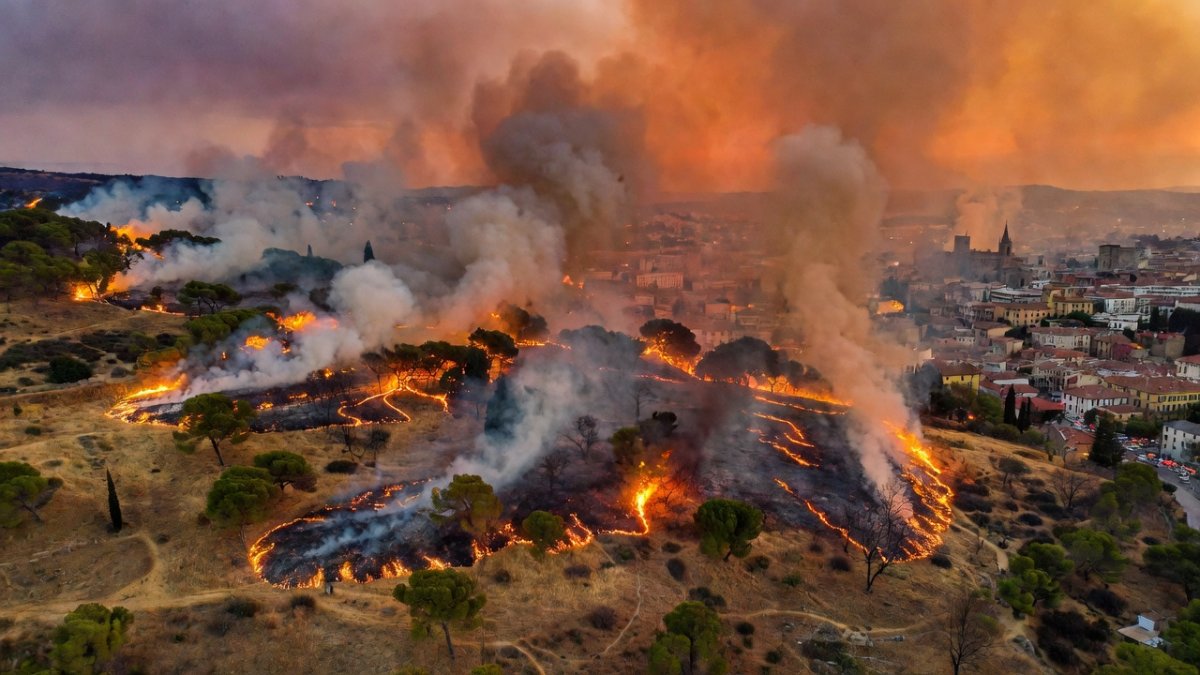
Fires Merge Outside the Spanish Capital in a Rapid Escalation
Two large wildfires merged outside Madrid on Friday, July 24, 2026, creating a single massive blaze that officials described as reaching a critical stage. A third fire stood on the verge of joining them, raising the stakes for emergency crews already stretched thin across the region. This is not some isolated spark in the countryside. This is a direct threat to communities ringing Spain's capital, and the speed of the merger left little room for half-measures.
Carlos Novillo, the Madrid regional environment official, did not mince words. He called the fire "at its peak" and "impossible to control." Those are the assessments that force governments to stop pretending this is business as usual. Almost 15,000 acres, or more than 6,000 hectares, have already burned near the capital. That is real ground lost in a matter of days under temperatures exceeding 40°C, or 104°F.
From where I sit in Atlanta, watching these numbers roll in from Reuters, BBC, The Guardian, AP, and the New York Times, the pattern is obvious. Southern Europe is baking, the vegetation is tinder-dry, and fires are no longer waiting for permission to link up. Madrid regional president Isabel Díaz Ayuso labeled it "the worst fire in the history of the region." When the regional president says that out loud, the rest of us should listen instead of reaching for the usual climate-denial talking points.
Spain has now moved past regional alerts. The scale forced a national response, and that shift tells you everything about how fast conditions deteriorated on July 24.
Spain Crosses a Historic Threshold with National Emergency Status
Spain declared its first-ever national emergency specifically for a wildfire. Let that sink in. Not a flood, not a storm, a wildfire. The Military Emergency Unit, known as UME, was placed in charge of coordinating the entire response. That decision puts uniformed specialists at the center of civilian protection efforts and signals that local fire services alone could not contain what was unfolding.
The declaration came as evacuations climbed and the burned area expanded. Officials requested additional resources from the European Union, acknowledging that Spain's own capacity had hit a wall. This is what happens when heat and drought stack year after year. You do not get to call it a surprise when the numbers have been climbing in plain sight.
Isabel Díaz Ayuso's description of the blaze as the worst in the region's history sits alongside Novillo's blunt assessment that control was impossible at the peak. Those two statements, from people with direct responsibility, strip away any remaining comfort. A national emergency is not declared for optics. It is declared when the map turns red and the wind keeps feeding the flames.
The move also puts pressure on EU partners to deliver help quickly. Spain is not waiting for committee meetings. It is asking for boots, aircraft, and coordination because the fire does not care about bureaucracy.
Nearly Twenty Thousand Forced from Homes Near Madrid
Between 19,000 and 20,000 people were evacuated from villages near Madrid as the merged fires advanced. Families left with whatever they could carry while emergency teams worked to clear roads and establish safe zones. That is a massive displacement so close to a major European capital, and it happened in a compressed timeframe.
Evacuation orders of this size test every layer of planning. Shelters, transport, medical support, and communication all have to function under extreme heat. The fact that Spain reached for military coordination through the UME shows how close the civilian system came to overload. These are not abstract statistics. These are thousands of residents watching smoke columns from their own streets.
Combined with the French evacuations, the total across both countries exceeds 90,000 people. That figure should end any debate about whether this is a localized inconvenience. When nearly six figures are on the move because of fire, the emergency is continental in scope even if the flames are still concentrated in the south.
Officials have kept the focus on getting people out first and worrying about the exact acreage later. That priority is correct. Lives come before land, and the evacuation numbers prove the threat was immediate.
Command Shifts to Military Emergency Unit as Resources Strain
Placing the Military Emergency Unit in charge marked a clear escalation in Spain's response structure. UME brings specialized training, logistics, and the ability to surge personnel into hot zones. Civilian firefighters had already been battling the blazes; the military overlay aims to impose order on a chaotic front.
Spain simultaneously requested additional resources from the European Union. That dual track—national military command plus international appeal—reveals the limits of any single country's firefighting fleet when multiple large fires converge. Aircraft, ground crews, and equipment are finite. When temperatures stay above 40°C, those assets get consumed faster than they can be rotated.
Novillo's statement that the fire was impossible to control at its peak underscores why the command change happened. You do not hand a wildfire to the military for ceremonial reasons. You do it when the fire is dictating the terms and every available tool must be brought to bear without delay.
The request to the EU also ties Spain's crisis to the wider European civil-protection mechanism. Neighboring states and EU stockpiles are now part of the calculation, which is exactly how these systems are supposed to work when national capacity is exceeded.
Spain's 2026 Season Already Nearly Triple Last Year's Pace
Look at the season-wide numbers and the Madrid fire stops looking like an outlier. In 2026, Spain has already seen roughly 70,000 hectares burned. That is nearly triple the rate recorded for the same period in 2025. Triple. That is not a rounding error or a bad week. That is a structural shift in fire behavior under sustained heat.
Earlier in July 2026, the Almería wildfire killed 13 people, injured 17, and left 10 missing. It was described as the deadliest in Andalusian history. Two major disasters inside the same month, one with a tragic human toll and another forcing a first-ever national emergency near the capital, make the pattern impossible to dismiss.
When I hear officials reach for the word "unprecedented," I push back. The data show a clear acceleration. Nearly 70,000 hectares gone, multiple mass evacuations, and fatalities already on the board. This is what a worsening baseline looks like, not a once-in-a-generation fluke.
The heat exceeding 40°C across southern Europe is the accelerant. Dry fuels plus extreme temperatures equal fires that merge, grow, and overwhelm. Spain is living that equation in real time.
France Battles Its Own Mass Displacement in the Southwest
More than 60,000 residents were evacuated in southwestern France as fires tore through the region under the same searing heat. The Cap Ferret peninsula was emptied by both land and sea, with boats pressed into service to move people out. That dual-mode evacuation is a stark image of how completely the fire cut off normal exits.
France, like Spain, is seeking EU assistance. Two major European nations asking for the same pool of shared resources at the same moment creates an obvious strain. The combined evacuations already top 90,000. Those are not parallel stories; they are linked chapters of the same heat-driven emergency.
Tinder-dry conditions across much of southern Europe turned ordinary summer weather into a regional tinderbox. French authorities faced the same physics Spain confronted: high temperatures, low moisture, and winds ready to push flames into populated zones. The use of boats at Cap Ferret shows how quickly standard road evacuations can become insufficient.
When two countries on the same weekend are emptying tens of thousands of homes and both are calling Brussels for help, the old playbook of treating each fire as a national silo collapses. Coordination is no longer optional.
Heat and Dry Fuels Turn Southern Europe into a Single Fire Theater
Temperatures exceeding 40°C have been the common denominator from Madrid to the French Atlantic coast. That heat does not respect borders. It dries fuels on both sides of the Pyrenees and sets the stage for the kind of rapid fire growth now on display. Searing conditions and tinder-dry landscapes are the through-line in every dispatch coming out of the region.
The Madrid fires burning more than 6,000 hectares, the French evacuations topping 60,000, and Spain's season total near 70,000 hectares all sit inside the same weather pattern. Calling any single blaze "unprecedented" misses the point. The pattern is the story. Heat that intense, repeated across weeks, produces exactly these outcomes.
Officials in both countries have stopped pretending they can handle the load alone. Spain put UME in charge and asked the EU for help. France is doing the same. That convergence of requests is the clearest evidence that southern Europe is facing a shared emergency rather than a string of unrelated incidents.
From an Atlanta newsroom, the lesson is straightforward. When the temperature stays that high and the ground stays that dry, fires will keep merging, evacuations will keep climbing, and national emergency declarations will keep coming. The data already show the trend. Ignoring it is a choice, not an analysis.
What the Numbers Demand Going Forward
The facts on the ground are blunt. Spain's first national wildfire emergency, 19,000 to 20,000 people moved near Madrid, more than 6,000 hectares blackened, a season total approaching 70,000 hectares—nearly triple the prior year—and an earlier July fire that killed 13 in Almería. Add France's 60,000-plus evacuations and the combined total above 90,000, and the scale is undeniable.
Carlos Novillo called the Madrid fire impossible to control at its peak. Isabel Díaz Ayuso called it the worst in the region's history. Those are not press-release phrases. They are admissions from the people paid to manage the crisis. The Military Emergency Unit is now running the coordination, and EU resources have been formally requested by both Spain and France.
This is what a pattern looks like when it stops being theoretical. Extreme heat above 40°C, repeated fire mergers, mass displacement, and the first national emergency of its kind in Spain. The question is no longer whether southern Europe faces a new fire reality. The question is how quickly governments and the EU match resources to the data already in front of them.
Residents deserve clear information and faster surge capacity, not recycled language about one-off events. The hectares, the evacuations, and the death toll from Almería are already written. The response has to catch up to those numbers without delay.
By Jessica Ali, Staff WriterThis article was produced with AI-assisted research and editorial support. Reporting is based on sources cited in the article.
What's Your Reaction?
 Like
0
Like
0
 Dislike
0
Dislike
0
 Love
0
Love
0
 Funny
0
Funny
0
 Wow
0
Wow
0
 Sad
0
Sad
0
 Angry
0
Angry
0

Editor-in-Chief at Global1.News. Atlanta-based journalist who cuts through the BS and tells it like it is. Lead anchor, host, and the voice you hear when the spin stops and the truth starts.










Comments (0)