
Drone Strikes Cooling Tower at Russia's Kursk Nuclear Plant Days After Energy Truce
The IAEA says a drone struck the cooling tower of a reactor unit at Russia's Kursk Nuclear Power Plant on September 17. No fire, no shutdown and no radiation release were reported, five days after Trump announced an energy truce between Kyiv and Moscow.
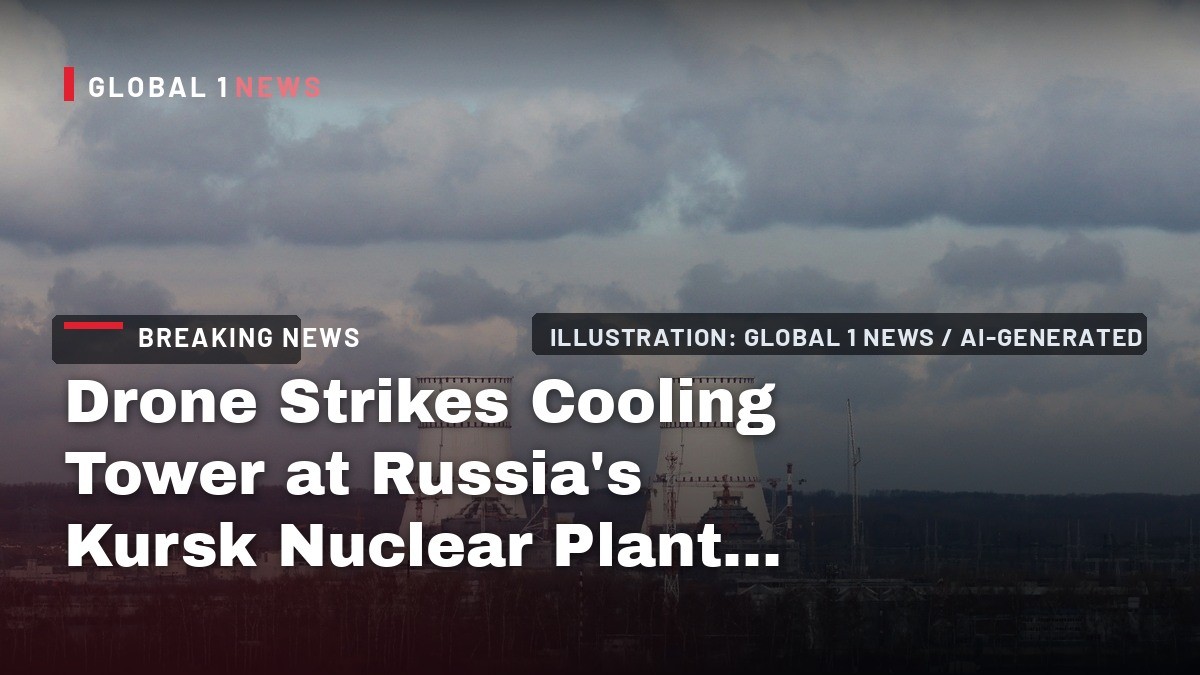
Folks, the United Nations' nuclear watchdog has now put its name to the thing it has spent four and a half years warning about. A drone struck the cooling tower of a reactor unit at Russia's Kursk Nuclear Power Plant in the early hours of Thursday, September 17 — and the International Atomic Energy Agency confirmed it publicly on Friday. No fire. No change in the reactor's operating mode. No movement in radiation levels. And no blame assigned by the agency that reported it.
Drone Strikes Cooling Tower at Russia's Kursk Nuclear Plant Days After Energy Truce
KURSK REGION, Russia — The strike did not start a fire, did not take a reactor offline and did not move a single radiation reading. But it landed closer to active reactor infrastructure than any confirmed incident since Russia's full-scale invasion of Ukraine began in February 2022. And it arrived five days after President Donald Trump told the world the two sides had agreed to stop hitting each other's energy systems.
What the Watchdog Confirmed
The IAEA said in a statement on X on Friday that it "has been informed that the cooling tower of a reactor unit of the Kursk Nuclear Power Plant in the Russian Federation was hit by a drone early on Thursday."
"It was reported that the unit was operating at the time, but its operating mode did not change and there was no fire," the agency said. The IAEA assigned no blame for the strike and did not identify the weapon's origin or launch point.
Director General Rafael Grossi used the statement to repeat a position the agency has held since the earliest days of the war. "All attacks on nuclear facilities are unacceptable as they could endanger nuclear safety and security, irrespective of where they occur," the agency wrote, adding that Grossi "reiterates call for maximum military restraint to prevent the risk of a nuclear accident."
The plant sits close to the Russia-Ukraine border and west of Kursk city, the regional capital of roughly 440,000 people. It has been a front-line concern since Ukrainian forces pushed into the Kursk region in 2024, and it has now become the site of the most direct confirmed contact between a drone and operating reactor infrastructure in this war.
Rosatom's Version, and What It Left Out
Russia's state nuclear corporation did not dispute the strike. It minimised it.
Rosatom said in a statement that the attack had caused "minor damage" at the plant's No. 1 reactor and that operation was unaffected. "The reactor is continuing to work at 100% capacity," the statement said. Radiation levels were unchanged and within norms, it added.
Those two accounts — the IAEA's and Rosatom's — are consistent on every physical fact: no fire, no shutdown, no release. They diverge on emphasis. The watchdog framed the incident as an unacceptable attack on a nuclear facility. Rosatom framed it as a survivable hit on hardened infrastructure.
What neither statement does is say who fired the drone. That absence matters, and it is not the same thing as ambiguity about whether the strike happened.
Five Days After the Truce
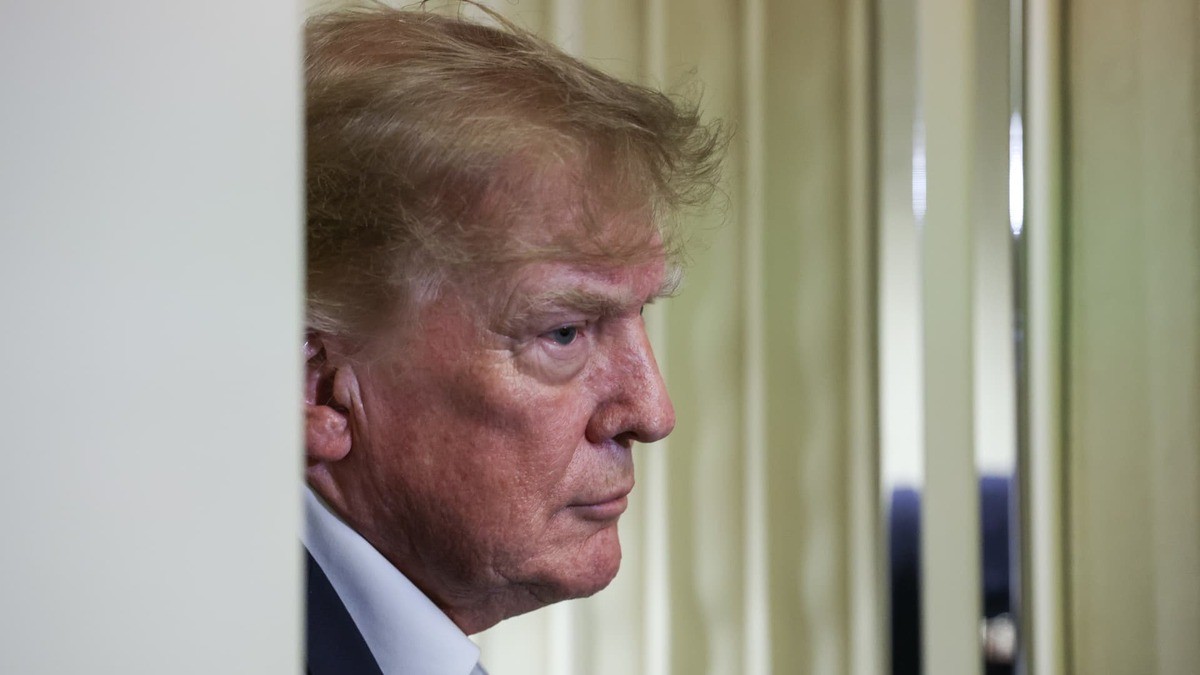
On Monday, September 14, Trump posted on Truth Social that the fighting over energy infrastructure was over. "Ukraine has agreed not to hit Russian Energy targets. Russia has agreed to do likewise!" he wrote.
The announcement was thinner than the headline. No document was published, no monitoring mechanism was named, and no intermediary confirmed the terms. Trump said the same day that the rise in global diesel prices was driven primarily by Ukraine's strikes on Russian refineries rather than by the US war with Iran — a claim he had first floated a day earlier, on September 13.
President Volodymyr Zelensky responded an hour later with a conditional yes. Kyiv, he said, was ready to halt strikes, but only if Ukraine's partners could guarantee that Moscow would genuinely stop attacking Ukrainian critical infrastructure. "Every day, Ukrainian energy facilities, port infrastructure, logistics, and even warehouses storing food and pharmaceuticals are targeted," Zelensky said, adding that "Ukraine is not convinced that Russia is willing to abide by any agreement."
He warned specifically that any deal must be durable enough to outlive Russia's State Duma elections, held September 18 to 20, and long-term enough to produce a tangible benefit for civilians.
Kremlin spokesman Dmitry Peskov called the proposal a "very good idea." He also attached conditions of his own, linking the wider energy question to safe commercial shipping — particularly oil tankers — and to the lifting of sanctions on Russia. Kremlin-aligned outlets presented the arrangement as a one-way measure in which Kyiv stops its long-range strikes, with no reciprocal commitment reported on the Russian side.
By Thursday morning, the cooling tower at Kursk had been hit.
Kyiv Has Not Claimed It
Here is the part that will get lost in the shouting. As of the IAEA's statement, neither Kyiv nor Moscow had commented on it. Ukraine has neither claimed nor denied responsibility for the Kursk strike, and the nuclear agency did not attribute it.
That is a materially different situation from the one reporters sometimes describe. Official Russian accounts of strikes inside Russia regularly attribute them to Ukraine as a matter of course. The IAEA, which operates on consent from member states and has no investigative mandate to assign responsibility, deliberately does not.
The practical consequence is that the attribution question is open. The physical facts are not.
A Pattern That Keeps Returning
Kursk is not a first, and that is the point.
In August 2025, a combat drone detonated near the plant, damaging an auxiliary transformer and sparking a structural fire. Radiation readings were reported normal. In July 2026, the governor of the Kursk region accused Ukraine of striking a cooling tower at Kursk II, the adjacent plant then still under construction. Thursday's strike hit a cooling tower attached to an operational reactor unit — a step further in.
The geography of nuclear risk in this war now spans three sites. Zaporizhzhia, occupied by Russian forces since March 2022, has repeatedly lost off-site power and relies on emergency diesel generation, a vulnerability the IAEA has documented through a long series of updates. Chernobyl's containment arch was damaged by a Russian drone in February 2025. Kursk sits on the Russian side of the border inside an active military theatre.
Separately, three power plant workers were killed in Ukraine's Donetsk region in February, a reminder that energy infrastructure targeting has been a constant feature of this war rather than an occasional escalation.
How Close Thursday Actually Came
The strike did not happen in isolation. It landed during one of the larger single-night drone exchanges of the conflict.
Russia's defence ministry reported that its air defences intercepted 629 Ukrainian fixed-wing drones across multiple regions, the Black Sea and the Sea of Azov. That figure cannot be independently verified and should be treated as a claim rather than a count. Kursk region governor Alexander Khinshtein said 196 of them were shot down over his region alone — a number that, if accurate, makes the phrase "one drone reached the plant" a matter of arithmetic as much as intent.
On the other side of the border, the same night brought Russian attacks on Ukrainian cities including Kyiv and Balakliia. Local officials reported 10 people injured, and Vitalii Karabanov confirmed two people killed.
This is the mechanical reality that makes nuclear proximity incidents more likely over time. Drone exchanges at this scale, repeated across months, make contact with sensitive infrastructure statistically more probable regardless of whether any commander ordered a specific facility hit. Each incident that fails to become a catastrophe lowers the perceived cost of testing proximity to reactor infrastructure again — a dynamic the IAEA's safety pillars were built to prevent, not to manage indefinitely.
The Diesel Number Behind the Diplomacy
There is a number sitting underneath all of this, and it is American.
US diesel prices surpassed $6 a gallon for the first time ever in September, as supply disruption from the Ukraine war and the Iran war compounded. Russia responded to Ukrainian refinery strikes by extending a ban on diesel exports through the end of September to stabilise its own domestic market. Saudi Arabia's East-West pipeline, the infrastructure that lets the kingdom bypass the Strait of Hormuz, was temporarily shut on Friday, September 11, after a drone attack.

Trump's public argument was that Ukrainian strikes on Russian refining are inflating the price at American truck stops. Zelensky's counter-argument, delivered in a CBS interview, was structural: "For Putin, energy is selling oil and gas. For us, energy is having electricity and gas supplies for our people."
He also described the mechanism by which the ceasefire idea reached Kyiv. US envoys Steve Witkoff and Jared Kushner raised the possibility of an energy ceasefire during their recent visit to the Ukrainian capital, he said. "We never attack first," Zelensky said. "Our tactic is to respond where we can because Putin doesn't respect and won't even think of negotiating with weaklings."
What the IAEA Can and Cannot Do
Grossi's statement is a warning, not an enforcement action, and the distinction is not a technicality.
The agency can monitor, verify and report. It cannot compel a belligerent to stop firing near a reactor, it cannot police a ceasefire it did not negotiate, and it has no authority to attribute an attack it has merely been informed of.
That gap is the whole problem at Kursk. The IAEA was informed of the strike by a party to the war it cannot adjudicate. It confirmed the physical consequences — cooling tower hit, reactor running, no fire, no release — and then repeated a call for restraint it has now issued across four years and three nuclear sites.
The agency's own reporting record shows the pattern: repeated loss of off-site power at Zaporizhzhia, the containment arch at Chernobyl, an auxiliary transformer at Kursk, and now a cooling tower serving an operating unit. Each entry in that ledger describes a warning that was heard and not acted on.
New York, September 21
This is where the Kursk strike collides with the calendar.
Zelensky has said he plans to raise both an energy ceasefire and a maritime ceasefire in the Black Sea during a possible meeting with Trump at the UN General Assembly, which runs from September 21 to 23, if the two presidents' schedules align. He said Kyiv is open to both. If Putin rejects a complete ceasefire, Zelensky said he will push for a partial agreement covering grain exports and the energy sector.
Read that alongside Thursday's strike and the picture is not a ceasefire being implemented. It is a ceasefire being tested before it is signed. Russia's parliamentary elections concluded on September 20, the deadline Zelensky explicitly flagged as the point at which he expected Moscow's real position to become clearer. He will walk into New York with a cooling tower in Kursk as his opening exhibit and a US diesel price above $6 a gallon as the pressure behind his counterpart.
What to Watch Now
Three things will tell you whether Kursk was an anomaly or an escalation.
First, whether the strike tempo around nuclear facilities changes. A single cooling tower hit during a 629-drone night is one statistical event. A second strike on a reactor-adjacent structure within weeks is a campaign.
Second, whether Moscow's conditions survive contact with the talks. Peskov paired the energy ceasefire with sanctions relief and shipping guarantees. That was always going to be the hard part, and it is why the arrangement announced on September 14 was never confirmed by both capitals.
Third, whether the IAEA gets anything beyond a statement. Watch for a request for access to Kursk, for a new update series on the site, or for the agency to fold the incident into its standing reporting on Zaporizhzhia. Any of those would signal the agency believes the risk has shifted from theoretical to live.
Nobody died at Kursk on Thursday. That is the only reason this is a warning and not a catastrophe — and warnings only work when someone acts on them. The IAEA has now said the same sentence about three nuclear sites in one war. The next escalation is not a failure of warning. It is a failure to hear one.
By Jessica Ali, Staff Writer
This article was produced with AI-assisted research and editorial support. Sources: International Atomic Energy Agency, Reuters, Rosatom, Al Arabiya English, The Straits Times, Cyprus Mail, Kyiv Post, Euronews, CNBC, RBC-Ukraine, Kyiv Independent, Crisis.Zone, The National Pulse.
What's Your Reaction?
 Like
0
Like
0
 Dislike
0
Dislike
0
 Love
0
Love
0
 Funny
0
Funny
0
 Wow
0
Wow
0
 Sad
0
Sad
0
 Angry
0
Angry
0

Editor-in-Chief at Global1.News. Atlanta-based journalist who cuts through the BS and tells it like it is. Lead anchor, host, and the voice you hear when the spin stops and the truth starts.















Comments (0)