
Danny Leon's Eclipse Skateboard Trick Goes Mega-Viral
Spanish Olympic skateboarder Danny Leon timed a mid-air 'stalefish' trick with the August 12 solar eclipse in Spain, going viral with 120 million views in 24 hours. The 30-second window, the year of planning, and what it means for SA skateboarding and the road to LA 2028.
There are moments in sport that defy logic, and then there are moments that defy the heavens themselves. On Wednesday, August 12, 2026, Spanish Olympic skateboarder Danny León did something no athlete on Earth has ever done: he launched himself off a custom ramp in the Aragón region of Spain and timed a mid-air 'stalefish' grab so perfectly that his silhouette appeared directly against the black Sun during the first total solar eclipse visible from mainland Spain since 1905. This wasn't just a trick. This was a statement that skateboarding — that raw, rebellious, street-born culture — can reach heights that even the cosmos can't ignore.
Danny León's 'Eclipse Mode': The 30-Second Window That Shook the Skateboarding World
Novales, Spain – August 13, 2026 — The numbers are staggering, the images are surreal, and the doubters are already screaming "AI." But make no mistake: what Danny León pulled off in the tiny Spanish village of Novales, Huesca, was as real as the concrete under his wheels. The 31-year-old Red Bull athlete, born in 1994 in Móstoles near Madrid, has competed at the highest level of Olympic skateboarding — finishing 9th at Tokyo 2020, agonizingly just outside the 8-skater final, and 20th at Paris 2024. But on Wednesday evening, he transcended competition entirely. He turned a celestial event into his personal skate park.
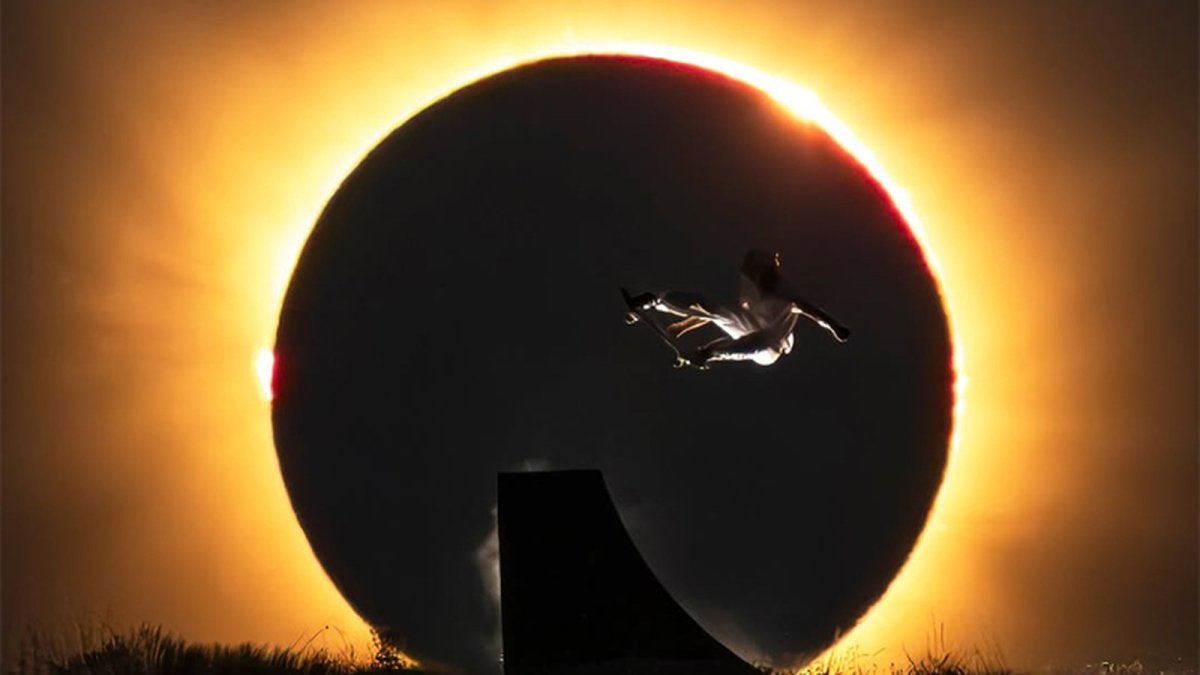
The Shot That Stopped the Internet
The physics of this stunt are almost impossible to wrap your head around. At the location in Novales, totality — the brief, breathtaking moment when the Moon completely blocks the Sun — lasted only about 30 seconds. That was the hard window. Not 30 minutes, not 30 tries. Thirty seconds to get it right, with the entire operation running from about 7pm until roughly 9:30pm on eclipse day.
León managed three tricks during that 30-second totality window. Three attempts. One of them produced the perfect alignment — a 'stalefish' grab, where the skater reaches behind their back to grab the heel edge of the board, suspended in mid-air with the black Sun and its corona blazing directly behind them. The photo and video were captured by photographer José Ángel Izquierdo (@jaicano on Instagram), working alongside audiovisual producer Gonzalo González de Vega (@gochiestrella) and a seven-person crew. The result: a silhouette of a skateboarder against the most dramatic sky show nature can produce.
León himself was effectively skating blind. During totality, the light changed dramatically and the wind picked up. The eclipse was to his right, but he had to keep his eyes locked on the ramp. Two spotlights on the setup made his vision even worse. He didn't wear eclipse glasses during the trick — he couldn't, not while flying through the air at speed. The crew wore protective glasses and the cameras had protective filters, but León had to trust his body, his muscle memory, and the ramp builders who had constructed his launch pad.
A Year of Planning, One Perfect Moment
This wasn't a lucky snap. This was a military-grade operation planned for more than a year. Izquierdo, the photographer, calculated exactly where the Sun would appear in the sky using a specialized app. He then found a private property in Novales whose owner gave permission for the project. SB Ramps, a custom ramp construction company, built a bespoke launch ramp that was installed on Tuesday, August 11 — just one day before the eclipse.
The preparation was meticulous. León trained from 7am to 10am on eclipse day itself, then returned around 5pm for another hour of practice before starting the final sequence at about 7pm. This wasn't a casual session at the local skate park. This was an athlete treating a celestial event with the same seriousness as an Olympic final. The ramp had to be positioned perfectly. The speed had to be exact. The timing of the trick had to align with the precise moment of totality — a window that would not come again over mainland Spain for decades.
The fact that this was León's third celestial stunt proves a pattern. In April 2025, he was pictured airborne against the setting sun. Then, about three months before the eclipse, he published a similar shot against a full moon, joking that he was an astronaut left behind by NASA. But this eclipse shot was the crown jewel — the culmination of a year of planning, calculation, and sheer audacity.
Skating Blind: The Pressure of 30 Seconds
Here's where the human drama kicks in. León had one shot. Well, three shots, technically, but all within that 30-second totality window. The pressure was immense. As he dropped into the ramp, the world around him changed. The light shifted into an eerie twilight. The wind picked up, threatening to destabilize his approach. The spotlights, meant to help illuminate the scene, actually made his vision worse, creating glare and shadows that could have thrown off his timing.
He couldn't look at the eclipse. It was to his right, but his eyes had to stay on the ramp, on the transition, on the lip where he would launch. He was skating almost blind, relying on feel and repetition. The crew, meanwhile, was watching the sky, counting down the seconds of totality. When León landed his final trick and the alignment was confirmed, the crew erupted in celebration. But León himself couldn't see it. Only after the critical 30 seconds passed could he finally look up — and by then, it was over. The eclipse had moved on. The moment had passed. But the image was captured forever.
This is the essence of elite sport. The preparation, the sacrifice, the willingness to perform under conditions that would break lesser athletes. León didn't just land a trick. He landed a trick while the sky went dark, while the wind howled, while his vision was compromised, and while the entire world was watching the sky instead of the ramp. That's not just skill. That's nerve.
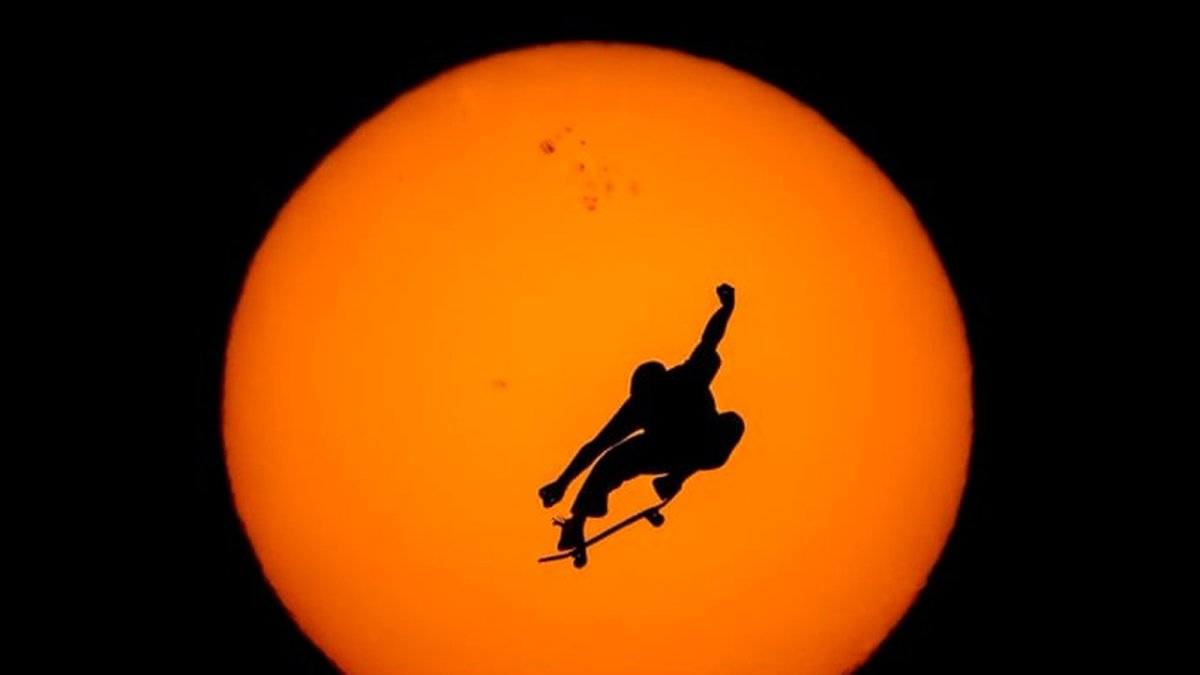
Mega-Viral Explosion and the AI Doubters
When León posted the video with the caption 'El truco de mi vida: Eclipse mode' — 'The trick of my life: Eclipse mode' — the internet went absolutely nuclear. The Olive Press reported the caption as "the move of my life," and the numbers backed up the hyperbole. Heraldo reported more than 80 million Instagram views. HuffPost pushed that figure past 100 million views with 10 million likes. AS Acción reported a staggering 120 million views within 24 hours. The Olive Press clocked 5.5 million likes. For context, that's more views than the entire population of Spain watching one skateboard trick.
But with great virality comes great skepticism. Almost immediately, online commentators speculated that the image was AI-generated or digitally manipulated. The perfect alignment, the dramatic silhouette, the sheer improbability of the shot — it all seemed too good to be true. But the doubters were wrong. Wider footage and other versions of the stunt proved it was real. The perspective, the timing, the preparation — all of it checked out. This wasn't a deepfake. This was a deeply planned, deeply human achievement.
The skepticism is understandable, though. We live in an age where AI can create photorealistic images of anything. But the fact that León and his team had the receipts — the behind-the-scenes footage, the multiple angles, the year-long planning documented on social media — is a testament to their professionalism. They knew the doubters would come. They were ready.
Skateboarding, the Olympics, and a Historic Eclipse
This stunt lands at a pivotal moment for skateboarding as a sport. Skateboarding made its Olympic debut at Tokyo 2020 and is now a permanent Olympic event from Los Angeles 2028, governed by World Skate. León's Tokyo 2020 performance — 9th place, just one spot outside the final — showed the razor-thin margins at the elite level. His Paris 2024 result of 20th was a disappointment, but this eclipse stunt has reminded the world that skateboarding is about more than medals. It's about creativity, expression, and pushing the boundaries of what's physically possible.
The eclipse itself was a historic event. It swept across Spain from Galicia to the Balearics, with Madrid, Barcelona and Andalucía seeing up to 99% coverage. It was also visible across parts of Portugal, Iceland, Greenland and the Atlantic and Arctic regions. The last total solar eclipse visible from mainland Spain was in 1905 — 121 years ago. León didn't just ride a wave; he rode the rarest celestial wave of the century.
And he wasn't alone in the cosmic stunt game. On the same day, Brazilian pro surfer Italo Ferreira was photographed inside a solar eclipse by Brazilian photographer Marcelo Maragni for Red Bull. Two action sports athletes, two celestial events, one unforgettable day. The Red Bull machine knows how to create moments, and Wednesday was a masterclass.
South African Perspective: What This Means for SA Skateboarding
Now let's bring this home, Mzansi. This stunt matters for South African skateboarding in ways that go beyond just a cool video. Skateboarding is now a permanent Olympic sport, and South Africa's Roller Sport South Africa (RSSA) has formed a Skateboarding Commission specifically to create an Olympic qualification path for SA skaters. The SA skate scene is small compared to other countries, but it's growing — with skateparks across the country and a strong grassroots and street culture that has produced raw talent for decades.
What León proved is that skateboarding can be a global stage for creativity and national pride. South African skaters have the same potential. The challenge is infrastructure and opportunity. While Spain has custom ramp builders like SB Ramps and photographers like Izquierdo who can spend a year planning a celestial stunt, SA skaters often have to make do with limited resources. But the talent is there. The hunger is there. What's needed is investment and a clear pathway to the Olympics.
SASCOC, South Africa's National Olympic Committee, is responsible for Team SA's preparation for the Olympics, Commonwealth Games and other multi-sport events. The question is whether skateboarding is getting the attention it deserves. With LA 2028 on the horizon, the RSSA's Skateboarding Commission needs support — from SASCOC, from the SA Sports Ministry, and from the private sector. León's eclipse stunt has shown the world what skateboarding can achieve. Now it's time for South Africa to show what our skaters can achieve.
What to Watch For: LA 2028 and the Growth of Action Sports in SA
The road to Los Angeles 2028 is already underway. Skateboarding will be a permanent Olympic event, and the qualification pathways are being established. For South African skaters, this is the moment to step up. The RSSA's Skateboarding Commission is the vehicle, but it needs funding, coaching, and competitive opportunities. The grassroots scene is alive — from the streets of Johannesburg to the skateparks of Cape Town and Durban — but it needs to be nurtured into Olympic-level performance.
León's journey from Móstoles to Olympic competitor to cosmic stuntman is a blueprint. He started as a kid with a skateboard and a dream. He became a Red Bull athlete in 2008 at just 14 years old. He competed at the highest level. And now he's done something no one else on Earth has ever done. South African skaters can look at that and see possibility. The sky is literally not the limit — León just proved that.
The growth of action sports in South Africa is a story waiting to be told. With the right investment, the right coaching, and the right opportunities, SA can produce its own Danny León. The transformation agenda in SA sport has focused heavily on traditional sports like rugby, cricket and football. But action sports offer a new frontier — one where street culture, creativity and raw talent can shine. The RSSA's Skateboarding Commission is a start, but it needs to be accelerated.
This article was produced with AI-assisted research and editorial support. Sources: Al Jazeera English, SurferToday, The Olive Press, India Today.
By Dante Williams, Staff Writer
What's Your Reaction?
 Like
0
Like
0
 Dislike
0
Dislike
0
 Love
0
Love
0
 Funny
0
Funny
0
 Wow
0
Wow
0
 Sad
0
Sad
0
 Angry
0
Angry
0

Breaking News and Investigations Correspondent at Global1.News. Based in London, covering global breaking news, security, and investigative stories. Known for digging deeper and connecting the dots across continents.











Comments (0)