
China's CXMT Says It Has Validated 4F² Memory Samples. Micron Says It Will Never Ship One.
China's CXMT says it has validated engineering samples of 4F2 next-generation DRAM on a production platform and aims to send server memory samples to customers by the end of 2026, a claim Micron has rejected and SK hynix is in no hurry to match.
China's biggest memory-chip maker told its own investors something on Friday that the industry has been bracing for since the summer: it says its next-generation memory cells have cleared the validation stage. The reaction among the companies that currently own this market was not warmth.
China's CXMT Says It Has Validated 4F² Memory Samples. Micron Says It Will Never Ship One.
HEFEI, China — Changxin Memory Technologies ended its third quarter with numbers almost nobody could argue with and a claim almost everybody will. On 30 October the company reported a record set of results and then, at the same briefing, said it had "completed engineering sample validation for a sixth-generation DRAM process platform based on 4F²." The results can be checked against a filing. The claim cannot, and that is where the story actually lives.
The Claim Out of Hefei
CXMT is China's largest maker of dynamic random-access memory, the short-term working memory inside every phone, laptop and server. Its disclosure reached an international audience on Sunday, when Chinese outlets including Yicai, The Paper and the Global Times reported it and Korean outlets carried it within hours.
What the company actually said is narrower than some of the headlines. "We expect to be able to send samples of our first server memory product utilizing the 4F² architecture, the DDR5 RDIMM, to clients by the end of this year," it told the briefing, adding that it will "first apply it to high-value-added and high-density products such as servers, and then gradually expand to other product lines." On timing it was explicitly non-committal: "Mass production will be pursued gradually in line with client verification progress and market demand."
It has published no yields, no power figures, no die sizes and no customer qualification results. Engineering samples are prototypes lent to customers for testing; validating them means core performance targets were met on real wafers. It does not mean a product exists that anyone can buy.
What 4F² Actually Means
The notation describes how much floor space one memory cell occupies. F is the smallest feature a fabrication process can print, and today's mainstream DRAM cell is 6F²: three F long, two F wide. A 4F² cell is two by two, a theoretical reduction in cell area of about 33 percent, which matters because density is the whole economics of memory.
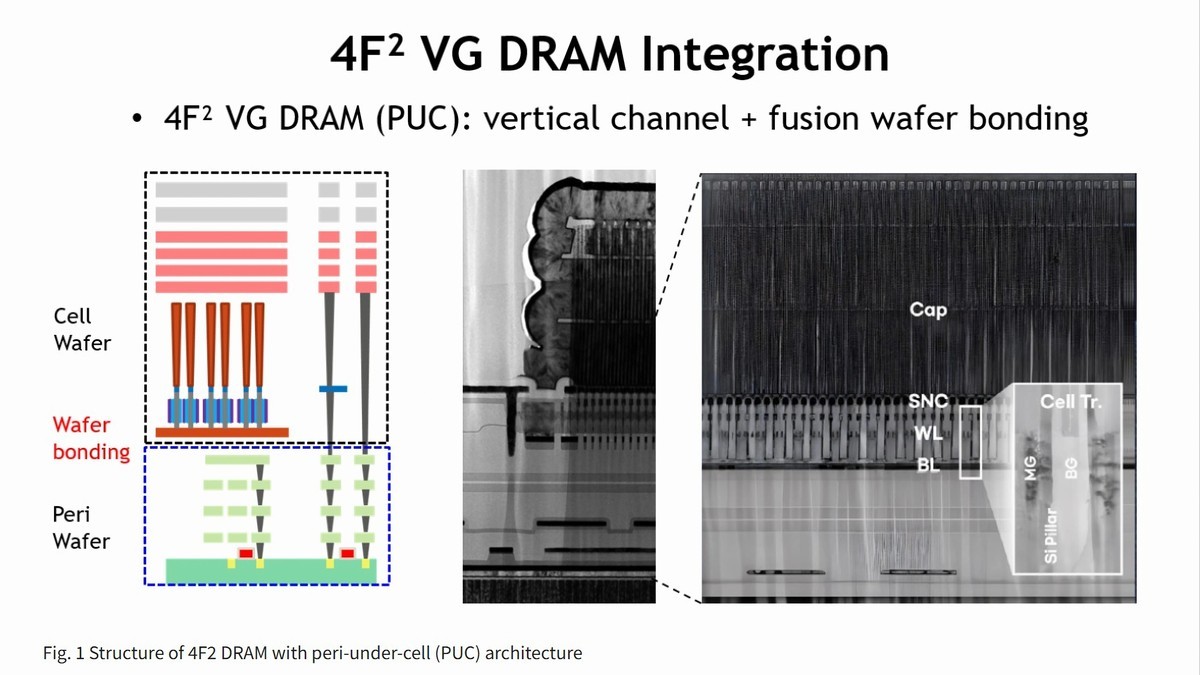
You cannot get there by drawing smaller lines. The transistor has to stand up, with the channel running vertically and the gate wrapped around or beside it - so each company has its own name for what is essentially the same physical bet. Samsung calls it a vertical channel transistor, SK hynix a vertical gate platform, CXMT a vertical surrounded gate.
Samsung showed a working 16Gb 4F² prototype at a conference in February and produced test wafers in March. For CXMT the appeal is sharper than for anyone else: US export controls stop it buying ASML's extreme-ultraviolet lithography tools, so 4F² is a route to density that does not require smaller line widths.
The Number That Moved the Market
CXMT first flagged progress on 4F² at a Shanghai industry event over the weekend of 10-11 October. On the Monday, Samsung fell 3.6 percent, SK hynix 3.4 percent and Micron about 4 percent, on figures reported intraday rather than at the close.
Seoul Economic Daily put the stakes in one sentence on Sunday: "On timing alone, that would put CXMT about two years ahead of market leader Samsung Electronics, a prospect that rattled the industry enough to drag down semiconductor shares worldwide."
That sentence needs a caveat attached to it. Samsung is developing 4F² on a vertical channel transistor design, and its chief technology officer Song Jae-hyuk confirmed as much at a Seoul industry event on 14 October. But he gave no schedule, and the widely repeated 2028 target for Samsung comes from media reporting rather than from the company. The two-year gap is a projection about a roadmap, not a measurement of two products.
Micron Looked at It and Said No
The most useful counter-argument comes from the American company that has decided the whole approach is not worth it. Micron has said 4F² is "not on the roadmap right now," and at a recent technology briefing it identified capacitor spacing as the real bottleneck on DRAM density. Shrinking the area the transistor occupies does not shrink the gap between capacitors, Micron argued, so the density gain is limited - and it declared it would walk away from commercialisation.
CXMT answered that directly. "The layout and structure of word lines and bit lines must be considered as well, not just the capacitor," it said, per Seoul Economic Daily.
Both statements can be true at once, which is the uncomfortable part. Micron is describing a manufacturing-cost problem. CXMT is describing a design problem it says it has solved. Neither has published the yield data that would settle it, and yield is where memory technologies go to die.
SK Hynix Argued for Patience on Its Own Call
Two days before CXMT's filing, SK hynix - the market leader in high-bandwidth memory and the second-largest DRAM supplier - was asked about 4F² by a Citigroup analyst on its own earnings call. President and chief executive Kwak Noh-Jung gave an answer that reads like a warning to anyone pricing in a Chinese leapfrog.
The plan, he said, is to "utilize the 6F² structure to the extent possible through process maturity and stable tech platform, then transition to 4F² or 3D DRAM platform." Through EUV-based scaling and process innovation, "we have secured the technological ability to further extend our current 6F² platform," making the proven route "the most efficient strategy." His reason is the substance: a new cell structure requires "not only performance, but also yield, reliability, and cost competitiveness," plus finished product design and customer qualification - "which is why the timing of technological development and the timing of commercialization are distinct from each other."
SK hynix also said long-term agreements covering 14 customers now account for more than half its capacity for 2027 and 2028, and that DRAM and HBM volumes through 2029 are effectively sold out.
The Profit Behind the Announcement
The technical claim landed on the best quarter in the company's history. CXMT's third-quarter revenue was 118.714 billion yuan, about 17.8 billion dollars, up 613.18 percent from a year earlier. Net profit attributable to shareholders came in at 54.435 billion yuan, roughly 8.2 billion dollars, reversing a loss.
Gross margin reached 89.53 percent, up 1.94 percentage points from the second quarter - a figure that would be extraordinary in almost any manufacturing business and is close to unanswerable as an argument.
For the first nine months the company booked revenue of 269.024 billion yuan, about 40.4 billion dollars, an increase of 738.51 percent, and net profit attributable to shareholders of 132.04 billion yuan, against a loss of 5.28 billion yuan a year earlier. Operating cash flow for the period was 254.751 billion yuan. It also announced a buyback of one to two billion yuan at no more than 72.69 yuan a share, split between employee incentives and cancellation - executable only after the six-month post-listing waiting period expires.
The Growth Is Already Slowing
Look one line lower and the miracle acquires an edge. Sequential revenue growth was 19.30 percent, against more than 90 percent in the previous quarter. Bloomberg read the deceleration as a signal that a brake may be going on China's memory semiconductor industry.
Morningstar analyst Jing Zhiwei made the mechanism plain: "Some 30 to 40 percent of global memory demand still comes from consumer electronics," he said, predicting that pushback from those buyers will cap CXMT's pricing power and leave results showing "stability rather than explosive growth" over the next few quarters. Industry analyst Xiang Ligang was blunter - the growth reflects rising global memory prices, and current profitability "will not last indefinitely."
The pushback is already physical. Xiaomi and Oppo have cut output of low-end handsets because memory has become too expensive to absorb. TrendForce expects the pace of conventional memory price increases to slow in the second half of 2026. One further detail drew attention in coverage of the filing: consolidated net profit of 196.5 billion yuan sat 64.46 billion above the figure attributable to shareholders, and quarterly attributable profit grew 3.01 percent against 19.38 percent for the consolidated line.
Where the Money Came From
None of this happened in a vacuum. AI data centres have absorbed the industry's advanced output, and as the big three shifted capacity toward high-bandwidth memory, conventional DRAM went short - which is precisely the door CXMT walked through.
The share gains are the measure of it, and the two main research houses do not agree on the number. TrendForce puts CXMT at 9.5 percent of global DRAM revenue in the second quarter, up from 7.6 percent in the first, ranked fourth behind SK hynix, Samsung and Micron, which held 23.3 percent. Counterpoint Research puts CXMT at 10 percent for the same quarter, up from 4 percent a year earlier, in a table showing Samsung at 38, SK hynix at 25 and Micron at 24.
CXMT was founded in 2016 by an investment vehicle under the economic and technology development zone of Hefei, in Anhui province, and listed on Shanghai's STAR Market in July 2026, raising 58 billion yuan. It spent 11 billion yuan on research in the first nine months. Omdia, cited in coverage of the results, expects the global DRAM market to grow from 150.5 billion dollars in 2025 to 763.8 billion in 2030.
The Harder Problem Next Door: HBM
The 4F² claim is the elegant half of CXMT's problem. The other half is the memory that AI actually pays for, and there the gap is not a projection - it is a yield number.
Reuters reported on 28 October, citing two people familiar with the matter, that CXMT intends to begin HBM3E production even though only 20 to 30 percent of the chips it makes are usable, against around 70 percent at SK hynix. In testing, its HBM3E performed closer to SK hynix's previous-generation HBM3 than to the current part. It has sent customers two versions, a standard design and one revised to improve yields, and its product is expected to cost more than overseas equivalents.
Counterpoint's second-quarter HBM revenue shares tell you who owns this: SK hynix 50 percent, Samsung 33, Micron 18. Samsung expanded HBM4 sales in July and has shipped HBM4E samples, putting CXMT at least a generation behind. Washington tightened controls on advanced HBM bound for China in December 2024, and Chinese buyers have paid several times the going rate through unofficial channels. Reuters reported last month that Huawei, Cambricon, MetaX and Iluvatar CoreX raised AI chip prices by 20 to 50 percent as memory costs bit.
Why This Reaches Your Shopping Cart
Memory is the input nobody sees and everybody pays for, and Friday proved it in the most expensive way available. Intel closed down 28.6 percent at 65.76 dollars, its worst single day since 1974, after guiding fourth-quarter revenue to 15-16 billion dollars against roughly 17.1 billion expected, with adjusted earnings of 25 cents a share against 43 cents forecast.
The cause was not Intel's own quarter. Revenue rose 21 percent to 16.5 billion dollars and data centre and AI revenue jumped 78 percent to 7.3 billion. Client computing fell 9 percent to 8.1 billion, and the company said AI data centres are soaking up the world's memory chips, pushing up the price of laptops and desktops. It now expects PC shipments to fall about 12 percent in 2026 and another 10 percent in 2027, with an accident at its plant in Israel costing about 300 million dollars of fourth-quarter revenue. Chief financial officer David Zinsner sees the slump lasting at least through the first half of next year.
What Friday Cost, and What Comes Next
How much value the day erased depends on who is counting: nearly 140 billion dollars by Yahoo Finance's reckoning, about 138 billion by Benzinga's, about 120 billion by an estimate carried in Israeli coverage. Chief executive Lip-Bu Tan called the rebuild "a multiyear journey." Bank of America's Vivek Arya cut the stock to Neutral, saying the "agentic tide" in data centre chips is "more than offset by PC/supply headwinds."
That is what a memory shortage looks like when it stops being a chip-industry story. The thing to watch now is not another press release from Hefei. It is the DDR5 RDIMM sample, the customer qualification behind it, and a yield figure nobody has published. If CXMT ships 4F² server memory at a cost the hyperscalers will pay, Micron's cost argument and SK hynix's patience argument both get tested at once, and a market that has been a three-company arrangement for a generation becomes something else. Until then, the honest description of Sunday's news is this: a company with its margins and its momentum says it has solved the next cell architecture, and has shown no one the numbers that would prove it.
By Jessica Ali, Staff Writer
This article was produced with AI-assisted research and editorial support. Sources: Seoul Economic Daily, SBS News, Nocutnews, Yonhap, TrendForce, Counterpoint Research, Reuters, Bloomberg, Morningstar, Omdia, Yahoo Finance, Benzinga, CXMT third-quarter 2026 report. Photographs: CXMT entrance sign via SBS; CXMT memory module via RPRNA; 4F2 vertical-gate DRAM figure via TrendForce. Cover: Global 1 News editorial image.
What's Your Reaction?
 Like
0
 Dislike
0
 Love
0
 Funny
0
 Wow
0
 Sad
0
 Angry
0

Editor-in-Chief at Global1.News. Atlanta-based journalist who cuts through the BS and tells it like it is. Lead anchor, host, and the voice you hear when the spin stops and the truth starts.















Comments (0)