
China's 30-Year Sea-Power Plan Meets Japan's Drone Answer
A Renmin University scholar urges China to prepare for a decades-long sea-power contest with the United States, while Japan fast-tracks a domestically built interceptor drone to counter Beijing's expanding military capabilities.
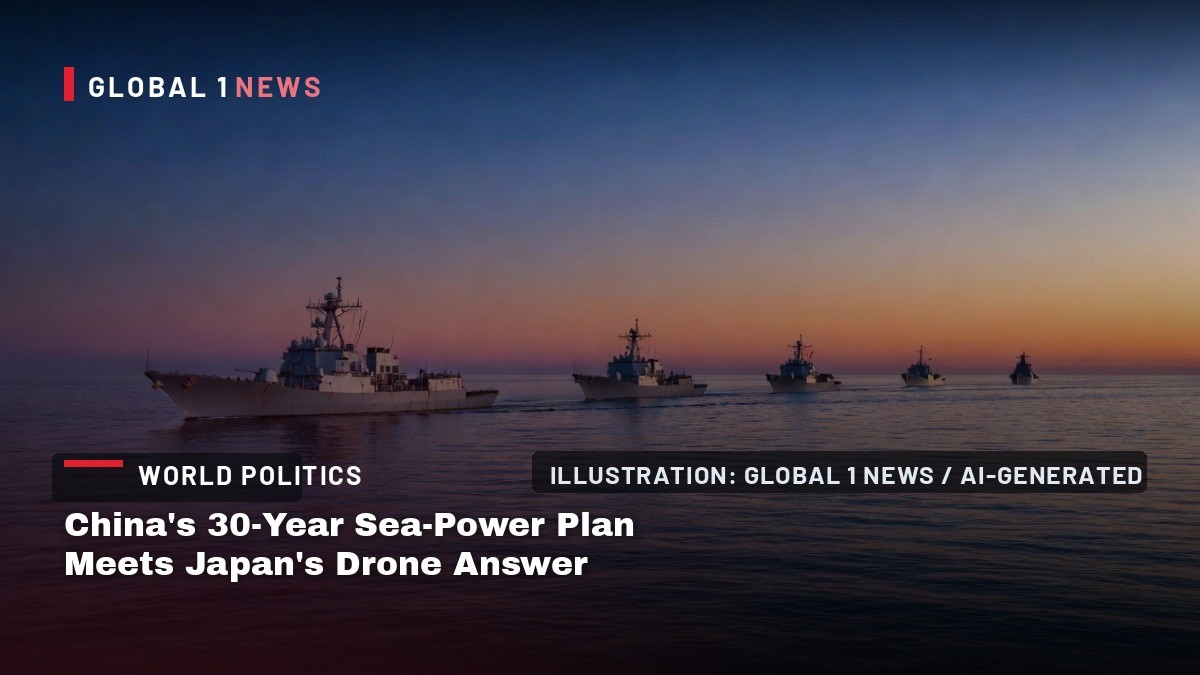
Beijing Prepares for a Long Contest Over the World's Sea Lanes
Beijing should forge a national consensus on "regaining mastery of the oceans" and channel returns from its overseas investments into defence spending to brace for sea-power competition with the United States, a prominent Chinese academic has argued. Di Dongsheng, associate dean of Renmin University's school of international studies in Beijing, warned this week that as economic ties between Washington and Beijing shift from interdependence towards competition, the era of open oceans could be drawing to a close.
"We must prepare for struggle in a coming contest over sea power and the security of shipping routes," Di wrote in a note on his social media channel, in remarks reported by the South China Morning Post. The warning lands at a delicate moment: President Xi Jinping's expected visit to Washington next month is meant to stabilise the relationship, even as crises from the Strait of Hormuz to the Panama Canal test the maritime order that China's export-driven economy depends on.
Three Decades to Secure the World's Shipping Lanes
Di argued that it could take about three decades for China to secure dominance over, and access to, ports, straits, canals and shipping lanes around the world in a step-by-step process. Before that consolidation is complete, he cautioned, a portion of China's import and export trade that relies on maritime transport could come under threat, or even partial shocks, and "still warrants close attention".
The timeframe matters for Tokyo as much as for Beijing. Japan, like China, depends on long sea lines of communication for energy and food, and the sea lanes running through the South China Sea and the Strait of Malacca are strategic arteries for both economies. Chinese naval activity around the First Island Chain - the arc of islands stretching from Japan's southwestern prefectures through Taiwan to the Philippines - has been the single biggest driver of Japan's own defence build-up over the past decade.
The Warning Signs: Panama, Greenland and Hormuz
Di described geopolitical events since the second half of 2025 around the Panama Canal, Greenland and the Strait of Hormuz as "a series of warning signals that the openness of the seas is tending towards an end". He noted that Beijing had gained the "upper hand" in last year's tariff and sanctions wars, forcing US President Donald Trump into a temporary compromise, but said his research indicated the White House remained unconvinced and some in Washington were actively targeting China's vulnerabilities.
"One of China's obvious soft spots is the maritime routes," Di said. He identified several natural deepwater ports in which China has invested heavily in recent years - Ream Naval Base in Cambodia, the Port of Chancay in Peru, Kyaukphyu in Myanmar and Gwadar in Pakistan - as "potential focal points of geopolitical struggle in the future". Some observers have read Trump's repeated calls to take control of Greenland, the diplomatic contest over the Panama Canal and Washington's broader pressure campaign as moves to constrain Beijing's strategic space by controlling key international trade and energy nodes.
Why Overland Routes Are Not the Answer
Di pushed back against the argument that China could sidestep a head-on maritime rivalry with the United States by expanding overland corridors linking Asia, Europe and Africa. Such an approach "would probably be nowhere near enough to solve the problem of foreign trade channels", he said, noting that annual freight by weight on the China-Europe Railway Express matched about two days' throughput at Ningbo, the world's busiest port by cargo volume.
He also pointed to a fragility that resonates across the region: the entire rail service could be shut down if a single country along the line blocked the route, whereas sea-bound trade could switch to alternative passages during emergencies. The prescription that follows is sweeping - upgrade both the quality and quantity of China's naval capabilities, build supply bases around the world through long-term diplomatic and military efforts, and forge "a series of new national consensuses". "Only by embracing, taming and regaining mastery of the oceans does the Chinese nation have a future," Di wrote.
Japan's Answer: Interceptor Drones at Unprecedented Speed
Japan is already moving on the threat dimension of the same competition, with a procurement experiment that its own defence establishment calls "unprecedented". The Acquisition, Technology and Logistics Agency (ATLA) announced on August 25 that it had signed a contract to buy Terra Drone's Terra B1 interceptor system following competitive trials - less than three months after launching the process in June. It is the first time the ministry has used its rapid-acquisition approach for drones.
The Tokyo-based company said the Terra B1 was the only system to pass the demonstration stage, in which the Maritime Self-Defence Force tested four finalists between July 15 and August 6. Delivery is planned for around September, with the MSDF expected to receive the system first before any expansion to the Air and Ground Self-Defence Forces. ATLA evaluated proposals from 38 companies before shortlisting the Terra B1, Beyond Vision's BVQ404, Quantum Systems' QS Interceptor and DZYNE Technologies' IonStrike; the contract value and number of units have not been disclosed.
Analysts say the speed is the story. "I am astonished by how quickly this has all transpired," Jeffrey Hornung, Japan lead at the Rand Corporation's National Security Research Division, told the South China Morning Post, adding he could not recall a system moving through the Japanese acquisition process so quickly in more than two decades of following it. Terra Drone has drawn on experience from Ukraine, where other systems in its portfolio have been used against long-range attack drones, and has acquired stakes in two Ukrainian interceptor-drone companies.
What It Means for Northeast Asia
The two stories are opposite sides of the same strategic shift. Di's essay frames sea power as the arena where China must eventually surpass the United States; Japan's defence white paper, approved by the Cabinet on August 4 under the Takaichi administration, describes China's external stance and military activities as Japan's "unprecedented and the greatest strategic challenge". The document places new emphasis on unmanned systems as part of the "new ways of warfare" for which Tokyo must prepare, and highlights Beijing's accelerating development of AI-enabled unmanned capabilities.
That is exactly the gap the Terra B1 is meant to fill. Japan has lacked a cost-effective interceptor for unmanned systems, and while the B1 will not "level the playing field" on its own, according to Hornung, it signals a broader lesson drawn from Ukraine: cheap drones and rapidly evolving counter-drone technologies are now central to high-intensity conflict, and procurement must move at the speed of the threat. Masashi Murano, a senior fellow at the Hudson Institute, called the rapid acquisition a "groundbreaking step", while cautioning that a narrowly defined competition designed around one domestic platform may not translate easily to genuinely new and unforeseen challenges.
What to Watch For
For Japanese readers, the practical milestones are concrete: the Terra B1's delivery to the Maritime Self-Defence Force around September, and any decision to extend the interceptor to the Air and Ground forces. The deeper question is whether the rapid-acquisition model becomes the template for future Japanese procurement, or remains a special case for low-cost unmanned systems - defence expert Yoshihiro Inaba of Naval News argues the latter, noting that more sophisticated weapons require engineering, manpower and funding that cannot be compressed into a three-month cycle.
The regional backdrop, meanwhile, keeps tightening. China's navy has surpassed the United States in the number of ships, even if total tonnage and Washington's network of about 800 overseas bases remain unmatched, and Di's own assessment concedes "a gap in experience and capability" for Beijing. As the White House and the Great Hall of the People prepare for next month's summit, the maritime domain remains the quiet core of the rivalry - and both capitals, like Tokyo, are racing to be ready for a contest that each side says could last decades.
By Kenji Tanaka, Staff Writer
This article was produced with AI-assisted research and editorial support. Sources: South China Morning Post, Terra Drone, Janes, The Diplomat.
What's Your Reaction?
 Like
0
Like
0
 Dislike
0
Dislike
0
 Love
0
Love
0
 Funny
0
Funny
0
 Wow
0
Wow
0
 Sad
0
Sad
0
 Angry
0
Angry
0

Japan Correspondent at Global1.News. Tokyo-based voice covering Japanese politics, technology, economy, and culture. Tracks the intersection of tradition and innovation in one of the world's most dynamic societies.















Comments (0)