
China, US Military Commanders Meet in Canada, Ending Two-Year Hiatus
The PLA commander who would lead any Taiwan operation met the head of US Pacific Command for the first time at a defence conference in Canada, reopening a channel frozen since 2022 and watched closely in Tokyo.
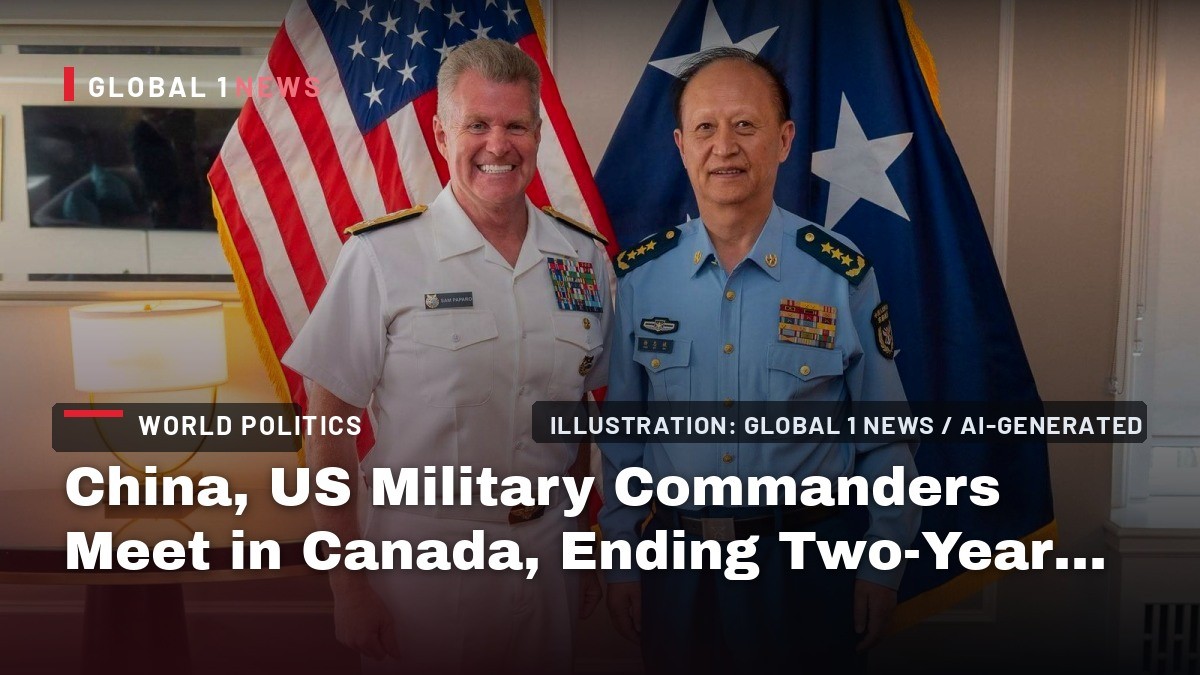
The Generals Who Would Run a Taiwan Crisis Finally Share a Table
TOKYO - The two commanders whose forces would face each other first in any Taiwan contingency have met face to face for the first time. Chinese General Yang Zhibin, who leads the People's Liberation Army's Eastern Theater Command, and US Admiral Samuel Paparo, commander of the US Pacific Command, held talks on the sidelines of the 28th Indo-Pacific Chiefs of Defence Conference in Victoria, British Columbia, on August 31, ending what Washington and Beijing both framed as an unusually long silence at the command level.
The US Pacific Command said on Friday that the two men discussed "the importance of maintaining open lines of communication between senior US and Chinese military leaders to reduce the risk of miscalculation and to promote safe and professional conduct between forces." China's Defence Ministry confirmed the meeting the same day through spokesman Senior Colonel Jiang Bin, adding that the Chinese delegation also held bilateral talks with France and Singapore.
For Tokyo, the meeting is more than a footnote in the US-China relationship. The Eastern Theater Command headquartered in Nanjing does not only face Taiwan; its area of responsibility also covers the East China Sea, where Japanese and Chinese aircraft and vessels regularly shadow one another around the Senkaku Islands, which Beijing calls Diaoyu. The channel reopened in Canada is the one Japan's own defence planners would be watching in a crisis.
A Two-Year Silence, Broken on a Canadian Sideline
The Victoria conference, co-hosted by the Canadian Armed Forces and the US Pacific Command from August 31 to September 2, drew 32 senior military representatives from 29 countries. Yang attended in person, a notable shift: Beijing opted out of last year's edition in Thailand.
The meeting was only the second theatre-level contact between the two militaries since China scaled back military ties with the United States in August 2022, following then-House Speaker Nancy Pelosi's visit to Taiwan. Engagement formally resumed after Presidents Biden and Xi agreed in San Francisco in November 2023 to restart PLA-Pentagon communications. The previous theatre-level encounter came in September 2024 in Hawaii, when Paparo met General Wu Yanan, then commander of the PLA Southern Theater Command.
Yang's presence this year therefore marks a step up in significance. Yang delivered a speech during the conference, Jiang Bin said, outlining the Chinese military's position and achievements in maintaining regional peace and stability and proposing that regional countries strengthen defence exchanges and cooperation to jointly address common challenges.
The Two Commands That Face Each Other Across the Strait
Yang Zhibin, a 63-year-old air force general from Henan province, took command of the Eastern Theater Command in December 2025 and was promoted to full general the same month. He previously served as deputy commander of the Western Theater Command and, before that, deputy commander of the Southern Theater Command. His current post is widely described as the PLA's most strategically sensitive: the Eastern Theater is the formation that would lead any operation against Taiwan, and its writ extends into the East China Sea and the western Pacific.
On the American side, Paparo, a career naval aviator, assumed command of the Pacific Command in May 2024. He is the 27th commander of America's oldest and largest unified combatant command, which spans 36 nations and covers the waters from the US West Coast to India's western border. In June 2026, under the Trump administration's broader rebranding of the Pentagon, the command dropped "Indo" from its name and returned to the Pacific Command designation it carried for more than 70 years; its mission and area of responsibility were unchanged.
Analysts have long noted a gap in the deconfliction architecture: earlier US-China military dialogues tended to run through the Southern Theater commander, whose focus is the South China Sea. Yang's Eastern Theater is the command most likely to direct forces in a Taiwan scenario, which makes a direct channel with the American commander responsible for the same waters structurally important.
Why Japan Watches This Channel So Closely
Japan has a direct stake in every signal between Washington and Beijing. The Defence of Japan 2026 white paper, released on August 4, again identifies China as Japan's greatest strategic challenge and warns that the military balance across the Taiwan Strait is tilting rapidly in Beijing's favour. It highlights the risk of a "grey zone" blockade, in which Chinese coast guard and naval vessels are forward-deployed to squeeze Taiwan short of open conflict.
Prime Minister Sanae Takaichi told the Diet in November 2025 that a Chinese use of force against Taiwan, including a naval blockade, could constitute a "survival-threatening situation" for Japan. Under Japan's 2015 security legislation, that classification is the legal threshold that would allow the Self-Defence Forces to act even without a direct attack on Japan.
The stakes are geographic as much as legal. PLA activity east of Taiwan has increased in recent months, activity that experts read partly as an attempt to counter growing Japanese-Philippine cooperation in waters that sit astride Japan's own sea lanes to Southeast Asia and the Middle East. Any US-China command channel that reduces the chance of miscalculation in that crowded space is, from Tokyo's perspective, a stabiliser worth having - as long as it does not become a cover for Washington to accept a fait accompli around the island.
Japan also has its own version of the same architecture. Tokyo and Beijing have operated a direct telephone line for their sea and air liaison mechanism since 2023, designed to manage maritime and air incidents in the East China Sea. The Takaichi administration has signalled it remains open to dialogue with China even as it hardens its defence posture, and Paparo's sideline meetings at the conference included sessions with Quad partners, of which Japan is one.
What the Reopened Line Can and Cannot Do
Military-to-military communication channels are crisis-management tools, not trust-building exercises. Their purpose is narrow but vital: when aircraft and warships operate at close quarters, commanders need a tested way to clarify intent, challenge dangerous behaviour and walk back from the brink without losing face.
The American statement after the Victoria meeting stressed exactly that logic - reducing the risk of miscalculation and promoting safe, professional conduct. China's framing was broader, casting Yang's participation as a contribution to regional stability and an invitation for stronger defence cooperation among Asian countries. The two readings overlap enough to keep the channel open and diverge enough to guarantee it will remain fragile.
What the channel cannot do is resolve the underlying dispute. Beijing continues to describe Taiwan as its own territory and has not renounced the use of force; Washington continues to arm and reassure the island under the Taiwan Relations Act framework. A direct line between theatre commanders reduces the odds of an accidental war. It does nothing, by itself, to reduce the odds of a deliberate one.
A Thaw Timed for the Washington Summit
The timing of the announcement was not accidental. The meeting took place in late August, but the US command and China's Defence Ministry both confirmed it on Friday, September 4, roughly three weeks before President Xi Jinping is expected to visit Washington for a September 24 meeting with President Donald Trump.
Taiwan is expected to be the most sensitive item on that agenda, and the resumption of military communication gives both sides something concrete to point to as evidence that they are managing the relationship responsibly. For Beijing, Yang's participation also serves a second audience: by holding bilaterals with France and Singapore and delivering a speech on regional cooperation, the PLA can present itself as a normal, responsible stakeholder in the Indo-Pacific security order even as its exercises around Taiwan grow more assertive.
For Washington, the channel is a hedge that limits the downside if the political track stumbles. Neither capital is treating the Victoria meeting as a breakthrough in the strategic competition; both are treating it as essential plumbing for that competition.
What to Watch For
The first test will come on September 24, when Xi and Trump meet in Washington. Whether Taiwan is handled with the care both militaries now claim to want will tell allies in Tokyo, Seoul and Manila whether the reopened command channel is a genuine stabiliser or simply a way to manage the noise.
Watch also for the follow-through. The September 2024 Hawaii meeting did not immediately produce a standing rhythm of theatre-level talks. If Yang and Paparo meet again before year's end, or if their staffs begin scheduling regular exchanges, the channel will have become institutionalised. If the September 24 summit stalls, the Victoria handshake may prove to have been a one-off.
For Japan, the quiet variable is the East China Sea. The same Eastern Theater Command that now talks to the Americans also patrols the waters around the Senkaku Islands, and Tokyo will be watching whether Beijing treats its new channel with Washington as a template for warmer military communication with Japan, or as an exclusive line that leaves Japan's own defence dialogue with China exactly where it has been: functional, narrow and carefully controlled.
By Kenji Tanaka, Staff Writer
This article was produced with AI-assisted research and editorial support. Sources: South China Morning Post, Japan Times, US Pacific Command, Canadian Armed Forces.
What's Your Reaction?
 Like
0
Like
0
 Dislike
0
Dislike
0
 Love
0
Love
0
 Funny
0
Funny
0
 Wow
0
Wow
0
 Sad
0
Sad
0
 Angry
0
Angry
0

Japan Correspondent at Global1.News. Tokyo-based voice covering Japanese politics, technology, economy, and culture. Tracks the intersection of tradition and innovation in one of the world's most dynamic societies.










Comments (0)