
China-Russia Live-Fire Drill Near Okinotorishima and the Strategic Stakes for South Korea
China-Russia Live-Fire Drill Near Okinotorishima and the Strategic Stakes for South Korea A Calculated Probe in Contested Waters On July 19, 2026, the Chinese guided-missile destroyer Kaifeng, a Type 052D vessel, and the Russian frigate Rezkiy conducted joint live-fire gunnery drills approximately 110 miles (180 kilometers) southwest of Okinotorishima, inside waters Japan claims as part of its Exclusive Economic Zone.
A Calculated Probe in Contested Waters
On July 19, 2026, the Chinese guided-missile destroyer Kaifeng, a Type 052D vessel, and the Russian frigate Rezkiy conducted joint live-fire gunnery drills approximately 110 miles (180 kilometers) southwest of Okinotorishima, inside waters Japan claims as part of its Exclusive Economic Zone. The activity formed part of follow-on operations after the maritime phase of the Joint Sea-2026 exercise, which concluded off Qingdao on July 13. Participating forces subsequently transited into the Philippine Sea for joint patrols, converting a bilateral exercise into a forward demonstration of naval interoperability well beyond the Yellow Sea and East China Sea.
Japan's Ministry of Defense responded by mobilizing Maritime Self-Defense Force vessels and aircraft to monitor the drill. Tokyo lodged a diplomatic protest with Beijing. Chinese Foreign Ministry spokesman Lin Jian rejected the protest, asserting that Chinese activities on the high seas are fully consistent with international law and international practice. Reporting indicates this was the first instance of a Chinese warship conducting live-fire drills inside Japan's claimed EEZ around Okinotorishima. Around the same period, China and Russia also conducted a joint air patrol over the East China Sea and the Sea of Japan, underscoring the multi-domain character of their coordination.
For South Korea, the episode is not a distant Sino-Japanese quarrel. It raises direct questions about maritime legal precedent, the durability of EEZ claims built on contested features, and the operational environment in which the Republic of Korea must manage security ties with the United States and Japan while preserving a complex economic relationship with China.
Okinotorishima and the UNCLOS Fault Line
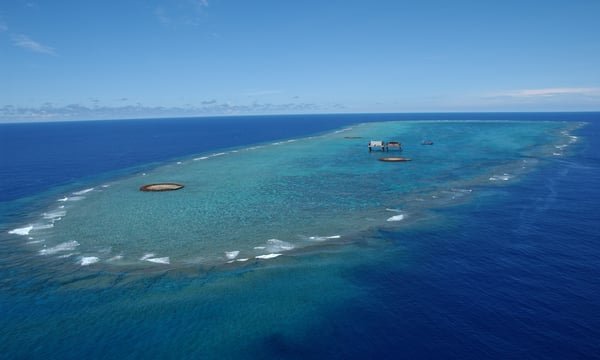
Okinotorishima is Japan's southernmost territory, a small coral atoll in the Philippine Sea. Tokyo claims an EEZ of roughly 154,000 square miles around it. Beijing's counterargument rests on Article 121 of the United Nations Convention on the Law of the Sea: features that cannot sustain human habitation or economic life of their own are rocks, not islands, and do not generate an EEZ. By treating Okinotorishima as a rock, China frames the surrounding waters as high seas in which naval gunnery is lawful absent other prohibitions.
This is not a technical quibble. EEZ rights govern resource jurisdiction, marine scientific research, and the regulatory environment for foreign military activities short of pure high-seas freedoms. When a major naval power conducts live-fire drills inside another state's claimed EEZ and simultaneously denies the legal basis of that claim, it tests both operational tolerance and the political will to defend interpretive positions. Japan's surveillance response and diplomatic protest reflect that dual pressure. China's rejection of the protest signals that Beijing intends to normalize such activity under a high-seas rationale.
The China-Russia dimension compounds the challenge. Joint Sea follow-on patrols and combined gunnery demonstrate growing interoperability and a shared interest in contesting what both governments often describe as containment architectures in the Western Pacific. For regional middle powers, the message is that bilateral China-Russia naval activity can appear with limited warning in waters where legal title is disputed and where alliance consultation mechanisms must operate under time pressure.
The Ieodo Parallel and South Korea's Yellow Sea Vulnerability
South Korea maintains an overlapping EEZ claim with China in the Yellow Sea centered on Ieodo, also known as Socotra Rock-a submerged reef on which Korea has built the Ieodo Ocean Research Station. Ieodo is not an island; it is a permanently submerged feature. Korea's jurisdictional posture rests on continental shelf and EEZ delimitation principles rather than on an Article 121 island claim identical to Japan's Okinotorishima position. Nonetheless, China's rhetorical and legal strategy against Okinotorishima-minimizing the maritime zones generated by marginal features and maximizing high-seas freedoms for Chinese naval operations-creates an uncomfortable parallel.
If Beijing successfully normalizes the argument that contested or marginal features cannot anchor expansive EEZ enforcement against Chinese military activity, Seoul could face analogous pressure around Ieodo and in broader Yellow Sea delimitation talks. China has already resisted Korean administrative and research activities in the area and has conducted law-enforcement and naval operations that test Korean responses. A precedent in which live-fire drills inside a claimed EEZ are justified solely by denying the opponent's legal characterization of a feature would narrow Seoul's room for maneuver.
The UNCLOS interpretive struggle therefore cuts across both the Philippine Sea and the Yellow Sea. Korea's maritime claims in the Yellow Sea and its interests in the East Sea (Sea of Japan) depend on stable, widely accepted readings of entitlement, delimitation, and the residual rights of coastal states within EEZs. Erosion of those readings in one theater weakens diplomatic and legal consistency in others. Academic and policy communities in Seoul have long warned that feature-based disputes are interconnected through doctrine even when they are geographically separate; the Okinotorishima drill illustrates that warning in operational form.
Historical Context: China-Russia Military Activity Near the Peninsula
Korea is not a stranger to China-Russia joint military activity near its maritime approaches. Prior Joint Sea exercises and associated movements have included phases in the Sea of Japan/East Sea and adjacent waters, prompting monitoring by the ROK Navy and Air Force and careful calibration of public messaging. Joint air patrols over the East China Sea and Sea of Japan, including patterns reported in the same period as the Okinotorishima drill, reinforce a cumulative picture: Beijing and Moscow are prepared to operate in tandem along the arc from the Yellow Sea through the East China Sea into the Western Pacific.
Historically, such activity has forced Seoul to balance three imperatives: maintain situational awareness without escalation; avoid diplomatic ruptures with Beijing that could jeopardize economic and North Korea-related channels; and demonstrate sufficient alignment with the United States and Japan to preserve deterrence credibility. When joint China-Russia operations occur closer to the peninsula, domestic political scrutiny intensifies. When they occur farther afield but establish legal-operational precedents, the scrutiny is quieter yet the structural implications may be greater. The Okinotorishima case falls into the latter category-distant enough to avoid immediate crisis politics in Seoul, significant enough to reshape the maritime rules environment Korea inhabits.
Inter-Korean dynamics add another layer. Pyongyang watches China-Russia military coordination with interest, both as a diplomatic shield and as a model of great-power partnership opposing U.S.-led frameworks. Any perception that Beijing and Moscow can conduct combined live-fire activity inside a U.S. ally's claimed EEZ without decisive cost may encourage North Korean risk-taking in its own gray-zone and missile activities. That does not mean a direct causal chain; it means the regional permission structure for coercive maritime and aerial signaling is evolving.
Seoul's Strategic Position Between Alliance and Economy
South Korea's position remains structurally dual. The U.S.-ROK alliance anchors deterrence against North Korea and underwrites advanced military capabilities, intelligence sharing, and extended deterrence consultations. Trilateral security cooperation with the United States and Japan has expanded in recent years in missile warning, exercises, and information sharing, partly in response to North Korean threats and partly in recognition of broader regional military balances. At the same time, China is a central trading partner and a critical actor in any sustainable diplomacy toward Pyongyang. Korean chaebol supply chains, export markets, and intermediate goods networks remain deeply exposed to Chinese demand and industrial policy.
A China-Russia live-fire drill inside Japan's claimed EEZ pressures that dual structure. Strong solidarity with Tokyo and Washington on freedom of navigation, EEZ respect, and opposition to coercive maritime practices strengthens trilateral cohesion and maritime domain awareness. Overly visible alignment, however, risks Chinese economic and diplomatic pushback of the sort Korean policymakers still remember from earlier political disputes. The result is a familiar but sharpening dilemma: principled consistency on maritime law serves Korea's long-term interests in the Yellow Sea, yet short-term political management favors calibrated language and quiet professional monitoring rather than high-profile confrontation.
Daily life and bureaucratic practice in Korea reflect this tension. Fisheries management, coast guard operations, energy shipping routes, and undersea infrastructure protection all depend on predictable EEZ administration. When major powers treat EEZ claims as optional political facts rather than stable legal ones, Korean operators face higher insurance, routing, and contingency-planning costs even if no shot is fired near Busan or Jeju. Strategic ambiguity may be diplomatically convenient; operationally, ambiguity is expensive.
Trilateral US-Japan-ROK Cooperation and Maritime Domain Awareness
The drill's implications for trilateral cooperation are concrete. Maritime domain awareness-shared pictures of surface, subsurface, and air activity-depends on sensor coverage, data fusion, and political permission to act on shared information. A China-Russia formation transiting from the Qingdao area into the Philippine Sea and conducting gunnery inside a contested EEZ is precisely the type of multi-day, multi-theater event that tests whether trilateral mechanisms can track, characterize, and consult in real time.
Freedom of navigation operations and presence missions are politically sensitive in Seoul, which has traditionally been more cautious than Washington or Tokyo about framing China policy in navigational-challenge terms. Yet the logic of collective maritime security does not require identical public rhetoric. It requires interoperable surveillance, agreed thresholds for diplomatic demarches, and contingency planning for scenarios in which live-fire warnings or exclusion zones affect commercial shipping and allied naval movement. The Okinotorishima episode offers a case study for refining those thresholds without forcing Korea into a maximalist FONOP posture it may not choose.
Institutionally, the ROK Ministry of National Defense is likely to emphasize monitoring, information sharing with allies, and assessment of interoperability trends between Chinese and Russian naval forces. The Ministry of Foreign Affairs faces the complementary task of articulating Korea's attachment to UNCLOS-based order, managing bilateral messages to Beijing and Moscow, and coordinating with Tokyo in terms that defend legal principle without locking Seoul into every Japanese diplomatic formulation on Okinotorishima. Precision matters: Korea can support stable EEZ governance and oppose coercive precedent-setting while noting that each feature's legal status turns on specific geographic and legal facts.
Legal Doctrine, Delimitation, and Korea's Dual-Sea Interests
UNCLOS leaves genuine interpretive space regarding military activities in EEZs, the definition of rocks versus islands, and the relationship between coastal-state resource rights and foreign military uses. That space is now being filled by state practice. China's practice around Okinotorishima-live-fire activity plus an explicit high-seas claim-pushes state practice toward a permissive regime for naval gunnery wherever Beijing denies the opposing EEZ entitlement. Russia's participation lends additional weight, suggesting that two permanent members of the UN Security Council are prepared to jointly enact that permissive reading.
For Korea, delimitation in the Yellow Sea remains unfinished business with China, and maritime jurisdiction in the East Sea involves both Japan and the complex politics of Dokdo/Takeshima. Doctrinal consistency is an asset. If Seoul remains silent when EEZ claims are operationally disregarded elsewhere, it weakens the normative backdrop for its own future negotiations and incidents. If it overclaims parallels, it invites legal rebuttals that Ieodo and Okinotorishima are not similarly situated. The academically sound path is to distinguish facts while defending a common interest in restraining unilateral military theater-making inside zones of overlapping or contested jurisdiction.
Policy implications follow. Korean legal diplomacy should continue to invest in UNCLOS forums, bilateral maritime safety talks with China, and trilateral coast guard and navy communication channels. Defense planning should assume that China-Russia joint naval deployments into the wider Pacific will recur and may include live-fire serials near alliance sea lines of communication. Education and public communication-through institutions such as the Korea Institute for Maritime Strategy and relevant university security programs-should clarify why distant atolls matter to Korean fishermen, shippers, and energy importers. Chaebol logistics planners already price geopolitical risk; clearer government guidance reduces uncertainty premiums.
Strategic Significance Beyond the Immediate Protest Cycle
The July 19 drill will pass through a familiar cycle: operational monitoring, diplomatic protest, rejection, and analytical after-action review. Its deeper significance lies in precedent and patterning. First, China-Russia naval interoperability is being exercised not only near home waters but in locations chosen for legal and alliance sensitivity. Second, the denial of EEZ status to Okinotorishima is being operationalized, not merely argued in notes verbales. Third, South Korea's maritime security environment is shaped by doctrinal contests it does not control but cannot escape.
None of this requires exaggerated claims of imminent crisis. It requires sober recognition that the rules governing military activity in East Asian EEZs are being written through practice. Japan's nerves are understandable; Korea's interests are engaged whether or not the gunnery echoes reach the Yellow Sea. The task for Seoul is to convert that engagement into clearer legal diplomacy, tighter maritime domain awareness with allies, and a domestic strategic conversation that connects Philippine Sea events to Ieodo, UNCLOS interpretation, and the everyday security of a trading nation dependent on stable seas.
In that sense, Okinotorishima is a mirror. What China and Russia did southwest of a remote Japanese atoll reflects how power, law, and alliance politics now interact across the region's contested waters-and how South Korea must prepare for the next iteration, closer to home or equally rich in precedent.
By Prof. David Park, Staff WriterThis article was produced with AI-assisted research and editorial support. Reporting is based on sources cited in the article.
What's Your Reaction?
 Like
0
Like
0
 Dislike
0
Dislike
0
 Love
0
Love
0
 Funny
0
Funny
0
 Wow
0
Wow
0
 Sad
0
Sad
0
 Angry
0
Angry
0

East Asia/Technology Correspondent at Global1.News. Seoul-based voice covering Korean politics, technology, business, and culture. Analyzes how technology and geopolitics intersect across East Asia.















Comments (0)