
China's Arctic Power Play: The Northern Sea Route That's Bringing Beijing and Moscow Together
China and Russia are turning the Arctic's Northern Sea Route into a sanctioned-energy lifeline: LNG imports up 28%, eight blacklisted tankers, and six shipping lines planning 50 voyages as Middle East chokepoints stay blocked.
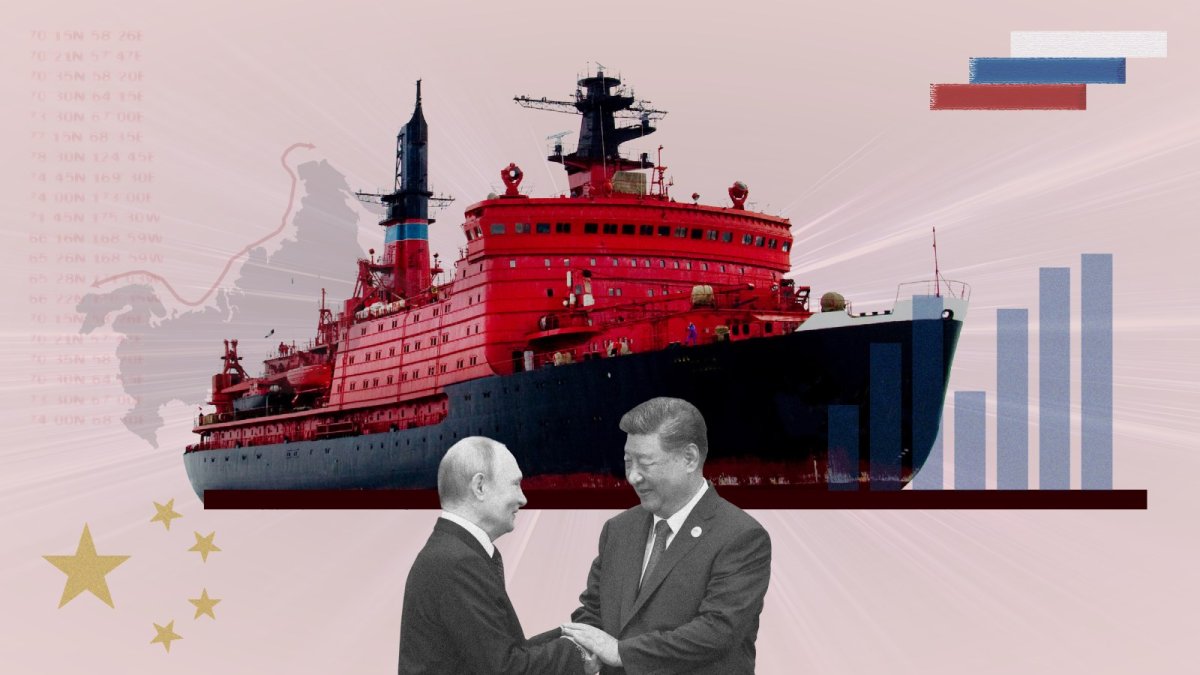
Ice was still heavy on the water when the hulking Christophe de Margerie tanker set off on the first journey of the season along the Northern Sea Route in late May, fresh from Arctic LNG-2, a US-sanctioned liquefied natural gas facility in the Russian Arctic. Led most of the way by an icebreaker, the tanker crossed thousands of miles of Arctic waters before its two-week trip ended in a secluded bay on Russia's Kamchatka Peninsula, once home to a Soviet military settlement.
There, satellite imagery reviewed by CNN shows the tanker sidled up against a sprawling floating storage unit, unloading its blacklisted cargo before heading back. A day later, a second US-sanctioned tanker, the Arctic Mulan, arrived, was tugged next to the unit, and switched off its tracking device for about a day. When its transponder came back on, it headed to China's Beihai port — where a satellite image 11 days later shows it docked at a terminal "ringfenced for taking in sanctioned Russian LNG cargoes" since last September, according to Charles Costerousse of trade intelligence firm Kpler.
The Northern Sea Route: A Contested Arctic Artery
Bound in impassable ice for much of the year and navigable without icebreakers for just a short summer window, the Moscow-controlled Northern Sea Route is a controversial artery cutting through a region increasingly cast as a new arena of great-power rivalry. The route stretches roughly 3,500 miles along Russia's Arctic coastline, and President Vladimir Putin has long dreamed of it becoming a major trade artery. He now claims disruptions around the Red Sea and Strait of Hormuz make it "the safest, the most reliable and efficient."
Chinese leader Xi Jinping has for years dreamed of a "polar silk road" across the Arctic, an icy extension of his Belt and Road drive — but the expected wave of Chinese investment in polar ports never materialized. Even so, the situation has created a "window of opportunity" for Beijing, said Marc Lanteigne of the University of Tromsø. A CNN analysis of data from Norway's Centre for High North Logistics shows that since Russia's full-scale invasion of Ukraine, international transit along the route has been dominated by one foreign player: China.
Trade Data: China Dominates the Route
The trade — buttressing Russia's wartime economy and boosting China's energy security — comes alongside Western concern that China's footprint could foreshadow military use. "China and Russia now are the only ones who are really using this (route) now," said Kjell Stokvik, managing director of the Centre for High North Logistics at Norway's Nord University.
China's imports of LNG from Russia surged nearly 28% in the first half of the year by volume as Middle East LNG exports froze during the US-Iran war. Each of the eight oil tankers that made full NSR transits last year directly bound for China had been blacklisted by the US for carrying sanctioned cargoes, the CNN analysis found. At least six Chinese shipping companies are expected to make more than 50 voyages along the route this season, according to the China Shipowners' Association.
Trade along the route remains tiny compared with major throughways like the Suez Canal and is dominated by Russian oil and gas, which principally flows to China. Europe remains the largest buyer of Russian LNG from non-sanctioned facilities like Yamal LNG, though an impending EU ban on seaborne Russian LNG purchases in 2027 will change that.
New Shipping Lines: Sea Legend and New New Shipping
This weekend, upstart Singapore-incorporated, Chinese-run shipping line Sea Legend is expected to launch the first regularly scheduled container service operating seasonally between China and Europe — advertising a 20-day transit time, about half of a standard Suez route, while "avoiding geopolitical disruption risks." The voyage is the first of eight bound for Europe this season, carrying Chinese-made electric cars, lithium batteries, and solar power products.
Another Chinese company, New New Shipping, formed after Russia's 2022 invasion, last month launched a line from China's Tianjin to Russia's largest Arctic port, Murmansk — adding to services sending Chinese industrial goods one way and Russian raw materials the other. "The goal is reliable logistics in the face of the current complex and volatile international situation," Sea Legend CEO Li Xiaobin told Caixin last October. Earlier this month, the head of Russia's nuclear agency Rosatom, Alexey Likhachev — whose agency operates the NSR — hailed the "full-fledged liner service" as the "next step" in developing regular, seasonal shipping to Europe.
Sanctions Evasion and the Shadow Fleet
Both Sea Legend and New New Shipping only began running the route in recent years — after China's state-owned shipping behemoth COSCO joined other international shippers in pulling back in 2022. Using new, privately held companies for Arctic forays may be a sign of caution on Beijing's part, said Elizabeth Wishnick of the Center for Naval Analyses. "(China) had to create new companies to avoid sanctions," she said.
New New Shipping, operating along the route since 2023, drew international attention after one of its vessels, the New New Polar Bear, allegedly damaged submarine cables and a pipeline in the Baltic Sea that year. The captain has pleaded not guilty to criminal damage charges in a case set to be heard early next year in Hong Kong.
A proliferation of shadow fleet vessels — often older ships using evasive techniques — is driving up environmental risks along the route, experts say. Analysts also say Chinese entities have quietly supplied key equipment to Arctic LNG-2, whose foreign investors — two Chinese state-owned enterprises, France's TotalEnergies, and a Japanese consortium — have frozen or exited their stakes.
Western Alarm: Greenland, Icebreakers, and NATO Warnings
The West has been paying attention. US President Donald Trump has raised the specter of Russian and Chinese ships patrolling North Atlantic waters near Greenland to justify his threat of forcibly taking over the Danish island territory — a move that has triggered a historic rift with NATO allies in Europe. Washington has also inked a shipbuilding deal with Finland to expand the US icebreaker fleet.
EU foreign policy chief Kaja Kallas warned earlier this year that China could weaponize Arctic shipping routes and supply chains. NATO chief Mark Rutte said in July the alliance must coordinate to address a "huge risk that Russia and China will gain more and more access to the Arctic." Western observers have been alarmed by expanding China-Russia security cooperation, including a joint bomber exercise near Alaska and a joint coast guard operation, both in 2024.
Beijing has repeatedly pushed back, saying such claims hype the "China threat," and it rejects unilateral sanctions. Moscow is widely seen as wary of opening the door to Chinese security engagement, hoping instead that China will keep buying energy and helping build out a lucrative NSR.
China's Arctic Ambitions and 'Near-Arctic State' Claims
For China, this also means a banner year in a region where it has long wanted to expand its presence as a self-proclaimed "near-Arctic state." "(China has) a huge frontier in front of them now," said Daisuke Harada of the Japan Organization for Metals and Energy Security, which froze its stake in Arctic LNG-2. China's involvement there and at Yamal LNG is providing its firms with "precious knowledge," he said — "they are learning in an effective way."
The main reason China can play this role is Washington's lack of follow-up on sanctions, said energy analyst Kjell Eikland of Eikland Energy AS. "It's hard to overstate the role of China for Russia when it comes to energy trade along the route," he said. As pioneers of these shipping lines, Chinese firms hold "a certain comparative advantage," said Zhao Long of the Shanghai Institutes for International Studies — especially once the "geopolitical situation normalizes," when he predicted "another wave of Chinese companies going to Russia to do more investments in the Russian Arctic."
Regional Competition: South Korea's PanStar Test Trip
Other Asian nations are eyeing the route too. South Korean shipping line PanStar is gearing up for a planned August 22 test trip from Busan to Europe via the NSR, after President Lee Jae Myung said the country was determined to "lead in opening the era of Northern Sea Route."
Questions of viability have always loomed. Transit requires registration with an agency under Russia's Rosatom, the seasonal window is short, and conditions change quickly — ships have gotten stuck in ice even in summer. "Predictability is something you have to think of if you want to operate a sea line," said Stokvik. The risk of oil spills in the hostile Arctic climate is another dissuading factor, and major logistics firms have signed a pledge eschewing the route over its "potentially devastating environmental impacts."
Global Trade Implications: Middle East Chokepoints and the Arctic Alternative
Now, as a US-led conflict in the Middle East strands oil and gas tankers and throttles global trade, China and Russia are gearing up for what could be a record season along this route at the top of the globe. Disruptions around the Red Sea and Strait of Hormuz have made the Arctic increasingly attractive as a hedge against volatility in shipping lanes.
Governments also know that as ice melts, transit seasons could extend and new routes could open — such as a trans-polar route avoiding Russian coastlines, giving China a fast track to the North Atlantic. The shippers are ambitious, but the challenges remain formidable: ice, costs, environmental risk, and unpredictability.
The route's future hinges on whether those obstacles can be overcome. For now, China and Russia are the primary beneficiaries, using the NSR to cement a partnership reshaping Arctic geopolitics. As the Christophe de Margerie and Arctic Mulan continue their sanctioned cargo transfers, and as Sea Legend prepares to launch its regular service, the world is watching whether this icy artery becomes a permanent fixture of global trade — or remains a seasonal gamble.
By Jessica Ali, Staff Writer
This article was produced with AI-assisted research and editorial support. Sources: CNN.
What's Your Reaction?
 Like
0
Like
0
 Dislike
0
Dislike
0
 Love
0
Love
0
 Funny
0
Funny
0
 Wow
0
Wow
0
 Sad
0
Sad
0
 Angry
0
Angry
0

Editor-in-Chief at Global1.News. Atlanta-based journalist who cuts through the BS and tells it like it is. Lead anchor, host, and the voice you hear when the spin stops and the truth starts.











Comments (0)